Our Top Picks


What's inside
As an Amazon Associate I earn from qualifying purchases. This post may contain affiliate links at no extra cost to you.
Most home garages get this backwards. Somebody buys the biggest gun on the page, 1,400 ft-lbs of advertised nut-busting torque, then snaps a stud off a rusted trailer hub the first weekend. The next guy grabs the cheapest cordless on the shelf and gets nothing but noise out of a rear axle nut. The right impact wrench for home garage work sits between those mistakes, and you pick it by the fasteners you actually turn, not by the number on the box.
In a shop that cuts and welds, this tool does more than tires. It breaks the bolts on a rusted bumper you are about to cut off. It strips equipment that has sat outside for ten years. And it works next to a torch, so the safety rules stack up fast.
As an Amazon Associate we earn from qualifying purchases at no extra cost to you.


| Class | Rough Breakaway | Best Use |
|---|---|---|
| 3/8 in compact | 100-350 ft-lbs | Brackets, exhaust bolts, tight spots |
| 1/2 in mid-torque | 350-650 ft-lbs | Lug nuts, chassis bolts, trailer hubs, teardown |
| 1/2 in high-torque | 650 ft-lbs and up | Seized axle nuts, crank bolts, farm gear |
| 3/4 in drive | 1,000 ft-lbs and up | Fleet trucks, structural work |
What we cover
Torque, Explained Plainly
Torque is twisting force. One hundred ft-lbs is roughly 100 pounds of pull on a wrench one foot long, or 50 pounds on a two foot bar.
Manufacturers publish two numbers. Fastening torque is what the tool can tighten to. Nut-busting or breakaway torque is what it cracks loose on a test rig, and it is always the bigger, prettier number. Real fasteners are rusted, cross-threaded, and glued with thread locker, so plan on losing a chunk of that figure. Rule of thumb: buy about double the breakaway torque of what you need to tighten.
An impact wrench is also not a torque wrench. It hammers in pulses, and output shifts with battery charge, air pressure, temperature, and socket stack-up. Anything that matters gets run down with the impact and finished by hand with a click-type torque wrench. Wheel nuts, suspension, anything holding a vehicle off the ground.
Choosing An Impact Wrench For Home Garage Work
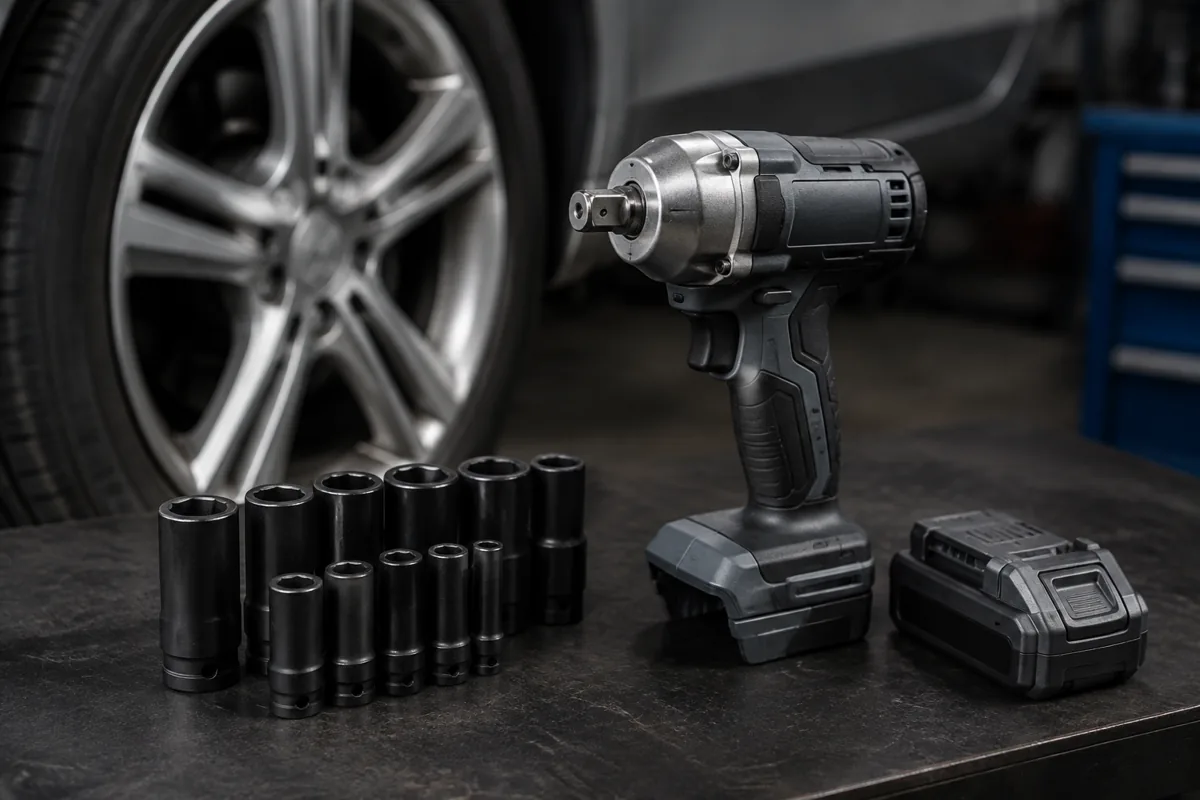
For nine out of ten home shops the answer is a brushless 1/2 in mid-torque cordless. Roughly 400 to 600 ft-lbs of breakaway, a few pounds in the hand, and short enough to fit inside a frame rail. High-torque bricks are longer, heavier, and much easier to snap hardware with.
Buy into the battery platform you already own. DeWalt 20V MAX XR, Milwaukee M18 FUEL, and Makita 18V LXT all build solid mid-torque tools, and three chargers for three brands is wasted bench space. Look for multiple torque modes, a work light, and a friction ring anvil, or a hog ring if you work overhead a lot.
1/2 in Mid-Torque Cordless Impact Wrench
The tool most shops should buy first. Enough breakaway for lug nuts, hubs, and rusted chassis bolts, short enough to work inside a frame rail. Filter by the battery platform you own.
3/8 in Compact Impact Wrench
Second tool, not first. A compact 3/8 in wrench gets into exhaust hangers and bracket bolts a big head cannot reach, and it is easier on light hardware.
Cordless Or Air, And What Amperage Means
Amperage is the rate current flows. On batteries you see amp-hours, or Ah, and that is tank size, not power. A 5.0 Ah pack runs about two and a half times as long as a 2.0 Ah pack. High-torque tools also want high-output cells; feed one a small pack and it sags, heats up, and trips its thermal cutoff mid-bolt.
On the wall, a standard 120 V, 15 A circuit gives about 1,800 watts, and you plan on 80 percent of that for anything continuous. A compressor big enough to feed an air impact all day generally needs 240 V and its own breaker. Share that circuit with your welder and your grinder and you will spend the afternoon resetting breakers. Most home shops now run cordless impacts and keep air for die grinders and cutoff tools.
Sockets, Extensions, And Material Thickness
Impact-rated sockets only. They are black oxide chrome-moly with thicker walls, built to deform under hammering. Shiny chrome-vanadium hand sockets are hardened to resist wear, so they crack instead and throw shrapnel. Six-point beats twelve-point on anything rusty, and wobble extensions bleed off torque and add flex.
Thickness talk gets sloppy, so use numbers. Sheet gauge is not inches: 14 gauge is about 0.075 in, 11 gauge about 0.120 in, and 1/4 in plate is 0.250 in. Self-drilling screws carry a thickness rating, and a common #12 self-driller with a short point tops out near 0.100 to 0.125 in of steel. Past that, drill and tap or run a bolt. Do not drive screws with a 1/2 in impact wrench either; use a 1/4 in hex impact driver, slow, with cutting fluid.
1/2 in Drive Impact Socket Set
An impact wrench with the wrong sockets is a projectile launcher. Get a black oxide chrome-moly set, six-point, SAE and metric, shallow and deep, plus one impact extension.
- ✔ Fits inside frame rails and wheel wells
- ✔ No hose, compressor, or 240 V circuit
- ✔ Shares batteries with your drill, light, and grinder
- ✘ Batteries and chargers add real cost
- ✘ Small packs heat soak on long jobs
- ✘ Still not a torque wrench
PPE, Fumes, And Fire Risk
Rusted fasteners throw scale and sockets do fail. ANSI Z87.1 glasses minimum, face shield under a vehicle or on badly corroded hardware. Impacts run past 100 dB and the noise is percussive, so plugs or muffs every time. No loose gloves near a spinning anvil; welding gauntlets are the wrong glove for a rotating tool. Rings off, sleeves tight.
The standard rust routine is penetrating oil plus heat, and that is where people get hurt. Heating galvanized or zinc-plated hardware puts off zinc oxide fume, which causes metal fume fever: chills, aches, and fever hours later. Grind the coating back first, ventilate hard, and wear a real respirator, not a dust mask. Never weld, grind, or heat near brake cleaner or chlorinated solvent, because an arc can turn it into phosgene gas.
Fire next. Penetrating oil is flammable. Undercoating, old grease, and seam sealer burn and keep burning. A torch near a fuel line, a fuel tank, or a tire is how garages end up on the news. Drain it, move it, shield it with a welding blanket, or work cold. Keep a charged ABC extinguisher in reach and watch the area for half an hour after, because insulation smolders quietly.
Frequently Asked Questions
Can I torque lug nuts with an impact wrench? No. Run them down with the impact, then set final torque by hand with a click-type wrench. Torque sticks help but they are approximate.
Do I need a high-torque model? Only if seized axle nuts, crank bolts, and farm equipment are regular work. Mid-torque handles normal garage and fab jobs and is less likely to twist a stud off.
Is 18 V better than 20 V? No, that is marketing. An 18 V pack and a 20V MAX pack use the same five-cell lithium chemistry, measured differently. Judge by breakaway torque, head length, and weight.
Buy the mid-torque, buy impact sockets with it, and keep a torque wrench on the bench for anything structural. That covers almost everything a working home garage throws at it.
Check prices on Amazon →