Our Top Picks
 EPAuto 1/2-inch Drive Click Torque Wrench1/2 Inch Drive (10-150 ft.-lb.)17.4 x 3.3 x 2.6 inches3.5 poundsCheck on Amazon


What's inside
As an Amazon Associate I earn from qualifying purchases. This post may contain affiliate links at no extra cost to you.
Rusted lug nuts do not care what the box says. If your tire routine is a breaker bar and a cheater pipe, the right impact wrench for truck tires ends that in about four seconds per nut. The wrong one spins up, ticks, gets hot, and puts you right back on the bar.
Truck lugs are the problem. Half-ton pickups usually land near 130 to 140 ft-lbs from the factory. Three-quarter and one-ton trucks with fatter studs often run 160 to 175. Class 6 and up with budd wheels starts around 450 and climbs from there. Now add road salt, seized chrome caps, and the last guy who ran them down at full trigger. Breaking a nut loose can take two to three times the torque that installed it.
As an Amazon Associate we earn from qualifying purchases at no extra cost to you.


| Tool | Drive | Where it earns its keep |
|---|---|---|
| Mid-torque cordless | 1/2 in | Rotations on half-tons, clean studs, tight wheel wells |
| High-torque cordless | 1/2 in | Rusted lugs, 3/4- and 1-ton trucks, roadside work |
| Air impact | 1/2 or 3/4 in | Shops with real CFM and all-day duty cycles |
| Heavy-duty impact | 3/4 or 1 in | Class 6 and up, hub nuts, trailer axles |
What we cover
How To Choose An Impact Wrench For Truck Tires
Torque, in plain terms. Torque is twisting force measured in foot-pounds. One foot-pound is a one-pound pull on a wrench one foot long. Every spec sheet lists two numbers. Fastening torque is what the tool applies while tightening. Nut-busting torque is what it hits going the other way, and it is always the bigger number on the label. Shop on fastening torque. For half-ton and three-quarter-ton work in salt country, look for a 1/2 in gun in the 400 to 600 ft-lb fastening range. Heavier trucks and loaded trailers mean more, or a bigger drive.
Control matters as much as power. Three or four speed modes let you run nuts on gently instead of blasting them. Full trigger is for removal only. Check the anvil too. A friction ring swaps sockets fast, a detent pin holds a heavy socket when you are working overhead.
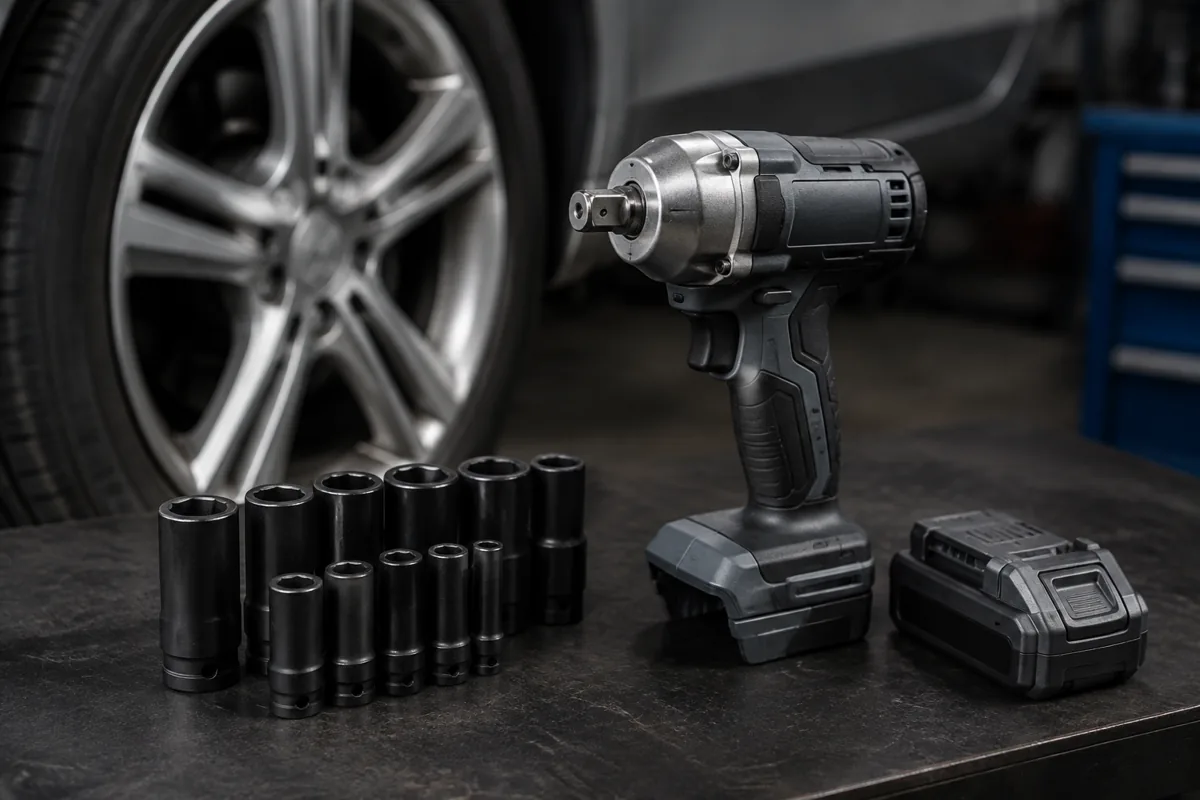
High-torque 1/2 in cordless impact wrench
This is the sweet spot for pickup and trailer work. Stay on a battery platform you already own, since DeWalt XR, Milwaukee FUEL, and Makita LXT all field high-torque guns. The pack matters as much as the tool.
Drive Size, Sockets And Wall Thickness
Half-inch drive handles almost every light truck and SUV wheel. Three-quarter goes on medium duty, hub nuts, and suspension work. One inch is fleet territory.
Sockets are what hurt people. Chrome sockets are hardened for hand tools and they are brittle, so hammering shatters them and throws shrapnel. Impact sockets are chrome-moly with thicker walls and a black finish, and they deform instead of exploding. That wall thickness is the whole point: more steel around the hex absorbs more shock. Thin-wall impact sockets exist because a lot of alloy wheels have deep, tight lug pockets, but less material means shorter service life. Keep those for wheels only.
Run 6-point, not 12-point. Six points grab the flats, which matters once a nut is rounded. Buy deep sockets so capped nuts clear, and plastic sleeves if you want the chrome caps to survive. Light trucks are usually 19, 21, or 22 mm. Heavy trucks are usually 33 mm. Confirm yours before you order.
Impact-rated deep socket set, 1/2 in drive
A good gun with chrome sockets is a bad idea. Get 6-point impact sockets deep enough to clear capped nuts, and add thin-wall protective sleeves in the sizes your wheels actually use.
Power Source: Volts, Amps And CFM
Cordless. Volts are pressure, amp-hours are tank size. A high-torque gun pulls big current in short bursts, so a small pack sags, heats up, and never gives you the rated number. Run 5.0 Ah or larger high-output packs. Cold eats capacity, so batteries ride in the cab in January, not in the toolbox.
Corded. Amps are the current the motor draws. Most 1/2 in corded impacts sit around 7 to 10 amps, which is fine on a 15 amp circuit. Long skinny extension cords are what kill them. Voltage drop shows up as lost torque and a hot motor. Use 12 gauge and keep it short.
Air. PSI is pressure, CFM is volume, and CFM is what actually runs the gun. A 1/2 in air impact generally wants somewhere around 4 to 6 CFM at 90 PSI to keep working, and a 3/4 in gun wants more. A pancake compressor cannot feed either one. Use 3/8 in hose minimum and quit necking fittings down to 1/4 in couplers, because that choke point costs real torque. Drain the tank. Water eats vanes.
- ✔ No hose, no cord to drag around the truck
- ✔ Modern brushless high-torque guns break most rusted light-truck lugs
- ✔ Speed modes let you snug without blasting
- ✔ Same batteries run your grinder and work light
- ✘ Heavy and nose-long in tight wheel wells
- ✘ Torque sags on small or cold packs
- ✘ Duty cycle limited by heat on long jobs
- ✘ Costs more than a comparable air gun
When The Nut Will Not Move: Heat, Fumes And Fire
Penetrant first, and give it real time. Then let the gun hammer on it, because the repeated shock is the mechanism. Still stuck? Most of us reach for a torch, and that is exactly where shop guys get hurt on wheels.
No open flame near a mounted, inflated tire. Pull the wheel off the truck, break the bead down or shield the sidewall with a welding blanket. Heat raises the pressure inside the tire, and a bead failure throws steel. Multi-piece and lock ring wheels are worse: deflate fully and cage them. Heat the nut only, fast and local. Soak an aluminum wheel or a hub and you have ruined both.
Fumes. Lug hardware is usually zinc plated. Glowing zinc puts off zinc oxide fume, and metal fume fever hands you chills and a night that feels like the flu. Ventilation is the fix. Work outdoors and upwind, or put an extractor on it. A P100 respirator is backup, not a substitute for air movement. Same respirator for wire wheeling rust and brake dust.
Fire and PPE. Chlorinated brake cleaner near flame or an arc can make phosgene. Use non-chlorinated and let it flash off completely. Grease, undercoating, and rubber all burn, so keep an ABC extinguisher in arm’s reach and walk the area again 30 minutes later. Hearing protection every time, since impacts are loud enough to do damage in one rotation. Safety glasses minimum, face shield when you are knocking rust loose. No rings, no loose glove cuffs near a spinning anvil. Steel toes, because a truck wheel and tire runs 80 to 120 pounds.
Never Use The Impact To Torque Them Down
The gun removes and snugs. Final torque comes from a calibrated click wrench, star pattern, two passes, with the wheel just touching the ground. Brush the mating faces clean and dry. Skip grease on the seats and threads unless the manufacturer calls for it, because lube changes clamp load and you will overstretch studs at the same reading. Re-check after 50 to 100 miles on anything you pulled, especially aluminum wheels. A galled nut means a new stud, not another hour of hammering.
Click-type torque wrench, 1/2 in drive
Pick a range that covers 80 to 250 ft-lbs so light-truck and HD specs both land mid-scale, where these wrenches are most accurate. Back it off to its lowest setting for storage.
FAQ
Is a 1/2 inch impact enough for truck lug nuts? For pickups, SUVs, and most trailers, yes, as long as it is a high-torque model rated around 400 ft-lbs fastening or better. Move to 3/4 in drive for heavy wheels and hub nuts spec’d near 450 ft-lbs and up.
Do I still need an air compressor? Only if you already have the CFM to feed one. Air guns are cheaper per foot-pound and shrug off heat on long jobs. Cordless wins on the roadside and in a driveway.
Will an impact wrench damage my wheels or studs? The tool will not. Full trigger on installation will. It stretches studs, warps rotors, and chews alloy seats. Snug in low mode, then torque by hand.
Buy for the heaviest wheel you touch, feed it a real battery or real CFM, pair it with 6-point impact sockets, and keep a torque wrench in the same drawer. That combination pulls a seized lug without wrecking a stud.
Check prices on Amazon →