Our Top Picks


What's inside
As an Amazon Associate I earn from qualifying purchases. This post may contain affiliate links at no extra cost to you.
Most impact wrench buys go wrong in the first thirty seconds. You scan the box, find the biggest number, buy that, and then snap a 3/8 inch stud on a bracket you spent an hour fitting. The best 1/2 inch impact wrench for a metal shop is not the one with the highest nut-busting figure. It is the one matched to the fasteners you actually turn, on the power you actually have, that will not wreck thin stock.
This is a buying guide, not a bench test. Below is how the classes differ, what the ratings really mean, and which type earns wall space next to your welder.
As an Amazon Associate we earn from qualifying purchases at no extra cost to you.


| Type | Nut-busting range | Where it earns its keep |
|---|---|---|
| High-torque cordless (18V/20V) | 700 to 1,500+ ft-lbs | Seized suspension, axles, machine hold-downs |
| Mid-torque cordless | 350 to 650 ft-lbs | Daily fab work, fixtures, brackets, tube |
| 1/2 inch air impact | 500 to 1,200 ft-lbs | Bench work if the compressor has the CFM |
| Corded electric | 300 to 700 ft-lbs | Budget breaking power, no packs to manage |
What we cover
What Those Torque Numbers Actually Mean
Two numbers get printed on these tools and they are not the same thing. Fastening torque is what the gun applies while tightening. Nut-busting torque is what it applies to loosen, measured in one hard hit on a clean, hardened test joint. Breakaway is always the bigger figure, so that is the one on the box. A gun advertised well north of 1,000 ft-lbs nut-busting fastens at a good deal less, and it does neither with precision.
A seized fastener in the real world is worse than any test joint. Rust binds the whole length of the thread, not just the face of the nut. So buy headroom, but know that headroom is brute force, not accuracy. An impact wrench loosens and snugs. Final torque comes off a calibrated click wrench, every time.
How to Pick the Best 1/2 Inch Impact Wrench
Platform first. The gun matters less than the packs and chargers behind it. If the shop already runs Milwaukee M18 FUEL, DeWalt XR, or Makita LXT, stay there. A fifth platform means another charger hogging an outlet and a dead battery the day you need it.
Anvil style. A friction ring swaps sockets fast at the bench. A detent pin holds the socket overhead or under a trailer, where dropping one in the gravel is not an option.
Size. Five pounds with a short head beats nine pounds with a long nose inside a tight weldment. Weigh it with the battery you will actually run, not the compact pack on the display.
Amperage, plainly. A high-torque cordless gun can pull well over 50 amps out of the pack on a hard pull. A 2.0Ah compact battery cannot feed that. It sags, heats, and shuts itself down. Run 5.0Ah or bigger, and use high-output packs if your platform sells them. Multiple speed settings and an auto-stop mode that eases off once the nut breaks free are worth the money.
High-torque cordless: the rust breaker
The gun for axle nuts, suspension hardware, and machine hold-downs that have not moved in a decade. Expect weight, length, and a big battery. Do not make it your only impact wrench if most of your day is fixture bolts.
Air, Cord, or Battery
Air. A 1/2 inch air impact wants roughly 4 to 6 CFM at 90 PSI to run continuously. A pancake compressor delivers a fraction of that, so you get three seconds of hammer and forty seconds of waiting. Air guns are light and nearly indestructible, but they are only as good as the tank, the hose diameter, and the water trap ahead of them.
Corded. Corded impacts draw 10 to 15 amps. Do not share a 15 amp circuit with your welder or plasma cutter. Heavy duty cycle plus an impact gun trips the breaker, and voltage sag at the arc ruins the bead before the breaker goes. Learn which outlets share a circuit and label them.
Battery. For anything that leaves the bench, cordless wins on time. No hose, no drop cord across a floor where you are dragging steel.
1/2 inch air impact
Cheap power, provided the compressor keeps up. Check your CFM at 90 PSI before buying, and run a filter and regulator at the drop. Skip air if your tank is small.
Matching Torque to Bolt Size and Material Thickness
Torque comes from the fastener, not the plate it passes through. Rough dry-thread ballparks: a 3/8 inch grade 5 bolt sits around 30 ft-lbs, a 1/2 inch grade 5 near 75, the same size in grade 8 closer to 105, and a 3/4 inch grade 8 up in the 350 to 400 range. Lubricated threads run lower. Check the print before you commit. Those are numbers for sizing a tool, not torque specs.
Thickness decides what fails first. On sheet under 1/8 inch, or thin-wall tube around 0.065 to 0.120, the material dimples and crushes long before the bolt reaches spec. That calls for a mid-torque gun on a low setting plus a load-spreading washer, a backing plate, or a weld nut. On 3/8 to 1/2 inch structural plate with clean threads, full spec is no problem. In tapped holes, keep thread engagement at roughly one to one and a half times the bolt diameter in steel and more in aluminum, or the impact pulls the threads out.
Mid-torque cordless: the everyday gun
For most metal shops this is the one that lives on the bench. Enough grunt for fixture and trailer hardware, short enough to reach into a weldment, light enough for one hand. Pair it with a 5.0Ah pack.
- ✔ Breaks rust a mid-torque gun will not touch
- ✔ Anvil and drivetrain built for abuse
- ✔ Keeps the breaker bar and torque multiplier for real emergencies
- ✘ Heavy and long, poor access in tight weldments
- ✘ Snaps small or corroded fasteners if you get careless
- ✘ Needs large high-output packs to reach rated numbers[/afk_cons>
Breaking Seized Fasteners Without Starting a Fire
Short bursts, not one long pull. Continuous hammering work-hardens a rusted stud and snaps it. Hit it, stop, soak it with penetrant, hit it again.
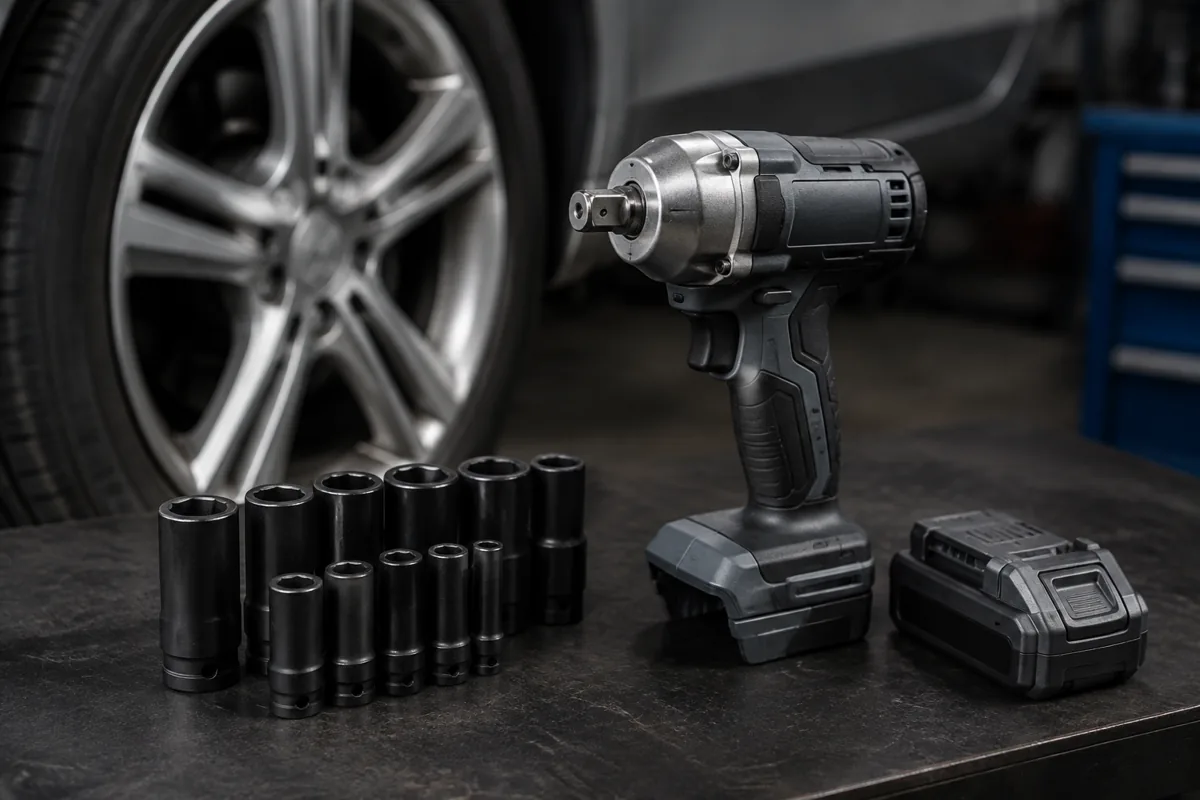
Impact sockets only. Chrome-moly, six-point, black finish. A chrome hand socket can shatter under hammering and throw shrapnel. Six-point holds a rounded nut where twelve-point slips.
PPE is not optional here. Safety glasses under a face shield when hammering rusty undercarriage hardware, because scale launches at eye level. Hearing protection every time; these guns run past 100 dB and you will pull the trigger all day. Snug gloves, no loose cuffs, no rings near the anvil.
If you torch a stuck nut, wipe the penetrating oil off and let the residue flash off first. Aerosol penetrant plus an open flame is a fire, not a technique. Extinguisher within arm’s reach, oily rags and swarf cleared out before the torch comes out.
Fume matters too. Heating galvanized hardware burns off zinc and produces zinc oxide fume, which is how you end up with metal fume fever. Extract at the source or work outside. Older cadmium-plated hardware is worse, so do not heat it indoors at all. And keep battery packs out of the spark cone and in their case. Conductive swarf across the terminals is a short circuit sitting on your bench.
1/2 Inch Impact Wrench FAQ
Is a mid-torque gun enough for shop work? For most fabrication, yes. Fixtures, brackets, jigs, vise hardware, trailer work that is not rusted solid. Mid-torque is lighter, shorter, and less likely to break something. Keep high-torque for rust and big hardware.
Can I set final torque on wheels or structural bolts with an impact? No. Impacts deliver hammer blows, not a measured value, and output shifts with battery charge, air pressure, and joint stiffness. Run the nut down with the impact, then finish with a calibrated click-type torque wrench.
Do I really need impact sockets? Yes. Impact sockets are chrome-moly and made to deform instead of shatter. Chrome hand sockets are hardened for steady pressure and can come apart under hammering. Skip cheap adapters and tall extension stacks too; they twist and eat torque.
Buy for the fasteners you turn most, not the worst one you fought last year. A mid-torque gun on a platform you already own, plus a solid set of six-point impact sockets, covers most days in a metal shop. Add high-torque when rust wins often enough to justify the weight.
Check prices on Amazon →