Our Top Picks
 DEWALT ATOMIC 20V MAX* 1/2 in. Cordless ImpactOne Size9.2 x 1 x 3.3 Inches2.76 poundsCheck on Amazon


What's inside
As an Amazon Associate I earn from qualifying purchases. This post may contain affiliate links at no extra cost to you.
A tire shop air gun put those lug nuts on. The lower control arm bolt has been soaking in road salt for nine winters. The caliper bracket bolt sits behind the knuckle with two inches of swing. That is the actual job, and a full-size 1/2 inch gun will not reach half of it. A compact impact wrench for cars handles most of it, and it is the one that ends up living in the truck.
Compact means a head under about six inches long and a bare weight near three to four pounds. You trade peak torque for access. That trade usually pays, because the fasteners that truly need four-figure torque are axle nuts, crank bolts and heavy truck hardware. Everything else is suspension, brakes, exhaust and brackets.
As an Amazon Associate we earn from qualifying purchases at no extra cost to you.


Check Price on Amazon →


| Class | Typical breakaway range | Where it earns its keep | Where it quits |
|---|---|---|---|
| 3/8 in compact | 150-450 lb-ft | Brackets, calipers, exhaust hangers, interior bolts | Rusted lug nuts, axle nuts |
| 1/2 in mid-torque | 450-700 lb-ft | Lug nuts, suspension, brakes, most under-car work | Crank bolts, heavy truck hardware |
| 1/2 in stubby high-torque | 700 lb-ft and up | Seized suspension in tight wheel wells | Fine control, weight, price |
| 1/4 in hex impact driver | Under 150 lb-ft | Sheet metal screws, splash shields, trim | Anything with a real torque spec |
What we cover
Why a compact impact wrench for cars beats a full-size gun
Access wins. A high-torque monster that cannot reach the bolt delivers zero lb-ft. On a strut-to-knuckle bolt or a starter bolt behind a manifold, head length decides whether you use a gun or a breaker bar.
Weight is the other half. Most car work happens on your back or upside down in a wheel well. Two extra pounds at arm’s length gets heavy fast, and a lighter tool controls better when the anvil is three inches from a brake line. A compact gun is also less likely to twist the head off a corroded 12mm bolt and turn a twenty minute job into drilling and tapping.
Torque, amperage and material thickness in plain terms
Nut-busting torque is a one-time spike measured while breaking a fastener loose. It is the big number on the box. Fastening torque is what the tool applies and holds, and it is much lower. Shop on fastening torque and treat the breakaway figure as advertising.
Amps are the rate current flows. Amp-hours are how long the pack keeps flowing, so a 5.0Ah battery is fuel capacity, not power. It does not add torque. It does stop the tool from feeling weak: a small 2.0Ah pack sags under a heavy pull, voltage drops, and the protection circuit cuts out mid-bolt. Run a mid-torque gun on 4.0Ah or larger. Brushless matters here too, for heat, runtime and a shorter head.
Material thickness sets the ceiling on any torque spec. A spec assumes good threads in solid metal. Thread into sheet thinner than about 1/8 inch, or into a bracket that rust has eaten to half its section, and you will strip threads or dish the panel long before the gun stops hammering. On thin material run a nut and washer through the back, or drop to a 1/4 inch impact driver and finish by feel.
Mid-torque 1/2 in cordless impact wrench
This class covers most car work: lug nuts, suspension, brakes, exhaust. Look for brushless, three or four torque modes, and buy on the platform whose batteries you already own, whether that is DeWalt XR, Milwaukee FUEL or Makita LXT. Pair it with a 4.0Ah pack or bigger.
Sockets, anvils and the parts that break
Use impact-rated sockets. The black ones are a tougher, softer alloy that deforms instead of shattering. Chrome hand sockets are hardened for steady hand pressure and can crack under hammering, which puts fragments at eye level. Face shield over safety glasses any time you are under a car with a gun running.
For wheels, use thin-wall lug sockets with the plastic sleeve so the finish survives. Skip long extension stacks where you can. Every extension, wobble and universal joint bleeds torque and stores energy, and a tall stack under full hammer whips.
Check anvil retention before you buy. Friction ring swaps sockets fast. Pin detent holds better overhead and under the car, where a dropped socket vanishes into the frame rail. Hog ring holds hardest and changes slowest.
- ✔ Fits behind knuckles, manifolds and subframes where a full-size gun cannot
- ✔ Lighter overhead, so control is better near lines and wiring
- ✔ Less likely to snap a corroded bolt head off
- ✔ Longer runtime on the same battery
- ✘ Stalls on axle nuts, crank bolts and heavy truck hardware
- ✘ Less mass means it hammers longer on a stuck bolt
- ✘ Still not a torque wrench for final specs
- ✘ Budget models quote breakaway numbers they cannot hold
3/8 in compact for tight quarters
Short head, light, and it goes where the 1/2 inch gun stops. Good for bracket bolts, calipers, exhaust hangers and interior work. Do not expect it to break a rusted lug nut loose on a salt-belt truck.
Heat, fume and fire risk when the bolt will not move
Order of operations: penetrant and time, then shock, then heat, then cut it off. Impact guns work partly by shock, so short bursts on the trigger move more stuck bolts than one long pull.
Heat is where a metal shop gets casual and a car bites back. Under a vehicle you are working next to fuel lines, brake lines, rubber bushings, wiring, plastic clips, undercoating and seam sealer. Undercoating catches, drips and keeps burning above your head. Keep a charged extinguisher in arm’s reach and pull the negative battery cable before a torch or welder comes out.
Fumes get skipped. Zinc-plated and galvanized hardware gives off zinc oxide when heated, and that is metal fume fever: chills, headache, a bad night. Burning undercoating is worse. Ventilate, move air away from your face, and wear a respirator rated for fumes, not a dust mask.
Welding a nut onto a snapped stud works if the heat input stays honest. Stick on that kind of stud generally lives in the 70 to 110 amp range, and MIG does better in short stitches. Amperage is heat: more amps, more penetration, more distortion in the thin metal nearby. Blanket the lines and ground close to the work so current does not travel through bearings or wiring. Cutting instead? Sleeves down, hearing protection, and a wheel rated above the grinder’s rpm. Sparks find carpet, insulation and the tire you are kneeling on.
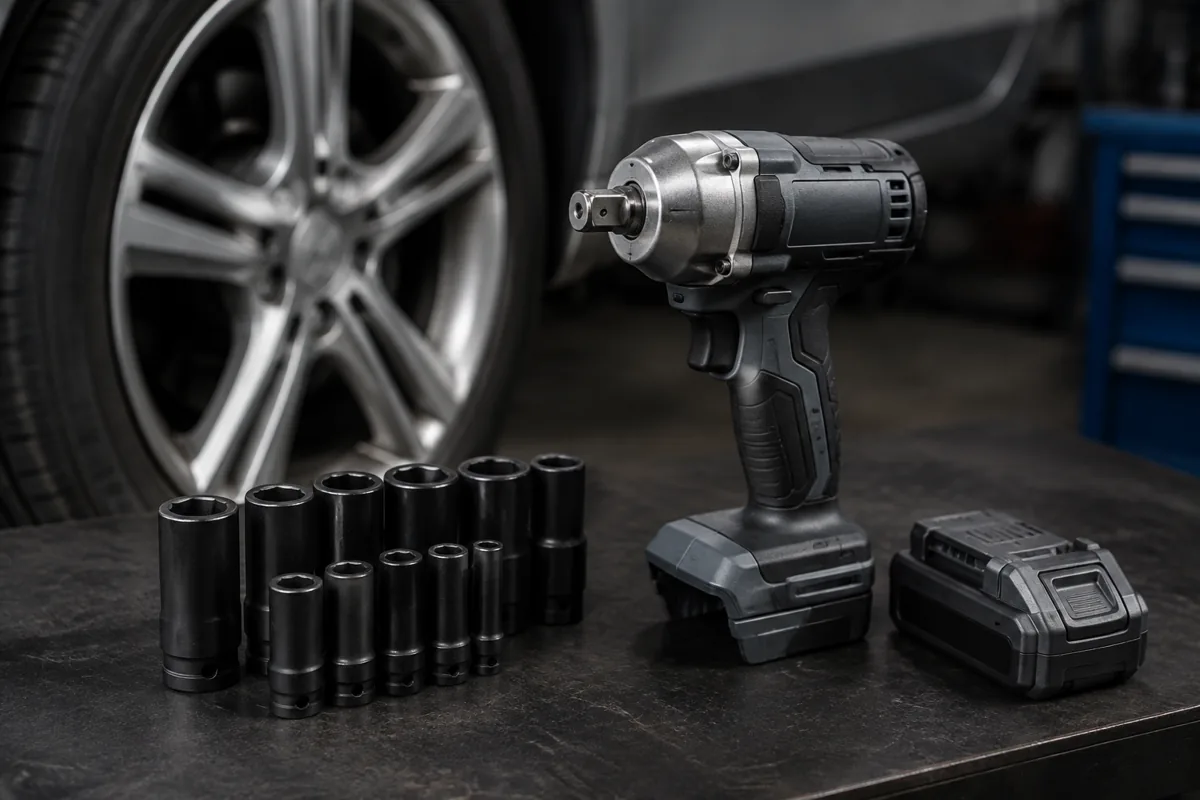
Impact-rated socket set, 1/2 in drive
The gun is useless without proper sockets. Get black impact sockets in metric and SAE, deep and shallow, plus thin-wall lug sockets. Chrome hand sockets on a hammering anvil are a shrapnel risk.
FAQ: compact impact wrenches for car work
Is a compact impact wrench strong enough for lug nuts? A 1/2 inch mid-torque gun handles typical passenger car lug nuts, which usually spec somewhere around 80 to 100 lb-ft. Rusted studs, seized alloy wheels and heavy trucks are another story, so keep a breaker bar with you.
Can I use my regular sockets on it? No. Chrome hand sockets are hardened to resist wear and can crack or throw fragments under impact. Use black impact sockets and eye protection.
Do I still need a torque wrench? Yes. Use the gun to remove and to run fasteners down snug. Final torque goes on with a torque wrench in the correct pattern. Torque-to-yield and stretch bolts get torqued and angled by hand, never by impact.
Buy for access first, torque second, battery capacity third. A mid-torque compact plus a 3/8 inch gun covers nearly every fastener on a passenger car. Add impact sockets, a torque wrench, a face shield and an extinguisher, and the job stops being a fight.
Check prices on Amazon →