Our Top Picks
 DEWALT 20V MAX Cordless Drill and Impact DriverOne Size15.06 x 6.4 x 9.88 inches3.6 PoundsCheck on Amazon


What's inside
As an Amazon Associate I earn from qualifying purchases. This post may contain affiliate links at no extra cost to you.
A seized bolt on a trailer frame does not care how good your welds are. It comes loose or it gets cut off. That is the real job of a cordless impact wrench with battery in a metal shop: breaking rusted hardware free, running fasteners down snug, and building fixtures without dragging an air hose across the floor. Most shops buy the wrong size. They grab a 1/2 in. high-torque gun and twist studs off 14-gauge tube, or they grab a compact and stall on the first anchor bolt.
Air still wins on duty cycle. But a compressor does not follow you to the truck or out to a field repair, and cordless does. The trade is that you are buying a battery platform as much as a tool, and the pack is half the performance. Get the class right first, then worry about the badge on the housing.
As an Amazon Associate we earn from qualifying purchases at no extra cost to you.


| Class | Advertised breakaway torque | Right job | Battery to run it |
|---|---|---|---|
| 3/8 in. mid-torque | 200-400 ft-lb | exhaust work, brackets, thin-wall tube, light hardware | 2.0-4.0 Ah compact |
| 1/2 in. mid-torque | 400-700 ft-lb | general fab, mount plates, lug nuts, jig hardware | 4.0-5.0 Ah |
| 1/2 in. high-torque | 900-1500 ft-lb | seized and rusted hardware, salvage teardown, suspension | 5.0 Ah and up, high-output cells |
| 3/4 in. and 1 in. | 1500 ft-lb and up | heavy equipment, ag gear, large flanges | largest pack the platform offers |
What we cover
What a Cordless Impact Wrench With Battery Actually Does in a Metal Shop
Four jobs, mostly. Cracking loose rusted and painted hardware on salvage, trailers and equipment. Running long fasteners down fast on base plates, mount brackets and weld fixtures. Wheel and hitch work in the yard. Assembly out on portable jigs where an air line is one more thing to trip over.
Here is the part nobody likes hearing. An impact is a loosening and run-down tool, not a torque tool. The hammer mechanism throws thousands of short blows, and what actually lands on the fastener depends on socket length, extensions, joint stiffness, pack charge and how long you hold the trigger. Anything load bearing gets finished with a calibrated torque wrench or by whatever method the joint spec calls for. Impact to snug. Torque wrench to spec. Do not improvise on that one.
1/2 in. Mid-Torque Cordless Impact Wrench Kit
If you only buy one, buy this class. A 1/2 in. mid-torque handles the bulk of fab hardware, fits between frame rails a high-torque gun cannot reach, and will not shear a fastener the second you lean on the trigger. Buy the kit if you have no packs yet.
Torque, Amp-Hours and Material Thickness in Plain English
Torque is twist. One foot-pound is one pound of force on a wrench one foot long. Makers publish two numbers: fastening torque, what the tool can tighten to, and breakaway or nut-busting torque, what it can crack loose. Breakaway is always the bigger, prettier number and it comes off a test rig, not a rusty leaf spring. Treat both as best case.
Volts and amp-hours are pressure and tank size. Voltage sets how hard the motor can push, amp-hours set how long it pushes. An 18V pack and a 20V max pack are the same five-cell class of battery, one labeled nominal and one labeled peak, so that is marketing, not muscle. Amperage is where small packs fall apart. A high-torque tool under load pulls current in the dozens of amps, and a compact pack has fewer cells splitting that draw. Voltage sags, cells heat, the protection circuit pulls the plug, and the tool feels dead. It is not broken, it is underfed. Run high-torque tools on 5.0 Ah or larger high-output packs and save the compacts for the mid-torque gun.
Material thickness decides how much torque the joint can even hold. Clamp load has to live in the metal. Thin-wall tube at 1/8 in. or 11-gauge sheet will dimple, crush and pull threads long before the fastener is tight, so spread the load with a proper washer or weld in a bushing, run the impact on a low setting, then finish by hand. At 1/4 in. plate and thicker you have real material under the head and can use the torque you have. If the honest answer is to weld the bracket instead of bolting it, the old rule of roughly one amp per thousandth of an inch of mild steel gets you a starting point, about 250 amps for 1/4 in., then adjust for joint, process and position.
Two hardware details matter more than brand. The anvil: a friction ring swaps sockets fast and suits bench work, while a detent pin holds the socket like it means it and is what you want overhead. And sockets: chrome hand sockets crack under hammer blows and throw pieces. Six-point impact sockets only.
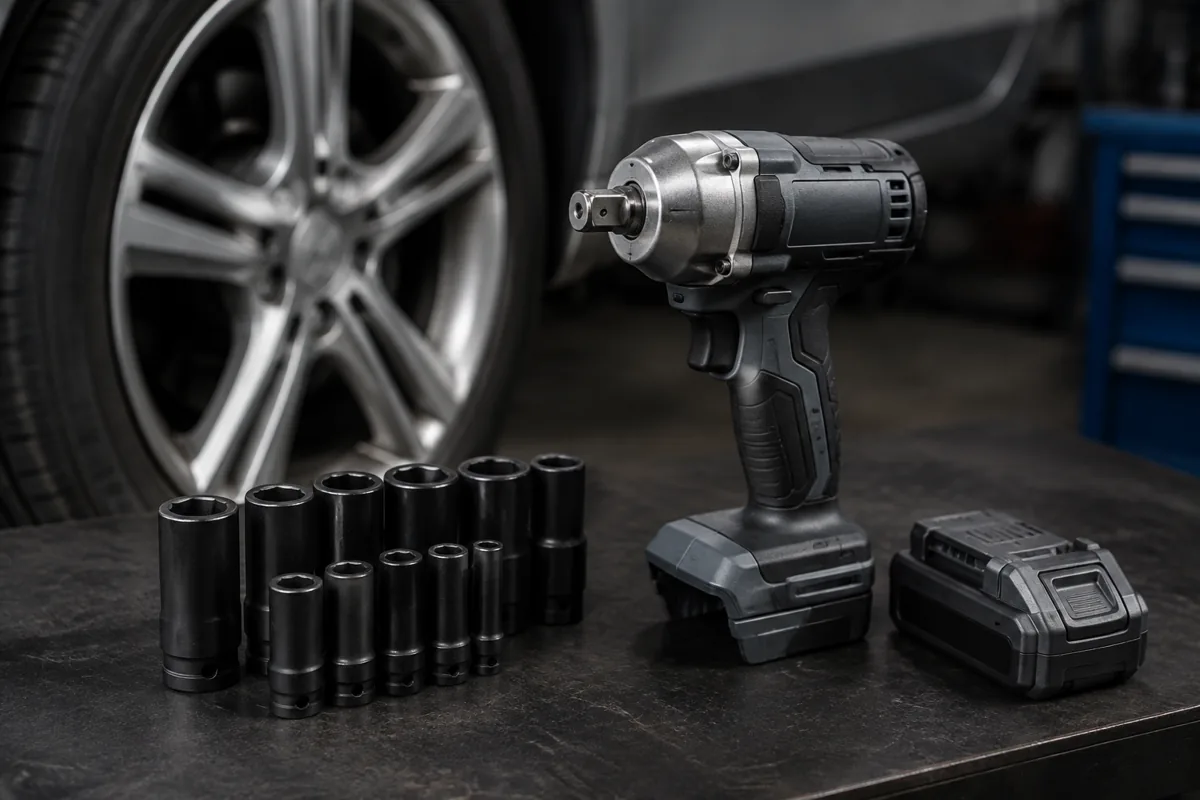
Six-Point Impact Socket Set
The cheapest safety upgrade you can make. Look for black oxide six-point impact-rated sockets in both deep and shallow, SAE and metric if you work on anything imported, and check the retaining ring and pin holes before you go overhead with them.
Hot Work Rules for When the Impact Loses
Sometimes the nut wins. Then you heat it, cut it or grind it, and now you are doing hot work with a lithium pack in your other hand.
PPE. Safety glasses under a face shield for cutting and grinding. Flame-resistant or cotton clothing, never polyester, because synthetics melt into skin. Leather gloves, sleeves down, cuffs outside the boots. Hearing protection is not optional either. OSHA’s action level is 85 dBA over an eight-hour day and an impact wrench under load walks right past that, never mind the grinder next to it.
Fume. Old hardware is coated hardware. Galvanized bolts and plate cook off zinc oxide, which buys you metal fume fever: chills, headache and a night that feels like flu. Grind the coating back a couple of inches from the heat, run a fume extractor or real cross ventilation, and wear a respirator if you cannot ventilate. Cadmium plating on old ag and aircraft fasteners is worse than zinc. Do not heat plated hardware in a closed shop.
Fire. Sparks and cut slugs travel farther than people think. Standard hot work practice is a 35-foot clear radius, covers over what you cannot move, nothing flammable and no gas cylinders in the spark path, an extinguisher within arm’s reach, and a fire watch for at least 30 minutes after the last spark. Batteries get their own rules. No packs staged on the welding table, no charging in the spark zone, no spatter on a plastic case. A pack that is swollen, hissing or hot after a hard drop goes outside onto bare concrete, away from the building and away from the cylinders. Do not shut it in a toolbox and hope.
Picking a Battery Platform You Will Not Regret
The platform you already own usually wins. Spare packs and chargers cost more over five years than the tool did, so running two systems is a tax you pay forever. Milwaukee M18 FUEL, DeWalt 20V MAX XR and FlexVolt, Makita LXT and XGT, and Metabo HPT MultiVolt all build a competent mid-torque and high-torque wrench. Ryobi ONE+ HP is honest value for occasional work. Brushless, always.
Buy bare tools once you have packs, but never own just one battery. Two minimum, plus a charger that is not the slow one from the kit box. In winter, lithium packs will not accept a charge much below about 40 F, so warm them inside before you decide the charger quit. Heat is harder on cells than cold, so a pack living on the truck dash all summer is a pack you are replacing.
- ✔ Works anywhere with no hose or compressor
- ✔ Breaks loose rust that hand tools will not touch
- ✔ Modes and low settings let you back off on thin material
- ✔ Same packs feed your grinder and work lights
- ✘ Nose-heavy and awkward in tight frame corners
- ✘ No replacement for a calibrated torque wrench
- ✘ High-torque models starve on compact batteries
- ✘ Platform lock-in makes spare packs expensive
1/2 in. High-Torque Cordless Impact Wrench
Buy this only if you fight seized hardware, salvage teardowns, suspension or equipment work. It is heavier, longer, and it will snap fasteners on light gauge material if you are careless. Get it as a bare tool and feed it your biggest high-output pack.
Frequently Asked Questions
Can I final-torque structural bolts with an impact wrench? No. Use the impact to run the nut down snug, then finish with a calibrated torque wrench, turn-of-nut, or direct tension indicator washers, whichever the joint spec or the engineer calls for. An impact has no idea what it just did to that fastener.
Do I need high torque or is mid-torque enough? Mid-torque covers most fabrication and trailer work, and it fits into places a high-torque gun cannot. Step up to high-torque when your normal day includes rusted equipment hardware, big suspension fasteners, or 3/4 in. and larger bolts.
Will cordless replace my air impact? For most shop work, yes. For all-day production runs or genuinely heavy 1 in. drive work, air and hydraulic tools still win on duty cycle and weight per unit of torque.
Size the tool to the fastener, size the pack to the tool, and keep a torque wrench on the bench for anything that matters. Then treat the battery like the flammable thing it is and keep it off the welding table.
Check prices on Amazon →