Key takeaways
- Tooth count, not brand, decides whether a metal blade lasts one cut or fifty: how to match TPI to wall thickness, when carbide pays, and how to cut hot metal without starting a fire.
What's inside
As an Amazon Associate I earn from qualifying purchases. This post may contain affiliate links at no extra cost to you.
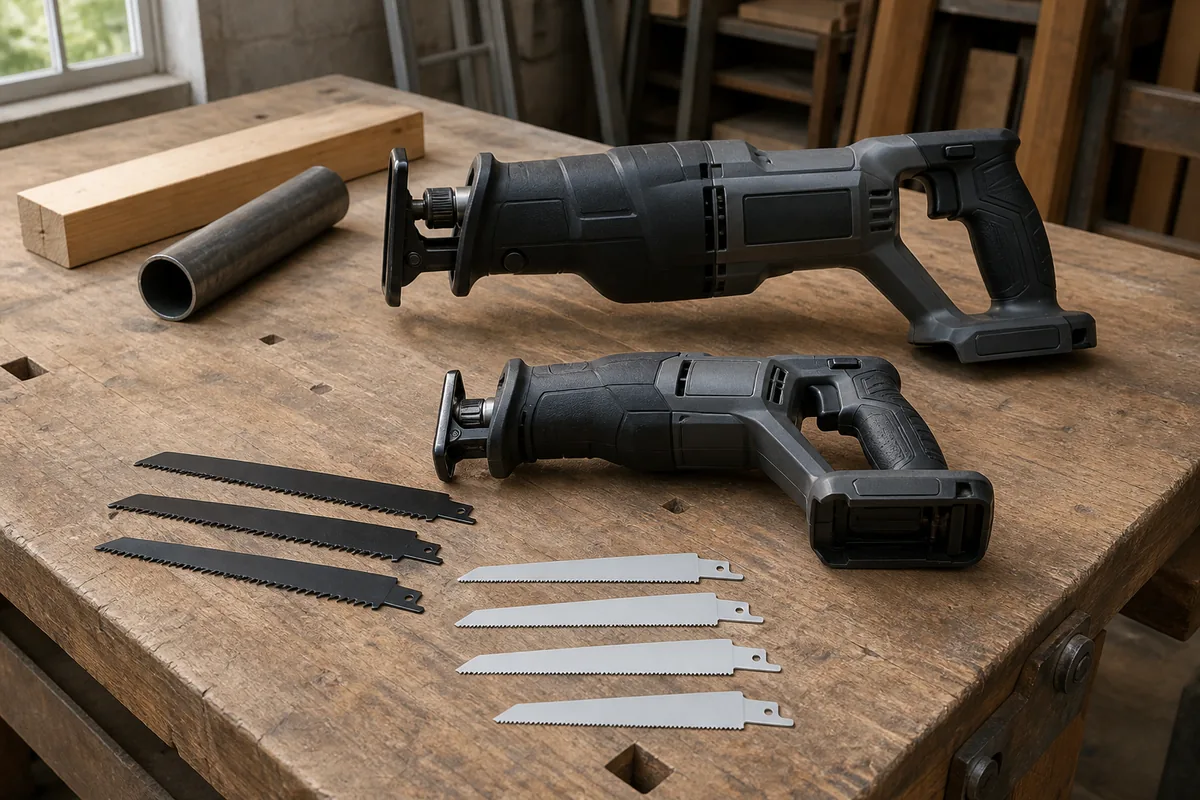
Wood blades in steel last about four seconds. The teeth roll over, the cut goes shiny, the blade turns blue. Choosing the best reciprocating saw blades for metal is not a brand decision. It is a tooth count decision, matched to the wall thickness of whatever is clamped in front of you.
A recip saw earns its place in a metal shop because it reaches where a bandsaw and a chop saw cannot. Pipe against a wall. Bolts under a trailer frame. Rusted angle in a corner. The tradeoff is heat and vibration. Wrong TPI and you shear teeth off in one pass. Wrong length and the blade bottoms out on the shoe.
As an Amazon Associate we earn from qualifying purchases at no extra cost to you.


| Blade type | TPI | Best use |
|---|---|---|
| Bi-metal 24 TPI | 24 | Sheet, EMT conduit, thin wall tube under 1/8 in |
| Bi-metal 18 TPI | 18 | Square tube, black pipe, light angle, 1/8 to 1/4 in |
| Bi-metal 14 TPI | 14 | Plate, heavy angle, rebar, solid bar over 1/4 in |
| Variable 10-14 TPI | 10-14 | Mixed thickness demo cuts and nail embedded steel |
| M42 cobalt bi-metal | 14-18 | Stainless and long cuts in hot, thick steel |
| Carbide tooth | 8-10 | Stainless, cast iron, hardened bolts, high heat |
| Carbide grit | None | Cast iron, hardened steel, abrasive junk |
What we cover
How To Pick The Best Reciprocating Saw Blades For Metal
One rule covers most of it. Keep at least three teeth in the material at all times. Fewer than three and the teeth grab, chip and break off.
Match TPI to wall thickness
Under 1/8 inch, meaning sheet, EMT conduit and thin tube, run 24 TPI. From 1/8 to 1/4 inch, meaning most square tube, black pipe and light angle, run 18 TPI. Over 1/4 inch, meaning plate, heavy angle, rebar and solid bar, run 14 TPI or a variable 10-14. Judge the wall, not the outside diameter. A 3 inch pipe with a 1/8 inch wall is a thin metal cut.
Length and body thickness
Blade length equals cut depth plus the stroke plus an inch of clearance. Most saws stroke 1-1/8 to 1-1/4 inches, so a 6 inch blade covers nearly all pipe and tube work and stays stiff. Nine and twelve inch blades flex, wander and whip. Body thickness matters too. Around 0.035 inch bends around contours. Thicker bodies, 0.042 to 0.062 inch, stay straight in plate.
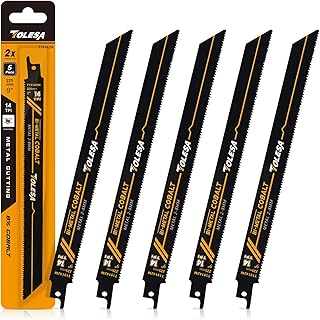
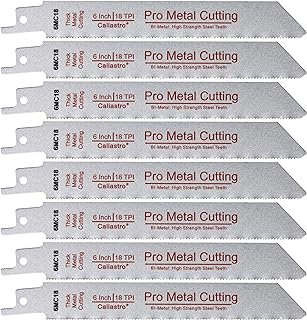
Bi-Metal 18 TPI Metal Cutting Blade Multipack
Buy these by the 10 or 25 pack and stop rationing blades. A 6 inch, 18 TPI bi-metal blade handles the bulk of shop steel from conduit up to 1/4 inch angle. Bargain steel shows up fast in consumables, so pick a known name and buy quantity over singles.
Bi-Metal vs Carbide: When The Upgrade Pays
Standard bi-metal is a spring steel body with high speed steel teeth welded to the edge. Cheap and forgiving. M42 adds roughly 8 percent cobalt to the teeth so they hold hardness hotter, which matters in stainless and thick plate. Carbide tooth blades braze real carbide tips on and last many times longer in hard material if you feed them right.
Carbide wins in stainless, cast iron, hardened bolts and embedded fasteners. Carbide loses in thin wall tube and conduit, where the coarse pitch grabs and chips tips off, and in any cut where the blade can twist or get pinched.
- ✔ Survives stainless and cast iron that dulls bi-metal in one cut
- ✔ Holds an edge hot, so cut speed stays up
- ✔ Lower cost per cut on repeat work
- ✔ Tips shrug off hidden fasteners
- ✘ Several times the price per blade
- ✘ Coarse teeth chip out in thin wall tube and conduit
- ✘ Brittle if the blade twists or binds
- ✘ Overkill for occasional mild steel
Carbide Tooth Blades for Stainless and Cast Iron
Keep two or three in a sealed sleeve for the jobs that kill bi-metal: stainless rail, cast pipe, seized bolts. They cost a lot more each and pay it back in one bad cut. Do not waste them on conduit and do not let them twist.
Saw Setup: Amps, Speed, Feed And Torque
Amps and batteries
Amps measure how much current a corded saw pulls, which is a rough stand-in for how hard it can work before it bogs or cooks itself. For repeat cuts in 1/4 inch and thicker, a 12 to 15 amp corded saw will not quit on you halfway through. Cordless is better for reach, and the brushless platforms (DeWalt XR, Milwaukee FUEL, Makita LXT) have the muscle, but feed them high capacity packs of 5.0Ah and up. Small packs sag, the stroke slows, heat climbs, the blade dies early.
Speed and feed
Switch orbital action off. Orbit is for wood. Stay low on the trigger or the speed dial, slower still in stainless. Push hard enough that the teeth peel chips instead of rubbing. Curled chips mean you are cutting. Sparks and gray dust mean you are burning the blade. A wax stick or cutting oil on the teeth is the cheapest way to double blade life.
Where torque actually matters
Recip saws are not rated in torque and nobody should shop for one that way. Torque matters in two other places. The blade clamp: seat the blade fully, let the clamp lock, then pull on it, because a half seated blade snaps at the tang and launches. The workpiece: clamp it. Loose tube twists under blade grab, pinches the blade and kicks the saw back at you.
Cutting Real Stock, Fume And Fire
Rebar and solid bar. 14 TPI or variable 10-14, thick body, steady feed. Let the blade cool between cuts instead of forcing it.
Pipe and tube. 24 TPI under 1/8 inch wall. Keep the shoe planted and roll the saw around the pipe rather than plunging through both walls at once.
Stainless. Slow speed, constant feed, cutting wax, carbide or M42. Never let the blade dwell. Stainless work hardens where it gets rubbed and then nothing cuts it.
Galvanized and painted steel. Cutting galvanized throws fine zinc bearing dust, and old paint can carry lead or cadmium primer. Wear a P100 respirator, work outdoors or under real ventilation, and never saw coated steel in a closed room. Metal fume fever feels like the flu and is entirely avoidable.
Sparks, hot slugs and fire watch
A recip saw throws fewer sparks than a cutoff wheel, but the chips and the offcut come away hot enough to start a fire. Slugs drop and roll into sawdust, insulation, rags and the gap under a wall plate. Clear roughly 35 feet of anything flammable or cover it with a welding blanket, keep a charged extinguisher in reach, and watch the area for 30 minutes after the last cut. Never cut a drum, tank or line you have not verified as empty, purged and vented.
PPE
Z87 glasses under a face shield, because chips leave at eye level, hot and sharp. Leather gloves for handling stock. Hearing protection, since a saw in steel tube is brutally loud. Cotton or leather sleeves, not synthetics that melt into skin. The cut edge burns for a full minute after the trigger comes off, so set the offcut somewhere you will remember it.
24 TPI Thin Metal and Conduit Blades
Fine tooth blades for anything under 1/8 inch wall, where a coarse blade grabs and rips. Short 4 and 6 inch lengths stay stiffer and are easier to control in tight bays. Cheap insurance against chewing up thin tube.
FAQ
How many TPI do I need for cutting metal? Match it to wall thickness so three teeth stay in the cut. 24 TPI under 1/8 inch, 18 TPI from 1/8 to 1/4 inch, 14 TPI or variable 10-14 above that. If you buy one pack, buy 18 TPI.
Can a reciprocating saw cut rebar and bolts? Yes. Use 14 TPI bi-metal or a carbide tooth blade, clamp the work, keep the shoe tight against it. Hardened bolts and lag screws are where carbide pays for itself.
Why do my blades lose teeth in the first cut? Usually too few teeth in the material, orbital mode left on, too much speed, or an unclamped part letting the blade bind. Fix those four and blade life changes completely.
Keep 18 TPI in the case for everyday steel, 24 TPI for conduit and thin tube, and a couple of carbide blades sealed for stainless and hardened work. Blades are cheap next to the time lost limping through a cut with a dead one.
Check prices on Amazon →