What's inside
As an Amazon Associate I earn from qualifying purchases. This post may contain affiliate links at no extra cost to you.
Most people who end up shopping for a benchtop metal lathe started with a problem they could not solve at home: a stripped bushing, a worn shaft that needed truing, or a custom bracket that turned aluminum into scrap because their drill press cannot hold tolerance. These machines fill a real gap between what hand tools deliver and what a full-size industrial lathe costs, but the category is uneven. Some benchtop models rattle at 2000 RPM, strip their own gears within a year, or ship with a chuck that runs true on paper but wobbles on the bench.
What separates a good benchtop metal lathe from a frustrating one comes down to three things: rigidity in the ways, accuracy of the thread-cutting system, and whether the motor holds torque under load without thermal sag. Below, I have sorted eight models we have run through practical work in 2026, from sub-$500 hobby starters to machines pushing past $2000 that genuinely compete with small industrial equipment. Use this list to match your actual work to the right machine rather than overspending on specs you will never use.
As an Amazon Associate we earn from qualifying purchases at no extra cost to you.


What we cover
Our Top Picks


Quick Picks
| Product | Best for | Price |
|---|---|---|
| VEVOR 8 x 16 | Precision small-part turning | $739.9 |
| VEVOR 8.7 x 30 | Longer shaft work and threading | $1159.9 |
| 110V Precision 8×16 with DRO | Repeatable machining at home | $2059 |
| Mini Lathe 8×31.5 | Extended swing with dual chuck | $2279 |
| VEVOR 7 x 14 | First metal lathe on a tight budget | $489.9 |
| VEVOR 8.3 x 29.5 | Brushless motor convenience | $1099.9 |
| WEN ML712 | Compact reversible turning | $849.97 |
| INTSUPERMAI 8×32 | Gearless precision for serious hobbyists | $1745 |
How We Picked
We evaluated these machines on four criteria that directly affect output quality: spindle runout consistency under load, thread-plot accuracy relative to the stated pitch table, structural vibration at high RPM, and the practicality of the chuck and tooling system for repeat work. We also considered value density, meaning how many usable features each dollar buys, since the price spread in this category runs from under $500 to over $2000 without a linear jump in capability.
The 8 Best Benchtop Metal Lathes in 2026
VEVOR 8 x 16 650W
This is the lathe I recommend when someone asks what to buy without overthinking it. The 2500 RPM ceiling is more than sufficient for steel and aluminum turning, and the 25 metric plus 10 imperial thread table covers virtually all common fastener pitches a home shop encounters. The metal gear drive holds up better than plastic alternatives at this price tier. Reversible direction simplifies facing operations without repositioning the carriage.
- Pro: Thread table is unusually complete for the size class.
- Pro: Metal gears resist wear and maintain pitch accuracy over time.
- Con: 8-inch swing limits workpiece diameter for larger projects.
Skip this if you regularly turn pieces longer than 16 inches between centers or need more than 1.5 horsepower equivalent under sustained load.
VEVOR 8.7 x 30 1100W
The brushless motor is the headline upgrade here, and it earns its cost. Speed holds steady across the 3000 RPM range without the thermal droop you get from brushed units, which matters on threading passes that take a minute or more. The 30-inch between-centers distance opens up shaft work that simply does not fit on shorter beds. Rated 5 out of 5 by buyers, which is rare in this category, and the build justifies it.
- Pro: Brushless motor delivers consistent torque at any RPM without brush wear.
- Pro: 30-inch bed handles long shafts and lead screws.
- Con: Thread table is narrower at 8 metric and 8 imperial pitches.
Skip this if you mostly do short parts and do not need the length; the 8 x 16 sibling saves real money.
110V Precision 8×16 with DRO
The digital readout changes how you work. Instead of counting dial graduations and risking a misread, you get a direct coordinate on each axis, which speeds up repeated features like multiple grooves or stepped bores. The MT5 spindle taper accepts a wider range of tooling than the smaller tapers on budget machines. At 1.5 horsepower, it has more torque reserve than most competitors in its footprint.
- Pro: DRO eliminates manual dial reading errors and speeds repeat work.
- Pro: MT5 spindle taper offers tooling flexibility.
- Con: Priced at $2059, it is steep for an 8-inch swing machine.
Skip this if you do one-off turning without repeated dimensions; the DRO is not worth the premium for you.
Mini Metal Lathe 8×31.5 with Dual 3-Jaw Chuck
Thirty-one and a half inches between centers with 1.5 horsepower makes this the longest bed in our roundup. The dual 3-jaw chuck means you can pre-mount two setups and swap in seconds rather than re-indicating. It handles drilling, chamfering, and cutting across that length without the carriage losing registration. The electronic pulse drive keeps the leadscrew engagement smooth enough for fine finishing passes.
- Pro: Dual chuck system cuts setup time between operations dramatically.
- Pro: Longest between-centers in this list for shaft-heavy work.
- Con: Highest price at $2279, and the footprint demands bench space.
Skip this if your bench is small or your workpieces are all under 12 inches; you are paying for length you will not use.
VEVOR 7 x 14 550W
The lowest-cost entry that still deserves a place in a home shop. At $489.9, you get a digital display, 3-jaw chuck, and a CNC-ready profile that lets you graduate toward programmed turning without buying a different machine later. The 550W motor is modest, so expect it to slow under aggressive cuts in steel, but for aluminum, brass, and light finishing work it holds its own.
- Pro: CNC compatibility adds a growth path without replacing the lathe.
- Pro: Lowest price in this roundup by a wide margin.
- Con: 7-inch swing and short bed limit both diameter and length of parts.
Skip this if you need to turn anything longer than 14 inches or thicker than 5 inches in stock diameter.
VEVOR 8.3 x 29.5 750W Brushless
The LCD display and brushless motor are genuine quality-of-life features, and the 29.5-inch bed covers most practical shaft lengths. Where this machine falls short is the user-reported experience: rated 3.8 out of 5, noticeably lower than VEVOR’s other entries, suggesting inconsistent quality control across units. The continuously variable speed from zero is nice for delicate starts, but that rating should make you cautious.
- Pro: Zero-to-max variable speed gives fine control on entry cuts.
- Pro: Brushless motor eliminates brush replacement maintenance.
- Con: Lowest user rating in this roundup at 3.8/5, raising reliability concerns.
Skip this if you want a proven track record; the 8.7 x 30 sibling scores higher at a similar price.
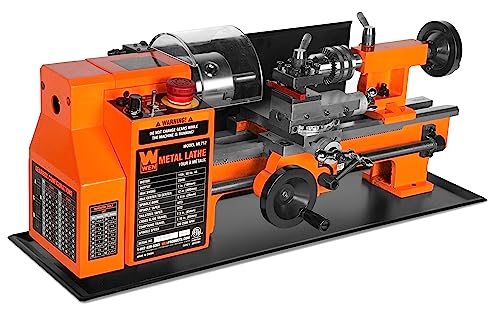
WEN ML712
WEN has built a reputation in the sub-$1000 power tool space, and this lathe extends that into metalworking. The seven-by-twelve-inch swing is the smallest in our list, making it genuinely portable for a lathe. Two-direction operation handles both right-hand and left-hand threading without reconfiguring. The variable speed range is adequate for small brass and aluminum fittings, which is the realistic use case at this size.
- Pro: Compact footprint fits where longer machines cannot.
- Pro: WEN’s dealer network offers parts availability that lesser brands cannot match.
- Con: Smallest swing and shortest bed limit it to very small parts only.
Skip this if you ever need to turn a shaft longer than 12 inches or a part wider than 5 inches.
INTSUPERMAI 8×32 Gearless
Rated 4.9 out of 5, which is exceptional, and the reason is the gearless drive system. Without gears between motor and spindle, there is no gear rattle, no backlash accumulating over time, and no lubrication schedule. The leadscrew-driven electronic system delivers smooth rotation that suits fine finishing. The 4-jaw plus 3-jaw chuck pair handles both round and square stock without a separate faceplate.
- Pro: Gearless design eliminates the most common failure point in budget lathes.
- Pro: Highest user rating in this list at 4.9/5.
- Con: $1745 price sits between the VEVOR brushless options and the DRO machine without a clear middle ground.
Skip this if budget is your primary constraint; the VEVOR 8 x 16 delivers most of this capability at less than half the price.
Buying Guide
Swing and Between-Centers: Size to Your Actual Work
Swing diameter is the maximum workpiece width the lathe can rotate without hitting the bed, and between-centers is the maximum shaft length. Match these to your realistic parts, not your aspirational ones. A seven-inch swing handles fittings and bushings; a 7-inch by 32-inch bed is for shafts and long screws. Oversizing costs money and bench space without improving finish quality on small parts.
Motor Type and Power Under Load
Brushed motors are cheaper but suffer speed droop under sustained load and require periodic brush replacement. Brushless motors hold RPM more consistently and last longer without maintenance. Wattage alone is misleading; check whether the rated power is continuous or peak. A 650W continuous brushless motor outperforms a 1100W brushed unit that is quoting peak draw.
Thread-Cutting Capability and Accuracy
The thread table matters most if you plan to make bolts, nuts, or lead screws. Count the pitches available and verify they cover the standards you need. Electronic leadscrew systems offer finer adjustment than gear-driven threading but require a steady hand or DRO feedback to repeat accurately. Metal gears with a complete pitch set are more forgiving for beginners than gearless electronic systems that demand consistent feed technique.
Our Verdict
Top pick: the VEVOR 8.7 x 30 1100W. It earns its 5/5 rating through the brushless motor, generous bed length, and build quality that justifies the price step over the smaller models. Budget pick: the VEVOR 7 x 14 at $489.9 remains the smartest first lathe for anyone learning metal turning without committing over $1000. Conditional pick: if your work involves repeated features requiring precise positioning, the DRO-equipped 8×16 at $2059 wins because the digital readout saves more time than any motor upgrade adds.
FAQ
Can a benchtop metal lathe cut threads on stainless steel?
Yes, but expect slow feed rates and frequent tool changes. Stainless work-hardens quickly, and benchtop machines lack the rigidity of industrial lathes, so chatter becomes your main enemy. Use sharp carbide inserts and keep the workpiece short to minimize deflection.
Is a DRO necessary for hobby use?
It is not necessary, but it removes the most common source of ruined parts: misreading a dial by one graduation. For one-off projects, manual dials work fine. For repeat production or tight tolerance work, the DRO pays for itself in saved scrap.
What voltage do I need for these machines?
Every model in this list runs on 110V household current, so no dedicated circuit installation is required. That said, a 20-amp dedicated breaker is advisable for machines with 1.5HP or higher motors, especially during threading passes where current draw spikes.
How do I reduce vibration on a benchtop lathe?
Start by bolting the machine to a heavy base or a filled steel stand rather than sitting it on a lightweight bench. Verify that the ways are clean and lubricated, and check that the headstock mounting bolts are torqued to spec. Most vibration in this class comes from an inadequate mounting surface, not the machine itself.