Our Top Picks


What's inside
As an Amazon Associate I earn from qualifying purchases. This post may contain affiliate links at no extra cost to you.
Twist bits and sheet metal do not get along. The bit walks, the lip hooks, the sheet lifts and spins, and the hole comes out triangular with a burr on the back. Step drill bits for metal fix that. One bit, one plunge, a round hole close to size, top edge already chamfered.
They are not a plate tool. Lean one into 3/8 in hot roll and you will smell it before you replace it. Below: how to size steps against material thickness, what coatings actually do, what drill to run, and how to keep hot chips and zinc fume out of your face.
As an Amazon Associate we earn from qualifying purchases at no extra cost to you.


| Bit range | Step jump | Where it earns it | Weak point |
|---|---|---|---|
| 1/8 to 1/2 in | 1/32 in | Sheet, boxes, light brackets | Small tip snaps under side load |
| 3/16 to 7/8 in | 1/16 in | Enclosures, gussets, 16 to 11 gauge | Wants low gear and torque |
| 1/4 to 1 3/8 in | 1/8 in | Conduit and grommet holes | Grabs hard at breakthrough |
| Single flute | Varies | Aluminum, copper, chip flow | Slower feel in steel |
| Double flute | Varies | Steel and stainless, cleaner wall | Packs chips if not cleared |
What we cover
Why step drill bits for metal beat twist bits in sheet
A twist bit cuts on two lips at the tip. In thin stock only the corners of those lips engage, so the bit hooks and climbs. That is where triangle holes and cut knuckles come from.
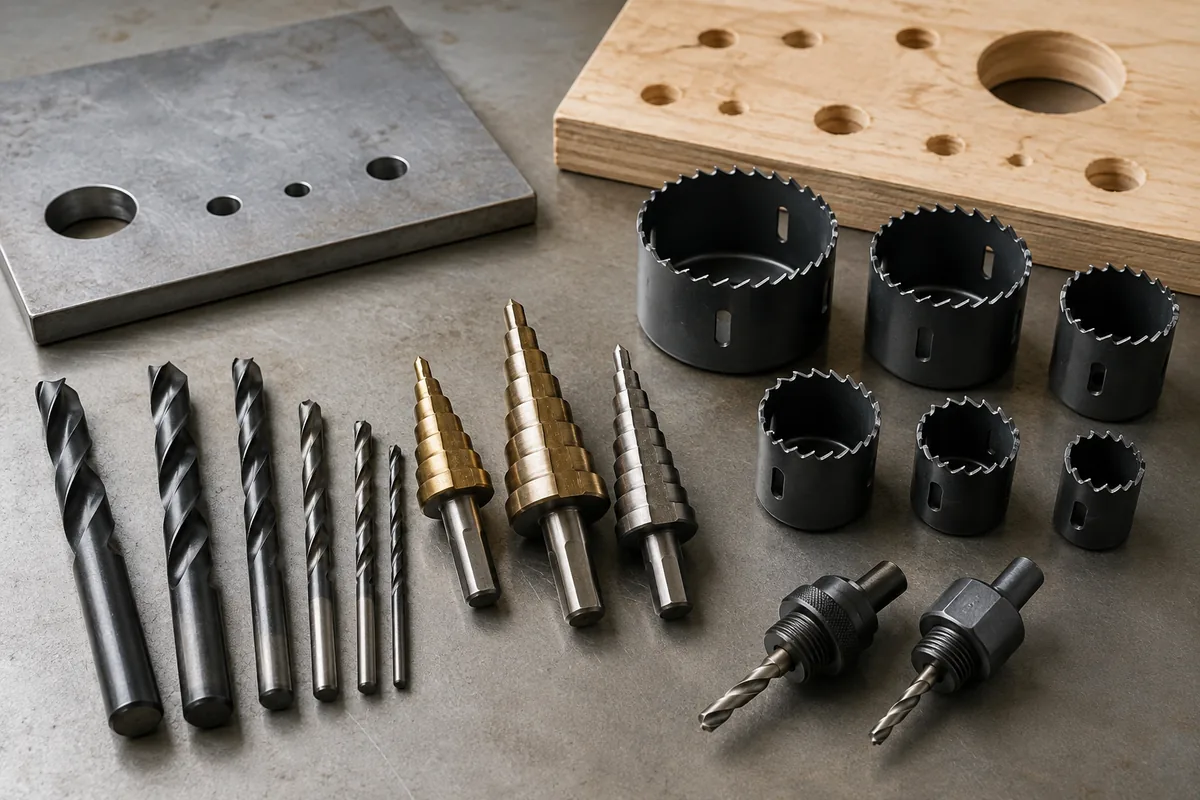
A step bit cuts on one land per step, and that land stays fully engaged. The small tip pilots itself, so there is no center punch fight on 20 gauge. The step above the cut works as a depth stop and a chamfer. Stop at the right step and the hole is round, on size and deburred. One mid-size bit also replaces a dozen twist bits.
Where they quit
Step height sets the ceiling. Most bits are rated to about 1/8 in of material, heavy industrial ones to roughly 1/4 in on the low steps. Thicker than one step and two steps cut at once. The load doubles and the edge dulls in a few holes.
Sizing steps against material thickness
Plain numbers for steel sheet: 18 gauge is about 0.048 in, 16 gauge about 0.060 in, 14 gauge about 0.075 in, 11 gauge about 0.120 in. Aluminum gauges run different. Use calipers, not the tag on the rack.
Buy for the holes you drill, not the biggest number on the box. Panel and box work stays under 1/2 in. Bracket and enclosure work wants a bit that runs to 3/4 or 7/8 in.
All-around step bit set for sheet metal
A three-piece set spanning roughly 1/8 in to 7/8 in covers most panel, bracket and enclosure work. Look for a flat or hex shank so it cannot spin in the chuck, deep-etched size marks, and a case that holds them. Skip the twenty-piece bargain kits. You will use three.
Bit steel, coatings and cutting oil
The body matters more than the color. M2 high speed steel is the baseline and it is fine for mild steel, aluminum and plastic if you keep heat down. Cobalt, M35 or M42, holds an edge hotter, which is what stainless and abrasive galvanized need.
Black oxide is light rust protection and a little lubricity. TiN, the gold one, cuts friction and helps chips slide. TiAlN runs hotter and suits stainless. None of it fixes a soft body, and the coating leaves the cutting edge the first time you touch up the flute.
Oil the cut. Cutting oil or a wax stick on steel and stainless, a dab on aluminum so chips do not weld to the land, dry is acceptable in cast iron. When the oil smokes hard, ease off and let the bit cool.
Torque, RPM and amps in plain English
Torque is twisting force. It is what shoves a 7/8 in step through 11 gauge without stalling. RPM is spindle speed. You want plenty of the first and not much of the second. Amps on a corded drill are how much current the motor can pull, a rough proxy for the work it does before it bogs and cooks. A 6 to 10 amp corded drill with a 1/2 in chuck is plenty. Cordless, run an 18V or 20V class brushless drill in low gear, which trades speed for torque at the gearbox.
Rough speeds in mild steel with an HSS bit: under 1/4 in, 1500 to 2500 rpm. Near 1/2 in, 600 to 900. Three quarters to an inch, 300 to 500. Halve those for stainless. Silver chips that curl and break mean you are close. Blue or straw chips mean too fast, too dry, or both. Feed firm and steady, because pecking work-hardens stainless under the edge and then nothing cuts.
Cobalt step bit for stainless and galvanized
Buy one cobalt bit and keep it away from the mild steel bits. It pays for itself the first time you run a dozen holes in 304 without stopping to cool the edge. Two-flute versions leave a cleaner wall in stainless; single flute clears chips better in soft metal.
Setup, PPE, fume and fire
Clamp the work, every time. A step bit grabs hardest at breakthrough and loose sheet becomes a spinning blade at throat height. Use the side handle and brace your forearm so a stall twists the tool into your body line, not out of your grip.
Safety glasses always, face shield overhead. Chips come off as long, hot, razor spirals. Brush them, never wipe them with a hand. No gloves near a rotating spindle. A glove catches and your hand follows the bit around before the trigger lets go. Gloves go back on to handle the part.
Galvanized, plated and painted stock puts zinc oxide and paint smoke into your breathing zone, and you are leaning right over the hole. Run a fan across the bench, away from your face, and wear a P100 for a long run of holes. Zinc fume causes metal fume fever, the chills the trade calls galv flu. Welding that hole later? Grind the coating back an inch past the weld zone first.
Hot swarf finds sawdust, rags, insulation and cardboard, so clear the area and keep an extinguisher close. Check the back side of every panel before you punch through: wiring, fuel and brake line, hydraulic hose, harness. Never drill a drum or tank that held fuel or solvent. Empty is not empty. Vapor is what goes off.
Step bit, hole saw or annular cutter
- ✔ One bit covers a dozen sizes in sheet
- ✔ Self-piloting, no center punch on thin stock
- ✔ Round hole with a chamfered top edge
- ✔ Fast on panel, box and bracket work
- ✘ Thickness limited, usually about 1/8 in
- ✘ Large steps need real torque and both hands
- ✘ Small tips snap under side load
- ✘ Long body is awkward in tight spots
Sheet and thin plate with holes under an inch: step bit. Over 1 1/2 in in sheet: bi-metal hole saw or knockout punch. Plate 1/4 in and up: annular cutter in a mag drill.
Step drill bits for metal FAQ
Can a step drill bit cut stainless? Yes. Cobalt bit, about half the RPM you would use in mild steel, oil, steady pressure. Never let it spin without cutting, because stainless hardens under a dull edge.
How thick can I go? Check the marking on the bit. Most are rated near 1/8 in, heavier ones to about 1/4 in on the smaller steps. Past that, switch to an annular cutter.
Can step bits be sharpened? Yes, on the flat face of the flute only. A few light passes on a fine stone brings a single flute back. Grind the step diameter and the sizes are wrong forever.
One mid-size set, one cobalt bit for stainless, oil, clamps. Run slow, feed firm, keep the chips silver and the fan running.
Check prices on Amazon →