Our Top Picks


What's inside
As an Amazon Associate I earn from qualifying purchases. This post may contain affiliate links at no extra cost to you.
A seized 3/4-inch bolt on a trailer frame does not care about your breaker bar. One good pull, the wrench slips, your knuckle finds the crossmember. A high torque cordless impact wrench handles that job better than any hand tool on the bench, and without fifty feet of air hose dragged across a floor full of slag.
The problem is that high torque is a shelf label, not a spec. Two tools with similar numbers on the box can behave nothing alike on a rusted fastener. Here is how the classes break down, how to match drive size to your metal, and what to do when the bolt wins.
As an Amazon Associate we earn from qualifying purchases at no extra cost to you.


| Class | Claimed nut-busting range | Where it earns its keep |
|---|---|---|
| Mid-torque 1/2 inch | About 400 to 650 ft-lbs | Lug nuts, 1/2 inch hardware, overhead work |
| High-torque 1/2 inch | About 900 to 1,600 ft-lbs | Rusted frame and suspension bolts, machine teardowns, fab work |
| 3/4 inch drive | About 1,200 to 1,900 ft-lbs | Ag and construction equipment, large flange and pin bolts |
| 1 inch drive | 2,000 ft-lbs and up | Fleet trucks and heavy iron, bolts bigger than your thumb |
Those ranges come from factory fixtures with clean hardware. Read them as class markers, nothing more.
What we cover
What a High Torque Cordless Impact Wrench Actually Does
An impact wrench does not push steadily. It spins a hammer, stores energy, and slams an anvil thousands of times a minute. Each hit is short and brutal. That shock breaks a rust bond loose without loading your wrist or your back.
Two torque numbers matter. Fastening torque is what the tool applies going on. Nut-busting torque, also called breakaway, is what it applies coming off, and it is always the bigger number because a stopped fastener lets the hammer hit harder. Shop on breakaway. That figure decides whether you keep the bolt or cut it off.
Then check the anvil and the modes. Friction ring anvils swap sockets fast and suit general work. Detent pin anvils hold harder, which matters on big drives and overhead. You want a low setting to start threads and an auto-stop mode that quits hammering once the fastener seats. That mode keeps you from twisting the head off a 3/8 inch bolt in a thin bracket.
Torque Comes From the Motor, Current Comes From the Pack
Amperage is the flow of electricity, measured in amps. A high torque impact under load pulls current in the tens of amps, far more than a drill asks for. A compact battery cannot feed that. It sags, heats up, and trips its own protection circuit halfway through the bolt.
Amp-hours describe capacity, roughly how long a pack runs. Cell size decides how hard it pushes. Packs built on larger cells, sold as high output or as the 5.0Ah and larger options across DeWalt 20V MAX XR, Milwaukee M18 FUEL and Makita LXT, give the tool the current it needs. Hang a 2.0Ah compact on a high torque wrench and you feel it go soft.
Buy the biggest pack you will tolerate on the tool, keep a second on the charger, and stay on one platform. Cold counts too. A battery that spent a January night in the truck makes no rated power until it warms.
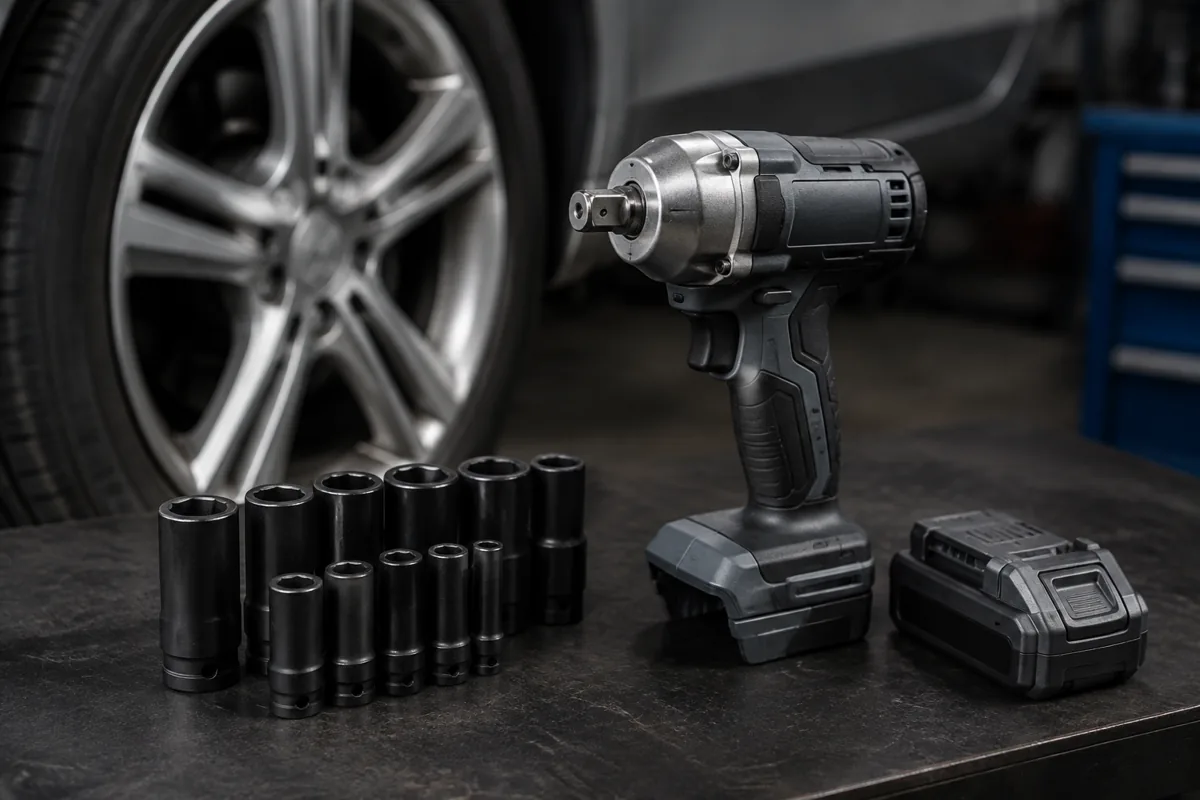
Brushless 1/2-inch high torque impact wrench
This is the buy for most metal shops. Brushless motor, several modes, friction ring anvil, and a 5.0Ah or larger pack. Get it in the platform you already own, and take the two-battery kit over the bare tool unless you have spares on the shelf.
Match the Drive Size to the Steel in Front of You
Bolt diameter sets drive size, not the size of the machine. Hardware up to 1/2 inch comes apart on a mid-torque tool, and the lighter body is easier overhead. Rusted 5/8 and 3/4 inch hardware is where high torque 1/2 inch pays. Past that, on pin bolts and big flanges, go 3/4 inch drive and stop fighting.
Material thickness limits what you can safely tighten. Torque clamps the fastener into whatever it passes through. Thread engagement wants at least one bolt diameter of depth, and sheet metal does not give you that, so 16 gauge and 11 gauge work needs nuts, backing plates, or a welded boss. Run a high torque tool into a threaded hole in thin plate and you strip it or crush a tube wall.
This is not a torque wrench. Impacts are for removal and for running hardware down close. Final numbers come from a click wrench. Structural bolting has its own accepted methods, turn-of-nut, calibrated wrench, or tension indicators, and a cordless impact is none of them. Use impact sockets only. Chrome sockets are hard, brittle, and they let go, sometimes past your face.
3/4-inch drive cordless impact wrench
Worth it if you work on ag equipment, dozers, or anything running 1 inch hardware. Heavier, longer, harder on batteries, and it snaps small fasteners without warning. Own it beside a mid-torque tool, not instead of one.
When the Bolt Wins: Heat, Cutting and Fumes
Sometimes the tool loses. Galled threads, rust jacking, a stud that seized before you owned the machine. This is where a metal shop has options, and where people get hurt.
Start with penetrant and time, overnight if you have it, then wipe the area down, because penetrating oil burns. Heat the nut, not the bolt, so it grows away from the threads. Before the torch lights: extinguisher in arm’s reach, no oil-soaked undercoating or tires nearby, and check the far side of the panel for wiring and insulation. Walk the area again a half hour after the gas is off.
Welding a nut or bar onto a sheared stud is the dependable fix, and that is where amperage and thickness meet. A rough starting point on mild steel is 1 amp per 0.001 inch of thickness, so 1/8 inch material starts near 125 amps and you adjust off the puddle. Thin sheet wants less current and faster travel or you blow through. A heavy nut wants enough current to fuse into the mass without cooking the metal around it.
Fume rules are not optional. Zinc off galvanized or plated hardware causes metal fume fever, and cadmium plating is far worse. Grind coatings back, pull local exhaust, wear a respirator rated for welding fume, and never do it in a closed room. Keep brake cleaner and other chlorinated solvents out of the bay, because an arc turns that vapor into phosgene. On the impact side: glasses always, face shield when grinding or knocking rust loose, muffs because these tools are loud enough to cost you hearing over a shift, and fingers off the socket and out of the pinch line between the tool and the frame rail.
- ✔ No hose, no compressor, no water in the air line
- ✔ One battery platform runs the impact, the grinder and the light
- ✔ Real breakaway grunt on rusted 3/4 inch hardware
- ✔ Auto-stop modes cut down on snapped studs
- ✘ Heavy and long, so tight frame rails and bell housings fight back
- ✘ High output packs cost real money and sag when cold
- ✘ Still no substitute for a calibrated torque wrench
- ✘ Destroys chrome sockets and small fasteners without warning
Deep 6-point impact socket set, 1/2-inch drive
Hand sockets shatter under this class of tool. Buy a deep six-point impact set in your drive size plus a couple of impact extensions. Six-point walls hold rounded heads better, which is most of what you meet on old equipment.
High Torque Impact Wrench FAQ
Is a high torque tool overkill for lug nuts? For removal, no. For installation, yes, and it is a fast way to stretch a stud. Run nuts down in the lowest mode, then finish with a torque wrench.
Can it replace my torque wrench? No. Output shifts with battery charge, temperature, thread condition and trigger time. Torque-limiting sticks get you close to spec, not to it.
Do I need 3/4 inch drive? Only if you regularly meet 7/8 inch hardware and up. A 1/2 inch high torque tool covers most fab shop and trailer work. Buy the bigger drive as a second tool, not a replacement.
Pick the class by the biggest fastener you actually meet, feed it a high output pack, keep impact sockets on it, and have a plan for the bolts that will not move. That plan is the part most shops skip, and it involves fire and fumes.
Check prices on Amazon →