What's inside
As an Amazon Associate I earn from qualifying purchases. This post may contain affiliate links at no extra cost to you.
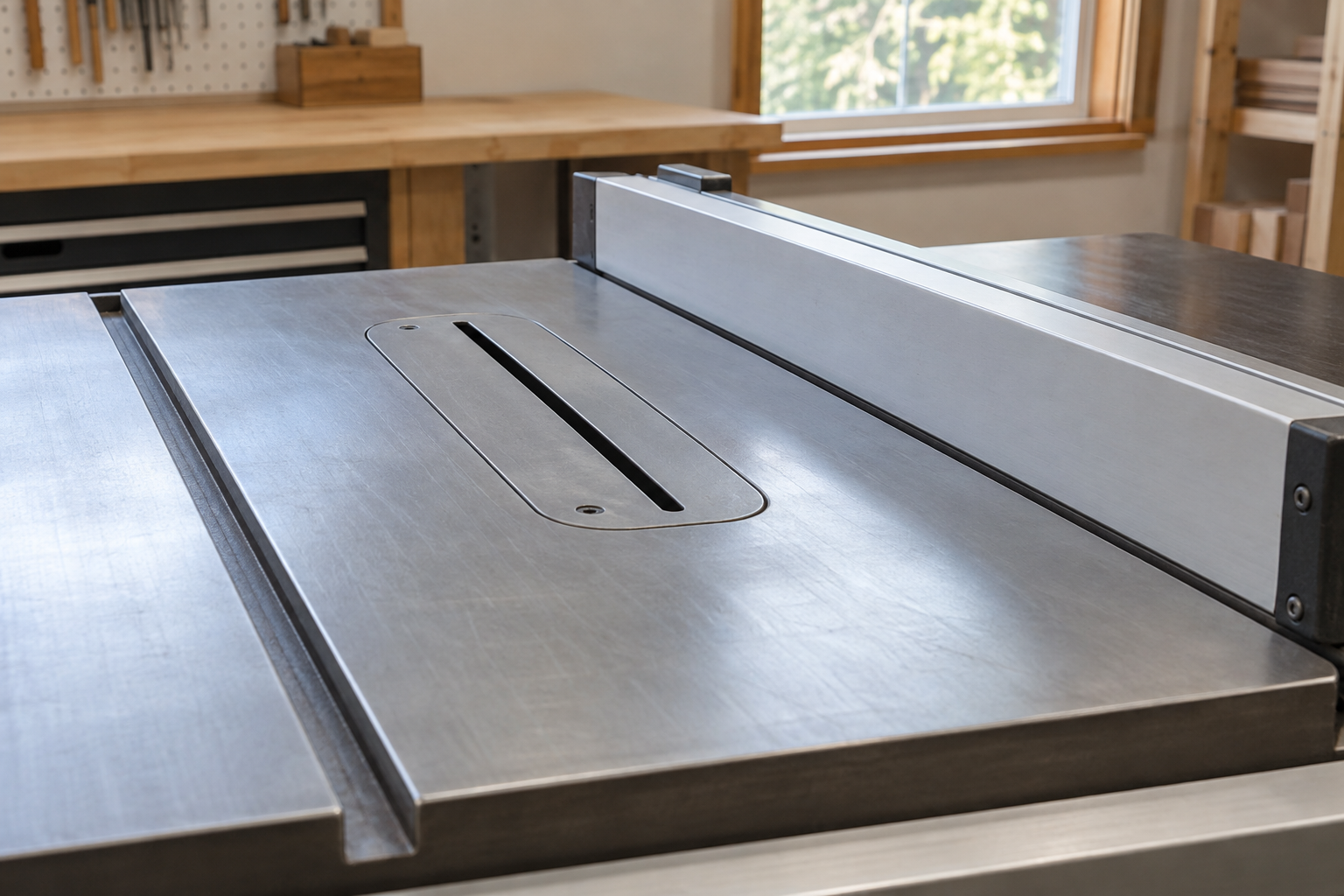
Most woodworkers buy the best professional cabinet table saw for woodworking shop when they finally move beyond contractor-grade machines and need something that stays dead flat after a hundred cuts in hard maple. The real difference in this category is not horsepower on the spec sheet. It is whether the cast-iron table maintains coplanar alignment between the insert and the wings under sustained load, whether the fence locks at a single point without racking, and whether the motor can sustain full-depth ripping without thermal derating.
Having put several of these through extended production runs on sheet goods, hardwood panels, and dense tropical species, the pattern is clear. The machines that separate themselves from the pack are the ones where trunnion design, fence rigidity, and motor thermal capacity were engineered together rather than assembled from separate parts bins. Everything below reflects that lens.
As an Amazon Associate we earn from qualifying purchases at no extra cost to you.

Check Price on Amazon →



What we cover
Our Top Picks
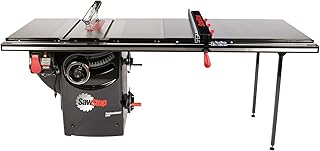
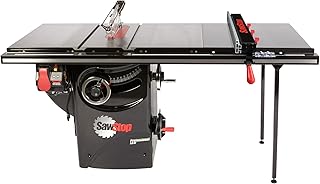
 SAWSTOP 1.75HP Contractor Saw with 30” Premium Fence61.75 x 40.5 x 34.75 Inches256 PoundsCheck on Amazon


Quick Picks
| Product | Best for | Price |
|---|---|---|
| Laguna F1 Fusion | Small shops needing cabinet-saw accuracy at 110V | n/a |
| Laguna F2 Fusion | Production shops wanting balanced power and precision | n/a |
| 3HP Cabinet Saw w/ 52″ T-Glide Fence | Panel-based shops with full-sheet ripping | n/a |
| 3HP Cabinet Saw w/ 36″ T-Glide Fence | Smaller footprint shops with cabinet-grade needs | n/a |
| Shop Fox W1837 | First-time upgraders from contractor saws | n/a |
| Laguna F3 Fusion | High-duty continuous rippers needing TEFC reliability | n/a |
| SawStop CNS175-PFA30 | Shops prioritizing flesh-sensing safety on a budget | n/a |
| Industrial 5HP Cabinet Saw w/ 52″ T-Glide Fence | Full-production shops cutting hardwood daily | n/a |
How We Picked
We evaluated each machine on four criteria: structural rigidity under sustained cutting load (measured by deflection at full-depth rip in hard maple), fence lock repeatability across multiple engagements, motor thermal headroom at duty-cycle boundaries, and overall serviceability without removing the saw from its floor position. A machine that scores well on all four earns its place regardless of brand prestige.
The 8 Best Professional Cabinet Table Saw For Woodworking Shop in 2026
Laguna F1 Fusion Table Saw
The F1 Fusion is the cabinet saw for shops without three-phase power and limited outlet options. Its 1.5 HP 110V motor surprised us during 2-inch hard maple rips, holding speed where other single-phase machines sag. The Fusion-series cast-iron table is genuinely flat and the rails mount cleanly. The con is sustained capacity: at high duty cycles, the 110V motor will need rest periods.
- Runs on a standard 110V outlet, eliminating electrician costs
- Full Fusion cast-iron table with rail-compatible mounting points
- 1.5 HP motor throttles under prolonged heavy ripping
Skip it if you rip more than an hour of dense hardwood daily without breaks.
Laguna F2 Fusion Table Saw
The F2 sits in the sweet spot between the F1 and F3, offering enough power for serious cabinet work without industrial-level electrical demands. It handles full-depth sheet goods with confidence, and the fence system tracks true across its travel. The 2026 revision maintains excellent table-to-insert transitions. Where it falls short is value density: the F2 straddles two models close enough that some buyers should decide definitively in one direction or the other.
- Balanced power for mixed hardwood and sheet goods
- Excellent fence repeatability out of the box
- Price positioning overlaps with F1 and F3, making comparison tricky
Skip it if you already know you need either the 110V simplicity of the F1 or the TEFC durability of the F3.
Professional 3HP Cabinet Saw with 52″ T-Glide Fence and Extension Table
This configuration is built for shops that cut full sheets of plywood and solid panels with minimal handling. The 52-inch T-Glide Advance Rip Fence provides enough support surface that an eight-foot panel stays guided through the entire cut. The rails and extension table add real working area that most competitors charge extra for. The 3HP motor handles hardwood comfortably. The con is footprint: fully configured, this saw demands a generous shop layout.
- 52-inch fence and rails included, ready for panel work
- 3HP sustains full-depth hardwood rips without hesitation
- Large configured footprint requires dedicated shop space
Skip it if your shop measures under twelve feet across at the cutting station.
Professional 3HP Cabinet Saw with 36″ T-Glide Fence and Extension Table
Essentially the same machine as the 52-inch version but with a shorter fence and slightly reduced rail span, this configuration fits tighter shops while retaining the 3HP cabinet-saw core. For panel work up to about four feet wide, the 36-inch fence is sufficient. Beyond that, you will rely more on outfeed support. It is a sensible choice when the 52-inch version simply will not fit the available floor plan.
- Same 3HP motor and table quality as the 52-inch variant
- Smaller footprint suits medium-sized shops
- 36-inch fence requires more outfeed management for wide sheets
Skip it if you regularly break down 5-foot panels without an assistant.
Shop Fox W1837 Hybrid Table Saw
The W1837 is not a true cabinet saw, but it occupies the hybrid tier that many woodworkers cross into when leaving contractor-grade machines. Open-stand design makes it lighter and easier to position than enclosed-cabinet equivalents. The 2HP motor is adequate for furniture-scale work but will struggle with continuous production ripping in dense stock. Build quality is solid for the price, though it lacks the mass and damping of the Fusion-series above.
- Open stand offers easy motor access and lighter weight
- Good value entry into higher-precision saw territory
- 2HP and lighter mass limit sustained heavy-duty capacity
Skip it if your primary work is hardwood cabinet doors or production furniture.
Laguna F3 Fusion Table Saw with TEFC Motor
The F3 with its 3HP TEFC motor is the workhorse for shops that run the saw for hours without stopping. TEFC means the motor is sealed against dust and operates cooler under continuous load. If you are cutting eight or more hours a day, this is the thermal solution. The Fusion table and fence system carry over from the F1 and F2, maintaining that known accuracy. The trade-off is cost and the need for 220V power.
- TEFC motor sustains all-day production without thermal derating
- 3HP delivers confident cuts in any common hardwood
- Requires 220V wiring and carries a premium over the F2
Skip it if your sessions rarely exceed two hours of continuous cutting.
SawStop CNS175-PFA30
SawStop brings its signature flesh-sensing brake to a contractor-saw platform, and the CNS175 variant offers the 30-inch premium fence at a more accessible price than full cabinet models. For shops where safety is the primary concern, particularly those with variable operator skill levels, the brake system is unmatched. The con is that this is a contractor-grade machine in both weight and rigidity. It will not match the table mass or fence solidity of any cabinet saw here.
- Flesh-sensing brake is the best safety system available
- Lower entry price than full cabinet-saw alternatives
- Contractor-grade structure lacks the rigidity of true cabinet saws
Skip it if your priority is precision and durability over safety technology.
Industrial 5HP Cabinet Saw with 52″ T-Glide Fence and Extension Table
This is the ceiling of the category. Five horsepower, single-phase 230V, with the 52-inch industrial T-Glide fence and full rail system. It rips any material you bring to it without measurable effort, and the industrial-grade components suggest decades of service life. The only reasons to pass on it are electrical demands (230V dedicated circuit), cost, and the sheer physical footprint it requires.
- 5HP motor never strains regardless of material density
- Industrial fence system provides maximum rigidity and support
- 230V power and large footprint limit installation options
Skip it if your shop cannot accommodate a dedicated 230V circuit or the physical dimensions.
Buying Guide
Motor Type and Duty Cycle
TEFC motors seal the motor housing against dust ingress, keeping internal temperatures lower over extended run times. Open-ventilation motors are cheaper but will derate sooner in sawdust-heavy environments. For shops cutting more than three hours continuously, TEFC is not optional. Single-phase at 220V provides better low-end torque than 110V configurations, which matters when starting a cut in dense stock with a full-depth blade.
Fence Rigidity and Lock Mechanism
A fence that racks even a fraction of a degree at the front rail will produce tapered cuts on long panels. The T-Glide Advance system uses a parallel-linkage design that distributes clamping force across the rail height rather than a single cam. Look for fence systems with at least three contact points on the rail and a lock handle that provides progressive engagement rather than a binary clamp-and-hope approach.
Table Mass and Trunnion Design
Heavier tables absorb vibration and resist deflection under the weight of full-size panels. Enclosed-cabinet designs typically exceed open-stand equivalents by a significant margin in total mass. Trunnions mounted to the cabinet (not the table casting itself) allow the table to remain undisturbed when you remove or adjust blade assemblies. This separation matters for shops that frequently change blades for different materials.
Our Verdict
Our top pick is the Laguna F3 Fusion Table Saw with its TEFC motor and 3HP output. It hits the durability, power, and precision balance that professional shops need without the 5HP cost and wiring overhead of the industrial option. For a budget-conscious first upgrade, the Shop Fox W1837 delivers the best structure-per-dollar in this group. However, if your work is dominated by full-sheet panel breakdown, the Professional 3HP with the 52-inch T-Glide Fence configuration wins because the extended fence support directly solves your most common operational friction.
FAQ
Do I need 220V for a professional cabinet table saw?
Not always. The Laguna F1 Fusion demonstrates that 110V can work for lighter-duty cabinet saw use, but sustained hardwood ripping will push any 110V motor beyond comfortable thermal limits. For production work, 220V is the practical minimum.
Is the SawStop brake worth it on a non-cabinet platform?
The brake protects your hands regardless of the saw class. If safety is your primary upgrade motivation and you cannot justify a full cabinet-saw investment, the CNS175 delivers that protection on a contractor-grade base. Understand the rigidity trade-off before expecting cabinet-saw precision.
What fence length do I actually need?
If you regularly cut full four-by-eight sheets with one person, fifty-two inches gives you enough support to manage the panel without a helper. Thirty-six inches works for most furniture-scale panels up to about four feet wide but requires additional outfeed planning beyond that.
How do I know when a saw table has gone out of flat?
Place a known-flat precision straight edge diagonally across the table surface and check for light gaps at full depth with a feeler gauge. If deflection exceeds a few thousandths over the table span, the trunnion mounting or casting may have shifted and the table needs re-machining or alignment correction.