What's inside
As an Amazon Associate I earn from qualifying purchases. This post may contain affiliate links at no extra cost to you.
What we cover
Best TIG Torches: How to Choose the Right Torch for Your Welder
Choose an air-cooled TIG torch for portability and occasional welding, or a water-cooled torch for sustained high amperage and long sessions—provided your welder, connectors, and cooling system are compatible. The right torch is the one that fits your machine and workload, not simply the one with the highest amperage rating.
Air-cooled vs. water-cooled: the practical difference
An air-cooled torch sheds heat through its body, cable, and surrounding air. It is simpler to set up: no cooler, coolant lines, or pump to maintain. The trade-off is a bulkier cable and more heat at the handle during demanding work. At its rated output, an air-cooled torch may still require frequent pauses, depending on its duty-cycle rating and welding conditions.
As an Amazon Associate we earn from qualifying purchases at no extra cost to you.


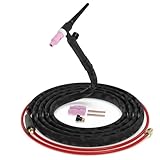
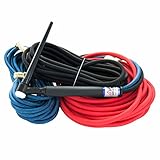
A water-cooled torch circulates coolant through the torch and leads, helping keep the handle and cable more manageable during extended welding. It is often the better fit for production work or high-amperage welding. But it adds equipment, connections, leak checks, and maintenance. A water-cooled torch must be used with an appropriate cooler or other manufacturer-approved cooling arrangement; do not run one dry.
| Factor | Air-cooled torch | Water-cooled torch |
|---|---|---|
| Common rated range* | About 150–250 A | About 250–500 A |
| Typical duty-cycle examples* | 35–60% at rated output | 60–100% at rated output |
| Handle and cable feel | Usually warmer; cable often stiffer or bulkier | Usually cooler; slim torch and flexible leads are common |
| Additional equipment | None beyond compatible power and gas connections | Compatible coolant circulation and return connections |
| Best suited to | Portable setups, repair, short welds, moderate output | Long sessions, repeated high-output welds, limited heat tolerance |
| Ownership trade-off | Less system complexity; heat can shorten comfortable working time | More setup and maintenance; greater comfort during sustained work |
*These are broad examples, not ratings for every torch. Compare the specific manufacturer’s rating, duty cycle, and test conditions. Amperage capacity can change with AC versus DC, gas, electrode, and cooling conditions.
Choose by workload, not headline amperage
- Light repair or occasional fabrication: An air-cooled torch rated above your usual welding current is often the simplest choice. For example, if most of your work is below roughly 150 A and involves short beads, you may not benefit enough from water cooling to justify a cooler and extra connections.
- Frequent welding near the torch’s limit: Check the duty cycle at the current you actually use. A 200 A rating at a 35% duty cycle does not mean the torch can weld continuously at 200 A. In a typical 10-minute duty-cycle period, 35% corresponds to 3.5 minutes of welding followed by time for cooling, under the rating’s stated conditions.
- Long runs or repeated high-current work: Consider a water-cooled setup if the torch gets uncomfortably hot or pauses for cooling interrupt your work. Confirm that the welder supports the torch and that a compatible cooler fits your workspace and budget.
- Mobile work or cramped access: Air cooling avoids transporting a cooler and coolant. If cable flexibility is the priority, compare the complete lead assembly: some water-cooled leads are easier to maneuver, but their paired coolant lines can still snag or add bulk.
Connector fit: verify before ordering
“TIG torch” does not describe one universal connection. A torch may connect through a machine-specific plug or through separate fittings for power, shielding gas, and—on water-cooled setups—coolant supply and return. The control switch may also connect separately. Two torches with the same amperage rating can therefore be incompatible with the same welder.
Before buying, identify your welder’s make and model, torch connection type, gas connection, and control connector. Check the owner’s manual or the machine manufacturer’s compatibility information. If the torch uses an adapter, confirm that the adapter matches the machine and preserves the needed gas, power, and control functions. Do not assume a connector fits because it looks similar.
Size, cable length, and consumables
Common TIG torch families include smaller, lighter torches for lower-current precision work and larger bodies for higher output. Size affects access and comfort as well as capacity: a compact torch can be easier to hold around tight joints, while a high-current torch needs adequate cooling and appropriately sized leads. Select a torch and consumables rated for the process and current you plan to use.
Choose cable length for the distance between the welder and workpiece, with enough slack to move without pulling on the torch or connections. Longer leads can add weight, voltage drop, and handling resistance; avoid buying extra length “just in case” if it makes the cable difficult to route. For a fixed bench, a shorter lead may be easier to manage. For larger work or a machine kept at a distance, extra reach may be worth the added bulk.
Also price the consumables that fit the torch: collets, collet bodies or gas lenses, cups, back caps, and electrodes. Some torch families have widely available parts; others rely on less common sizes. A lower torch price can be offset by having to replace several consumables or keep a larger assortment on hand.
Estimate the cost of ownership
Compare the initial torch cost with the parts you expect to replace and, for a water-cooled setup, the cooler and coolant-related maintenance. As a simple illustration, suppose a torch costs $80 and its commonly replaced consumables cost $20 per set. Over 10 replacement sets, the torch plus those sets totals $280, or $28 per set if you spread the torch cost across that usage. If a compatible alternative torch costs more but uses consumables you already stock, compare the total rather than the torch alone. These figures are illustrative market-style examples, not quotes; prices vary by brand, configuration, and region.
Consumables usually wear before the torch body. Cups can chip or accumulate spatter; collets and collet bodies can deform or become dirty; cables can fail where they are repeatedly bent, dragged, or crushed. Keep the torch away from hot offcuts, avoid sharp kinks, and inspect connectors and leads when changing consumables. For water-cooled systems, check hoses and fittings for leaks and follow the cooler maker’s coolant and maintenance instructions.
Quick buying checklist
- Match the torch’s amperage and duty cycle to your actual current and session length.
- Choose air cooling for simplicity and mobility; choose water cooling when sustained output and a cooler handle justify the added system.
- Confirm every power, gas, control, and coolant connection before ordering.
- Pick a cable length that reaches comfortably without excessive weight or clutter.
- Check the price and availability of the complete consumable set, not just the torch.
- Follow the torch and welder manufacturers’ ratings and setup instructions.
For most occasional welders, a compatible air-cooled torch with a suitable duty cycle is the practical starting point. For regular long runs at higher output, a properly matched water-cooled torch can make the work more manageable—but only when the machine, cooler, connections, and consumables are all part of the plan.