What's inside
As an Amazon Associate I earn from qualifying purchases. This post may contain affiliate links at no extra cost to you.
What we cover
Best Water Cooled TIG Torches for High-Current Welding (2026)
The best water cooled TIG torch for most high-current work is a 250–350 amp model like the CK Worldwide CK20 (250A) or a WP-18-class torch (350A) paired with a dedicated cooler — it lets you hold a compact torch body at amperages that would cook an air cooled TIG torch in minutes. Below is how to pick the right one based on amperage, connections, cooler requirements, and real ownership costs.
Water Cooled vs. Gas Cooled: When Water Wins
A gas cooled TIG torch (air cooled) dissipates heat through the cable and torch body alone, which forces two compromises: a thick, heavy cable, and a derating curve that punishes you above ~150 amps on AC aluminum. A tig welding torch water cooled circulates coolant through the power cable, so the same amperage runs through a much lighter lead.
As an Amazon Associate we earn from qualifying purchases at no extra cost to you.
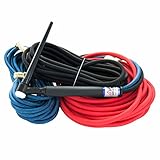


- Water cooled advantages: 250–400A ratings in a small torch body, leads roughly half the diameter of equivalent air cooled cables, steady temperatures on long AC aluminum beads, and dramatically longer consumable life at high current.
- Air cooled advantages: no cooler to buy, fill, or maintain; fine for under ~150A DC or short aluminum welds; ideal for mobile repair work.
The crossover point is roughly 200A continuous. If you weld .125″+ aluminum daily or do production stainless at 200A+, a water cooled tig welding torch pays for itself in consumables and wrist comfort alone.
Top Picks by Situation
| Torch | Rating (DC/AC) | Electrode Range | Consumable Series | Best For |
|---|---|---|---|---|
| CK Worldwide CK20 / Weldcraft WP-20 | 250A DC / ~200A AC | .020″–1/8″ | Standard 2-series (13N) gas lens & cups | General fab shops, .250″ aluminum, daily use |
| CK18 / WP-18-class (350A) | 350A DC / ~280A AC | .040″–5/32″ | 2-series and 3-series hardware | Heavy aluminum plate, production welding |
| CK310 / WP-310 | 310A DC | .020″–1/8″ | 2-series | High current in a slimmer body than WP-18 |
| Weldtec WT-20 / similar flex-head 250A | 250A DC | .020″–1/8″ | 2-series | Pipe welding, confined access |
| Micro/pencil water cooled (CK130-class, 130–150A) | 130–150A | .020″–3/32″ | Micro consumables | Thin aerospace/motorsport work where water cooling is already in the shop |
Decision Matrix
| Your Situation | Recommended Setup |
|---|---|
| Hobbyist, occasional aluminum, under 150A | Stay with a gas cooled TIG torch (WP-17/WP-26 class); a cooler isn’t justified |
| Home shop, regular .125″–.250″ aluminum, budget-conscious | 250A torch (CK20/WP-20) + entry 1–2 gal recirculating cooler |
| Production shop, 250–350A daily | WP-18/CK18 + industrial cooler with flow switch; 25 ft leads |
| Pipe/position work | Flex-head 250A torch, braided or vinyl-leather leads, short 12.5 ft hose |
| Mobile field work | Air cooled only — dragging a cooler to site negates the benefit |
Hose, Connector, and Cooler Compatibility
This is where buyers get burned. A water cooled tig torch kit needs three connections to the machine side: gas in, water in (to torch), water out/power return. Before ordering, check:
- Power connection: Most machines take a 3/8″ or 1/2″ lug, or a through-the-panel stud. Everlast and Lincoln machines often differ from Miller — order the adapter that matches your machine’s stud size, not the torch brand’s default.
- Quick-disconnects: 5/8″-18 RH (water/gas) fittings are the US standard. If your cooler uses a different thread, a brass adapter kit (~$15–25) solves it.
- Cooler size: A torch rated 250A needs roughly 1 quart/minute of flow. Small 1-gallon coolers handle occasional 250A work; sustained 300A+ demands a 2+ gallon unit with a real radiator and fan, not just a pump and reservoir.
- Flow switch: Mandatory if your welder doesn’t have one. A $30 inline flow sensor on the return line prevents instantly melting a $300 torch when a hose kinks or the pump fails.
Ergonomics and Heat Management in Practice
A 350A water cooled torch head is often smaller and lighter than a 150A air cooled torch — that’s the entire point. But the gains vanish if your leads fight you. Vinyl hoses are cheap and kink; braided rubber hose sets (~$60–90 more) flex better and survive being stepped on. For position work, a 12.5 ft lead reduces drag weight substantially versus the standard 25 ft.
Heat management isn’t just about the torch — it’s the consumables. Gas lens collet bodies at 250A+ on AC outlast standard collet bodies roughly 3:1 because they spread heat and shielding gas more evenly. Budget 1/8″ 2% lanthanated or E3 tungstens hold a stable ball on AC without the thorium handling concerns of 2% thoriated.
Ownership Costs: What Actually Wears Out
Worked example — a shop running 200A AC on aluminum 20 hours/month:
- Air cooled (WP-26 at duty-cycle limit): torch body degrades, cables stiffen from heat; torch/cable replacement every 12–18 months (~$150–200/yr), plus frequent cup and collet body changes.
- Water cooled (CK20): coolant change annually (~$15 for deionized water + algaecide or pre-mixed coolant), gas lens consumables ~$40–60/yr at this duty, hoses last 3–5 years, torch body effectively indefinite unless dropped.
Payback: the ~$400–600 cooler premium typically recovers in 18–24 months of regular high-current use through consumables and downtime alone — faster if operator fatigue matters, since a 250A air cooled setup weighs roughly 2× a water cooled tig torch at the hand.
Common mistakes that kill torches: running tap water (mineral buildup blocks the cooling passages — use deionized water or approved coolant), crimped hoses at the machine end, and exceeding the duty cycle even though the torch “feels cool.” Water keeps the handle cool while the electrode end can still overheat.
Setup Checklist
- Mount cooler below or level with the torch to avoid airlocks on first fill; run the pump and bleed air before striking an arc.
- Confirm return flow at the cooler sight glass or flow switch before welding — every session.
- Use a gas lens and stubby gas cap on 20-series torches for better access; keep spare collets, cups, and back caps on hand.
- Store leads coiled loosely — tight coils stress the inner conductor bundle where water and power share the line.
FAQ
Can I run a water cooled torch without a cooler?
Only at very low amperage (under ~125A) with the hoses drained, and even then it’s pointless — the torch costs more than an air cooled equivalent. Buy the cooler.
Do water cooled TIG torches work on any welder?
Any welder with a standard gas solenoid and a stud or Dinse-style output can drive one — the cooler is a separate device. Verify stud size and thread before ordering.
How often should I change the coolant?
Every 6–12 months, or immediately if it discolors. Algae and mineral scale are the main killers of cooling passages.