What's inside
- Best MIG TIG Welders of 2026: Dual-Process Machines That Do Both Well
- Quick comparison: the strongest dual-process choices
- Best overall: Miller Multimatic 220 AC/DC
- Best portable choice for steel: ESAB Rebel EMP 215ic
- Best familiar home-shop option: Lincoln Power MIG 215 MPi
- Best higher-output AC/DC alternative: Everlast PowerMTS 251Si
- How to choose between MIG and TIG on a combo machine
- Ownership realities: what wears out first
- What to verify before purchasing
- Related Guides
- Best MIG TIG Welders of 2026: Dual-Process Machines That Do Both Well
- Quick comparison: the strongest dual-process choices
- Best overall: Miller Multimatic 220 AC/DC
- Best portable choice for steel: ESAB Rebel EMP 215ic
- Best familiar home-shop option: Lincoln Power MIG 215 MPi
- Best higher-output AC/DC alternative: Everlast PowerMTS 251Si
- How to choose between MIG and TIG on a combo machine
- Ownership realities: what wears out first
- What to verify before purchasing
- Related Guides
As an Amazon Associate I earn from qualifying purchases. This post may contain affiliate links at no extra cost to you.
What we cover
- Best MIG TIG Welders of 2026: Dual-Process Machines That Do Both Well
- Quick comparison: the strongest dual-process choices
- Best overall: Miller Multimatic 220 AC/DC
- Best portable choice for steel: ESAB Rebel EMP 215ic
- Best familiar home-shop option: Lincoln Power MIG 215 MPi
- Best higher-output AC/DC alternative: Everlast PowerMTS 251Si
- How to choose between MIG and TIG on a combo machine
- Ownership realities: what wears out first
- What to verify before purchasing
- Related Guides
Best MIG TIG Welders of 2026: Dual-Process Machines That Do Both Well
The best MIG TIG welder for most buyers is the Miller Multimatic 220 AC/DC if you need clean MIG work plus real AC TIG aluminum capability; if aluminum is not part of the plan, a less expensive dual-process inverter with smooth MIG wire control and DC lift-arc TIG is usually the better value.
That distinction matters because “MIG/TIG welder” can describe two very different machines. Some units provide proper MIG and DC TIG, while others add a basic lift-arc function that is useful for steel and stainless but cannot weld aluminum. Aluminum TIG requires high-frequency AC output, adjustable AC balance, and enough current for the material thickness. A machine advertised as a tig welders mig welder combination is not automatically an AC/DC TIG machine.
As an Amazon Associate we earn from qualifying purchases at no extra cost to you.
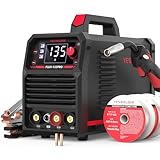


Quick comparison: the strongest dual-process choices
| Machine | MIG output | TIG type | Input | Approx. weight | Best suited to |
|---|---|---|---|---|---|
| Miller Multimatic 220 AC/DC | 30–200 A | AC/DC TIG, high frequency | 120/240 V | 56 lb | One machine for steel, stainless, and aluminum |
| ESAB Rebel EMP 215ic | 30–205 A | DC lift-arc TIG | 120/230 V | 40 lb | Portable fabrication and repair |
| Lincoln Power MIG 215 MPi | 30–200 A | DC TIG, lift start | 120/230 V | 34 lb | Home shops and general steel work |
| Everlast PowerMTS 251Si | up to 250 A | AC/DC TIG, high frequency | 120/240 V | about 40 lb | Higher-output shop welding at a competitive price |
| 200 A-class DC MIG/TIG inverter | about 200 A | DC lift-arc TIG | 120/230 V | 25–40 lb | Budget steel and stainless work |
Published weights and output ranges can vary slightly by package, torch, spool-gun equipment, and regional version. Check the manufacturer’s manual before buying, especially if a listing uses “TIG” without specifying AC/DC or high-frequency start.
Best overall: Miller Multimatic 220 AC/DC
The Multimatic 220 AC/DC is the clearest answer for buyers who want one capable MIG and TIG machine rather than two specialized welders. It supports 120- and 240-volt input, offers roughly 200 amps of output, and includes AC and DC TIG with high-frequency starting. That gives it the output control needed for aluminum TIG as well as the easier setup associated with MIG.
Its advantage is not merely the mode selector. A useful dual-process machine must also provide stable wire feeding, inductance or arc-control adjustment, gas-management options, and sensible TIG controls. The 220 AC/DC is a strong fit for repair work, vehicle fabrication, stainless projects, aluminum brackets, and occasional precision TIG.
The drawbacks are price and size. General market pricing is commonly in the upper-$2,000 to low-$3,000 range depending on accessories. If you weld only mild-steel frames, paying for AC TIG may not produce a worthwhile return.
Best portable choice for steel: ESAB Rebel EMP 215ic
The ESAB Rebel EMP 215ic is a genuinely useful MIG and TIG combination for people who prioritize portability. It weighs about 40 pounds, accepts 120 or 230 volts, and provides MIG, flux-cored, stick, and DC lift-arc TIG functions. Its TIG mode is appropriate for steel and stainless, but it is not an AC TIG aluminum welder.
That limitation is also what keeps the machine relatively compact and less expensive than a full AC/DC unit. It makes sense for a mobile repair setup, a small woodworking-and-metalworking shop, or a user who wants TIG control for neat steel joints without building an aluminum capability around it.
Best familiar home-shop option: Lincoln Power MIG 215 MPi
The Power MIG 215 MPi is aimed at general-purpose fabrication. Its approximately 200-amp class output, dual-voltage input, MIG capability, flux-cored operation, and DC TIG function cover common projects such as brackets, carts, gates, mower repairs, and mild-steel furniture frames.
For buyers searching for a mig and tig welder, this is the important qualification: its TIG mode is for DC materials, not aluminum TIG. Aluminum can still be MIG-welded with suitable equipment, including the correct spool gun or push-pull arrangement where supported, but MIG aluminum is not the same as AC TIG aluminum. It uses different wire, liner, shielding gas, contact tips, and technique.
Best higher-output AC/DC alternative: Everlast PowerMTS 251Si
The Everlast PowerMTS 251Si belongs on the shortlist when output and process flexibility matter more than brand-service convenience. It combines MIG, stick, and AC/DC TIG functions and reaches the 250-amp class. The AC TIG function makes aluminum welding practical, while the higher output gives more headroom for thicker steel and aluminum than many 200-amp units.
Before choosing it, compare the included torch, foot pedal, regulator, spool-gun provisions, warranty terms, and local service arrangements. A machine can have excellent specifications on paper yet cost more to own if replacement consumables or technical support are difficult to obtain in your area.
How to choose between MIG and TIG on a combo machine
| Your situation | Choose | Why |
|---|---|---|
| Mostly steel, occasional repairs, limited budget | 200 A-class MIG/DC lift-TIG inverter | Lower purchase cost and adequate capability |
| Frequent shop use, steel and stainless | Premium 200–215 A dual-voltage MIG/DC TIG unit | Better controls, duty cycle, support, and wire-feed consistency |
| Aluminum TIG is a real requirement | AC/DC TIG and MIG machine | AC output, balance control, and high-frequency start are essential |
| Mobile work or weak electrical service | 120/230 V machine under 45 lb | Easier transport and more installation flexibility |
| Thick material and repeated long welds | 240 V, 220–250 A machine | More duty-cycle margin and less nuisance tripping |
For sizing, a useful rule is that mild steel TIG commonly needs roughly 1 amp per 0.001 inch of thickness, although joint design, material type, preheating, and technique change the result. A 1/8-inch steel part may therefore call for around 125 amps of TIG capacity, while a 1/4-inch aluminum part may need substantially more. A 200-amp nameplate does not mean the machine can sustain 200 amps continuously; check the duty cycle at the output you actually use.
Ownership realities: what wears out first
On the MIG side, contact tips, nozzles, liners, drive rolls, and gun neck components are normal wear items. Poorly matched drive-roll grooves can deform wire, while excessive tension can add drag and flatten soft aluminum wire. Keep the wire path clean and use the correct liner rather than trying to compensate with higher roller pressure.
TIG consumables include tungsten electrodes, collets, gas lenses, cups, and torch leads. Contaminated tungsten should be reground or replaced; repeatedly touching the weld pool with the electrode spreads contamination and makes arc starts unreliable. Clean aluminum mechanically with a dedicated stainless brush immediately before welding, and avoid sharing brushes that have been used on oily or painted steel.
Gas flow is another frequent source of poor results. As a starting point, many indoor TIG jobs use approximately 15–20 cubic feet per hour of argon, while MIG flow often falls around 20–30 cubic feet per hour depending on nozzle size, drafts, and transfer mode. More gas is not always better: excessive flow can create turbulence and draw air into the shielding zone.
What to verify before purchasing
- Whether TIG is DC lift-arc or AC/DC high-frequency TIG.
- Real duty-cycle figures at 120 V and 230/240 V.
- Maximum spool diameter and whether standard 8-inch spools fit.
- Availability of a spool gun or aluminum MIG accessories.
- Whether the package includes a TIG torch, foot pedal, regulator, and suitable cables.
- Separate inductance, wire-speed, arc-force, AC balance, and AC frequency controls where relevant.
- Local access to liners, contact tips, torches, and warranty service.
The best mig tig welder is therefore not the machine with the longest mode list. For steel-only work, choose a reliable DC combination with a stable wire feeder. For aluminum TIG, reject any unit that lacks AC output. That single check eliminates many attractive but unsuitable tig/mig welder listings before price and accessories become distractions.