What's inside
- Best CK TIG Welding Torches for Comfort, Control, and Durability
- Quick recommendations by welding situation
- CK torch sizes compared head-to-head
- Flex head or rigid head?
- Air cooling versus water cooling
- Cable length, flexibility, and machine compatibility
- Consumables and long-term ownership
- A practical selection calculation
- Best choice by buyer profile
- Related Guides
- Best CK TIG Welding Torches for Comfort, Control, and Durability
- Quick recommendations by welding situation
- CK torch sizes compared head-to-head
- Flex head or rigid head?
- Air cooling versus water cooling
- Cable length, flexibility, and machine compatibility
- Consumables and long-term ownership
- A practical selection calculation
- Best choice by buyer profile
- Related Guides
As an Amazon Associate I earn from qualifying purchases. This post may contain affiliate links at no extra cost to you.
What we cover
- Best CK TIG Welding Torches for Comfort, Control, and Durability
- Quick recommendations by welding situation
- CK torch sizes compared head-to-head
- Flex head or rigid head?
- Air cooling versus water cooling
- Cable length, flexibility, and machine compatibility
- Consumables and long-term ownership
- A practical selection calculation
- Best choice by buyer profile
- Related Guides
Best CK TIG Welding Torches for Comfort, Control, and Durability
The best CK TIG welding torches are chosen by amperage, duty cycle, welding position, and machine connection—not simply by the torch with the highest current rating: choose a CK9 or CK17 for compact, low-amperage work, a CK18 or CK20 for everyday fabrication, and a water-cooled CK18, CK20, or CK24 when long welds create too much heat for an air-cooled handle.
Quick recommendations by welding situation
| Situation | Best CK torch type | Why it fits | Important limitation |
|---|---|---|---|
| Small steel, stainless, or motorcycle projects under about 125 A | CK9 air-cooled | Small handle and low hand fatigue in cramped areas | Limited heat capacity for long, high-current welds |
| General shop work up to about 150 A | CK17 air-cooled | Common consumables, comfortable size, simple setup | Can become hot during repeated high-duty-cycle welding |
| Frequent position welding and awkward joints | CK18 or CK20 with a flex-head option | More control around corners and better cable movement | More expensive and less compact than a basic rigid torch |
| Long stainless or aluminum welds above roughly 150 A | Water-cooled CK18, CK20, or CK24 | Lower handle temperature and better sustained-duty comfort | Requires a compatible cooler, hoses, and leak-free connections |
| Heavy fabrication near 200–250 A | CK20 or CK24 water-cooled | Higher heat capacity and larger power conductors | Heavier cable assembly and less convenient for tight spaces |
Current ratings are commonly quoted at a particular duty cycle and with specific shielding gas conditions. Treat the figures below as selection guidance, then confirm the rating for the exact CK Worldwide configuration, polarity, and duty cycle.
As an Amazon Associate we earn from qualifying purchases at no extra cost to you.


CK torch sizes compared head-to-head
| CK series | Cooling | Typical current class | Handle size | Best use |
|---|---|---|---|---|
| CK9 | Air | Approximately 125 A | Small | Fine work, thin sheet, tight access |
| CK17 | Air | Approximately 150 A | Medium | General-purpose fabrication |
| CK18 | Air or water, depending on configuration | Approximately 150 A air-cooled or higher with water cooling | Medium | Position welding and adaptable shop use |
| CK20 | Water | Approximately 250 A | Medium-large | Long welds, aluminum, and heavier fabrication |
| CK24 | Water | Approximately 180 A | Medium | Water-cooled work where a slimmer torch is useful |
| CK26 | Air | Approximately 200 A | Large | Higher-current work without a cooler |
The smaller CK9 is attractive because it reduces wrist strain and gives a clearer view of a narrow joint. Its small body also has less thermal mass, so it is a poor choice for repeatedly welding thick aluminum at high current. A CK17 is the safer default for a first replacement torch when most work falls between thin and medium-gauge material.
The CK18 is a useful middle ground, particularly when configured with a flex head. The CK20 and CK24 make more sense when heat is the deciding factor rather than absolute portability. The air-cooled CK26 provides substantial current capacity, but its larger handle and cable are less pleasant for delicate out-of-position work.
Flex head or rigid head?
A flex-head torch lets you angle the front of the torch without bending your wrist. That matters when welding inside corners, around tubing, or in positions where the torch must approach the joint at a shallow angle. It can also make overhead and vertical welding easier because the cable is less likely to pull the handle off line.
A rigid head remains a good choice for repetitive bench work. It has fewer moving parts, generally costs less, and holds a consistent torch angle when the joint is easy to access. A flex head is not automatically more durable: repeatedly forcing it beyond its intended range, sharply bending the power cable at the head, or using it as a lever can damage the internal conductors and gas path.
For a fabricator who alternates between flat, vertical, and overhead welding, a CK flex-head configuration is usually worth the additional cost. For production work on a fixture where the torch angle never changes, a rigid model may provide better simplicity and value.
Air cooling versus water cooling
Air cooling is the better fit when welds are short, the machine is used intermittently, or the workspace must remain portable. There is no pump, reservoir, return hose, or coolant maintenance. The trade-off is a hotter handle and a lower comfortable duty cycle, especially with aluminum AC welding.
Water cooling removes heat from the torch head and power cable, allowing a relatively compact torch to handle longer welds. It is particularly useful for aluminum fabrication, where higher amperage and extended AC operation can heat an air-cooled torch quickly. It also reduces heat transferred into the operator’s hand, but it does not eliminate electrical or thermal hazards.
Before buying a water-cooled CK torch, check that the machine or cooler supports the correct coolant connections and flow direction. A water-cooled torch connected to a system with inadequate flow can overheat quickly. Inspect fittings for leaks before striking an arc, and never treat coolant circulation as optional.
Cable length, flexibility, and machine compatibility
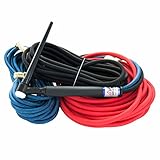
CK torch packages commonly use cable lengths around 12.5 or 25 feet. A 12.5-foot cable is easier to manage on a welding table and has less drag. A 25-foot cable is useful around a large fixture, vehicle, or fabrication bay, but the additional weight can pull on a small torch and create more loops that catch on the workpiece.
Choose the shortest length that reaches every normal welding position without stretching. For example, if the farthest joint is 9 feet from the machine, a 12.5-foot assembly may provide enough working room while avoiding the weight of a 25-foot cable. Allow extra length for routing around the fixture, but do not buy extra cable solely to avoid moving the machine.
Connection details matter as much as the torch model. Confirm the power connector, gas connection, switch or foot-control lead, and water fittings against the welder. A torch advertised as a CK17 may still require a different machine-side configuration. CK Worldwide offers components and accessories in multiple connection arrangements, so match the complete assembly rather than relying only on the series number.
Consumables and long-term ownership
CK torches generally use widely available TIG consumable formats, including collets, collet bodies, gas lenses, ceramic cups, back caps, and tungsten electrodes. The exact parts depend on the torch series and head. Smaller torches usually use smaller consumables, while higher-capacity models use larger collets and cups.
Consumable availability is one reason a CK17 or CK18 is often easier to own than an unusually compact or specialized torch. Keep several sizes of ceramic cup, spare collets, short and extended back caps, and a gas-lens setup suited to the work. Gas lenses can improve shielding coverage and visibility, but they are not a substitute for correct gas flow or a clean joint.
The first parts to wear are commonly the ceramic cup, collet, collet body, back cap, and the section of cable nearest the torch. A cracked cup can disturb shielding and should be replaced rather than wrapped or continued in service. Inspect the cable for flattened areas, cuts, exposed braid, and stiffness. Avoid coiling it tightly immediately after a hot welding session, since repeated sharp bends can shorten cable life.
A practical selection calculation
Suppose a shop welds at 140 A for six minutes at a time, with several minutes between joints. A CK17 may work for occasional jobs, but the torch is operating close to its practical limit. If the same shop performs 20-minute aluminum welds at 180 A, a water-cooled CK20 or CK24 is the more appropriate choice even if the welding machine itself can supply the current.
The decision is based on heat exposure, not only the machine’s maximum amperage. A torch rated above the intended current, with margin for duty cycle, will usually be more comfortable and last longer than a smaller torch used continuously at its limit.
Best choice by buyer profile
- Lowest-cost occasional setup: choose an air-cooled CK9 or CK17, using the smallest torch that covers the machine’s normal amperage.
- First serious general-purpose torch: choose a CK17 for straightforward access or a CK18 when position flexibility matters.
- Frequent awkward-position work: choose a flex-head CK18 or CK20 and keep the cable length as short as practical.
- High-frequency aluminum or long welds: choose a water-cooled CK20 or CK24 and budget for cooler maintenance and coolant lines.
- Heavy current without a cooler: consider an air-cooled CK26, accepting its larger handle and greater heat in the operator’s hand.
For most users, the CK17 is the sensible air-cooled starting point, while the CK18 offers the best balance when comfort and torch positioning are priorities. Move to a water-cooled CK20 or CK24 when sustained amperage, long welds, or aluminum heat make an air-cooled torch uncomfortable. Whatever the model, correct connectors, suitable consumables, sensible cable length, and regular inspection will have as much effect on ownership as the torch’s headline current rating.