Our Top Picks


What's inside
As an Amazon Associate I earn from qualifying purchases. This post may contain affiliate links at no extra cost to you.
Most guys buy the wrong impact wrench for automotive repair because they shop by advertised torque and nothing else. A tool box sticker says 1400 ft-lbs of nut-busting torque. Then it stalls on a 15-year-old rear lower control arm bolt that has been sitting in road salt since the Obama administration. The number was never a lie. It just was not measured the way you use the tool.
Here is the real problem. Automotive work is not one job. Lug nuts want 80 to 120 ft-lbs going on and maybe 300 to 500 ft-lbs coming off when some tire shop gorilla hit them with an air gun. Suspension and subframe bolts want 600 ft-lbs and up. Interior trim, brake calipers, and valve covers want almost nothing, and a big gun will snap those bolt heads clean off. Buy one tool for all three and you either bring too little or you break parts. Below is how to size the tool to the fastener, in plain numbers.
As an Amazon Associate we earn from qualifying purchases at no extra cost to you.


What we cover
Torque, Anvil Size and Material Thickness, Explained Plainly
Torque is twisting force. Ft-lbs is pounds of pull at one foot of leverage. A 250 ft-lb fastener means you would need to hang 250 pounds on the end of a one-foot bar to move it. Impact wrenches cheat by hammering, so a small tool hits harder than its size suggests.
Manufacturers publish two numbers and they are not the same thing. Fastening torque is what the tool delivers in a controlled pull, and it is the honest number. Nut-busting or breakaway torque is a peak reading on a hard joint, usually much higher. When you compare tools, compare fastening torque to fastening torque, or you are comparing nothing.
Anvil size is the square drive. In automotive work it comes down to three:
| Anvil | Typical Fastening Torque | What It Is Actually For | |
|---|---|---|---|
| 3/8 in | 150-400 ft-lbs | Brakes, calipers, valve covers, exhaust hangers, tight engine bays | |
| 1/2 in | 400-1000+ ft-lbs | Lug nuts, suspension, axle nuts, general R& | R work |
| 3/4 in and 1 in | 1000-2000+ ft-lbs | Heavy truck, trailer axles, frame and equipment work |
If you own one tool, it is a 1/2 inch. If you own two, add a 3/8 inch mid-torque, and that second tool will surprise you with how often it comes off the shelf. The 3/8 fits where the big gun does not, and it is far less likely to shear a 10 mm bolt.
Material thickness matters here the same way it does at the welding table. A bolt threaded into thick cast iron or a captive nut welded to a boxed frame rail can take punishment. A bolt threaded into 16 gauge sheet metal, a plastic-backed insert, or thin unibody stamping cannot. Same wrench, same trigger pull, and you pull the threaded insert right out of the panel. Read the joint before you pull the trigger. Thick and steel means go. Thin, aluminum, or plastic means hand tools or a torque wrench.
Air vs Cordless: Which Impact Wrench For Automotive Repair Actually Wins
Air used to win on power. It does not anymore, not at the sizes most people need. A modern brushless 1/2 inch cordless in the DeWalt XR, Milwaukee FUEL, or Makita LXT lines makes more usable torque than a mid-grade air gun running off a hobby compressor, and it does it without dragging a hose across a wet floor.
Air still wins in three places. First, duty cycle. If you are pulling wheels all day, an air gun does not overheat or run out of battery. Second, weight in tight spots, because there is no battery pack hanging off the handle. Third, cost per tool once you already own a real compressor. And that is the catch. A 1/2 inch impact wants roughly 4 to 5 CFM at 90 PSI in continuous use. A pancake compressor cannot feed it. It will pulse, drop pressure, and feel gutless, and you will blame the gun.
Cordless wins on convenience, on roadside and driveway work, and on control. Modern tools have real mode selection, not just a variable trigger. A three or four mode tool with an auto-shutoff setting for lug nuts is a legitimately useful feature, not marketing.
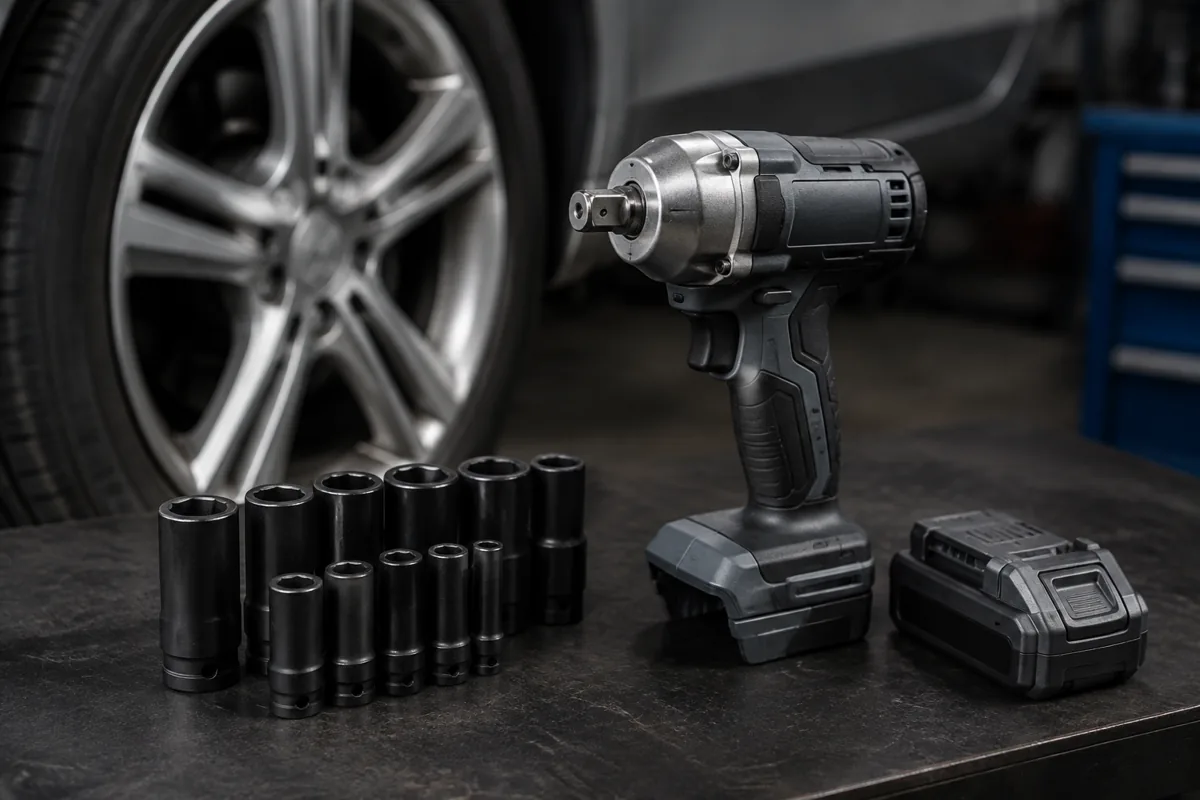
1/2 in Cordless Brushless Impact Wrench (High Torque)
This is the default choice for automotive repair. Buy into whatever battery platform you already own, prioritize a friction ring anvil for socket changes, and look for at least three power modes. Ignore any listing that only advertises breakaway torque. If the seller will not publish fastening torque, assume it is low.
What To Look For Before You Buy
Ignore the sticker on the case. Check these instead.
Fastening torque, published. For general car work, 500 to 800 ft-lbs fastening is plenty. Over 1000 and you are into truck territory and into snapped-stud territory on a passenger car.
Mode control. At minimum three power settings. Mode one should be gentle enough for a brake caliper bracket. A tool that only has full-send is a tool that will cost you a broken stud.
Anvil retention. Friction ring for fast socket swaps, detent pin for overhead and heavy work where you do not want a socket flying off. Friction ring is the better default for automotive.
Head length and weight. Measure your worst job, not your easiest. A compact high-torque head gets into subframe pockets that a full-size gun never reaches.
Battery capacity. High-torque tools pull hard amperage. Amperage is current draw, the electrical equivalent of how fast the tool drinks. A small 2.0 Ah pack will sag under load and the tool will feel weak, then get hot. Use 5.0 Ah or larger packs on high-torque tools. This is the single most common reason a good cordless impact feels disappointing out of the box.
Sockets, and this is not optional. Use black impact sockets, six point, correct size. Chrome hand sockets crack and throw shrapnel under impact. Six point grips the flats instead of the corners, which is what saves a rounded-off rusty nut.
- ✔ Cordless brushless tools now out-torque most shop air guns in the 1/2 inch class
- ✔ Mode selection prevents snapped studs on aluminum and thin steel
- ✔ No hose to drag through coolant, oil, or grinding sparks
- ✔ One battery platform covers the impact, ratchet, grinder, and light
- ✘ High-torque cordless is heavy and nose-heavy in tight engine bays
- ✘ Big batteries and chargers add real cost on top of the bare tool
- ✘ Advertised nut-busting numbers are close to meaningless for comparison
- ✘ An impact wrench never replaces a torque wrench for final assembly
Using It Safely In A Shop That Also Cuts And Welds
This is where automotive work and metal work overlap, and where people get hurt. If you are running an impact one minute and a cutoff wheel or MIG gun the next, treat the whole bay as a hot work area.
Eyes and hands. Safety glasses every time, no exceptions. Impacts throw rust scale, broken socket fragments, and undercoating chips at eye level. Wear snug gloves or none at all. Loose gloves and spinning anvils are a bad pairing. Keep sleeves buttoned and rings off.
Ears. Air impacts commonly run near or above 100 dB. Cordless is quieter but still loud enough to matter over a full day. Plugs or muffs.
Fire risk. The real hazard is not the impact, it is what you did five minutes earlier. Fuel lines, fuel tanks, brake fluid, undercoating, and grease-soaked frame rails all burn. Before you strike an arc or cut anywhere near a fuel or brake line, disconnect the battery, drain or remove the tank, and blanket the area. Keep a rated extinguisher within arm’s reach, not across the shop.
Fumes. Undercoating, seam sealer, galvanized coatings, and old primer put off genuinely nasty fume when heated. Galvanized steel in particular gives off zinc oxide fume and metal fume fever. Grind the coating off past the weld zone, run local extraction or at minimum a strong cross draft, and use a respirator rated for welding fume. An open shop door is not ventilation.
Torque control on reassembly. Run fasteners down with the impact on a low mode, then finish with a click-type or digital torque wrench to spec. Lug nuts especially. Overtightened lugs warp rotors and stretch studs, and an impact cannot hold a spec. If you must use the impact on lugs, use torque sticks and understand they are approximate.
3/8 in Mid-Torque Impact Wrench
The tool most people skip and then wish they had bought first. Short head, light in the hand, and enough torque for caliper brackets, exhaust hardware, and interior work without ripping threads out of aluminum. Pair it with a compact battery to keep the profile small.
FAQ
How much torque do I actually need for lug nuts? Most passenger cars and light trucks spec 80 to 120 ft-lbs on install. Removal is the hard part, since seized or overtightened lugs can need 300 to 500 ft-lbs. A 1/2 inch tool in the 500 to 800 ft-lb fastening range handles this with margin. Always do the final tightening with a torque wrench.
Can I use my regular chrome sockets on an impact wrench? No. Chrome sockets are hardened for steady hand-tool loads and can crack or shatter under hammering. Use impact-rated sockets, and use six point wherever a fastener is rusty or already rounded.
Do I need a separate torque wrench if I have a good impact? Yes. An impact wrench applies force, it does not measure it. Head bolts, wheel lugs, suspension fasteners, and anything with a published spec need a calibrated torque wrench on final tightening. The impact is for removal and for running fasteners down close.
Buy for the fastener, not for the sticker. One 1/2 inch high-torque cordless plus a 3/8 inch mid-torque covers nearly everything a home or small shop sees, and a torque wrench closes the loop on reassembly. Big batteries, impact sockets, glasses on, extinguisher close.
Check prices on Amazon →