What's inside
As an Amazon Associate I earn from qualifying purchases. This post may contain affiliate links at no extra cost to you.
Arc welding was invented in 1800, when Humphry Davy demonstrated an electric arc between carbon electrodes; practical shop welding followed in the 1880s, and later carbon, metal, and coated electrodes led to stick, TIG, and MIG welding.
As an Amazon Associate we earn from qualifying purchases at no extra cost to you.


What we cover
When Was Arc Welding Invented?
The first electric arc appeared in 1800, after Alessandro Volta’s invention of the voltaic pile made a sustained electric current possible. English chemist Humphry Davy used the current to strike a bright arc between carbon rods. His experiment proved the principle, but it was not yet a useful metal-joining process: the arc was difficult to control, the power source was weak by modern standards, and the exposed carbon could contaminate the work.
The next major step came in the 1880s, when inventors turned the arc from a laboratory demonstration into a practical heat source for joining metal. That development is the real beginning of arc welding as an industrial technology.
| Period | Milestone | Electrode or shielding | What it enabled |
|---|---|---|---|
| 1800 | Davy demonstrates the electric arc | Carbon electrodes, open air | Proof that an arc could create intense heat |
| 1881–1885 | Carbon-arc welding becomes practical | Separate carbon rod and workpiece | Early repair and fabrication work |
| 1888–1890s | Metal-electrode arc welding is developed | Consumable bare metal rod | Electrode metal can become part of the joint |
| 1904 | Oscar Kjellberg develops a coated electrode | Flux-coated metal rod | More stable arcs and better protection from air |
| 1920s–1930s | Manual coated-electrode welding matures | Flux-coated consumable rods | Modern stick welding, also called SMAW |
| 1941 | Inert-gas tungsten welding is demonstrated | Nonconsumable tungsten and inert gas | TIG welding for controlled, clean welds |
| 1948 | Gas-shielded consumable-wire welding is developed | Continuously fed metal wire and inert gas | Early MIG welding and higher productivity |
Carbon-Arc Welding: The First Practical Method
Auguste de Méritens is commonly credited with adapting the electric arc to practical welding in the early 1880s. His work used a carbon electrode to generate heat, with the arc directed toward the metal being joined. Nikolay Benardos and Stanisław Olszewski then developed carbon-arc welding systems during the same period, helping establish the method for industrial use.
Carbon-arc welding had an important advantage: the carbon rod could create a very hot, controllable arc without being consumed as filler. The operator could add a separate metal rod when extra material was needed. This arrangement resembles gas welding in one respect, because the heat source and filler were separate.
Its weaknesses explain why the process did not remain dominant. The carbon electrode was brittle, the open arc exposed the molten pool to oxygen and nitrogen, and the process could leave impurities in the weld. Carbon pickup could also affect certain steels. Carbon-arc equipment was useful for its time, particularly for repairs and heavy fabrication, but it required considerable operator skill.
The Move to Metal Electrodes
In 1888, Russian inventor Nikolay Slavyanov demonstrated arc welding with a consumable metal electrode. Instead of merely providing heat, the electrode melted into the joint as filler metal. This was a decisive change: the operator could create a joint and add material with one component.
Bare metal electrodes still had serious limitations. The arc was unstable compared with modern welding arcs, and the molten metal remained vulnerable to atmospheric contamination. Welders had to manage current, arc length, electrode angle, and travel speed with little help from flux or shielding gas. Porosity, cracking, and inconsistent penetration were common problems.
Even so, the consumable metal electrode established the basic concept behind today’s stick, MIG, and flux-cored processes: an electrode supplies the arc and, in many processes, becomes the weld deposit.
Why Coated Rods Changed Stick Welding
Oscar Kjellberg patented a coated electrode in 1904, a milestone often associated with the birth of modern manual metal arc welding. The coating was not simply cosmetic. As it burned, it produced shielding gases and formed a layer of slag over the cooling weld. Both helped isolate the molten metal from the atmosphere.
Electrode coatings also helped stabilize the arc, control the transfer of molten droplets, and add useful chemical ingredients to the weld. By the 1920s and 1930s, coated rods had made manual arc welding far more reliable and practical for structural steel, shipbuilding, machinery, pipelines, and field repairs.
This is the origin of what most people call stick welding. The technical name is shielded metal arc welding, or SMAW. It uses a flux-coated, consumable rod typically measuring about 230–450 mm (9–18 inches) long. Common rod diameters include 2.5, 3.2, and 4.0 mm, with typical welding currents of approximately 60–180 amps depending on rod size, position, and material.
When Was TIG Welding Invented?
TIG welding was invented in the early 1940s. Russell Meredith developed the process at Northrop Aircraft during World War II, and it was initially called Heliarc welding. The method uses a nonconsumable tungsten electrode, an inert shielding gas such as argon or helium, and optional separate filler rod.
TIG solved problems that coated electrodes could not. Because the tungsten does not normally melt into the joint and the shielding gas is supplied separately, the welder can control heat and filler addition with precision. The process became especially valuable for aluminum, stainless steel, thin sheet, aerospace components, and visible welds where low spatter matters.
Modern TIG machines commonly operate from roughly 5 to 250 amps, although the useful range depends on the machine and torch. A small inverter TIG unit may weigh around 8–15 kg, while a larger shop machine can exceed 25 kg. TIG is clean and versatile, but it is slower and demands more coordination than stick or MIG.
When Was MIG Welding Invented?
MIG welding was developed in the late 1940s, with a significant commercial breakthrough around 1948. The process grew from earlier gas-shielded metal-arc experiments and uses a continuously fed consumable wire electrode protected by an inert gas. Its technical name is gas metal arc welding, or GMAW.
Early MIG systems used inert gases and were particularly suited to aluminum and other nonferrous metals. Later developments introduced carbon-dioxide and argon-based mixtures, making gas-shielded wire welding practical for steel as well. The continuous wire removed the frequent rod changes required by stick welding and allowed higher deposition rates.
A typical hobby or light-fabrication MIG machine may use 0.6–1.0 mm wire and operate in the 90–200 amp range. Wire-feed speed, voltage, shielding-gas flow, and material thickness must be matched; simply turning up the amperage does not guarantee a sound weld.
Which Modern Arc Process Fits the Job?
| Situation | Best starting choice | Typical advantage | Main ownership drawback |
|---|---|---|---|
| Outdoor repairs or limited workspace | Stick/SMAW | No shielding-gas bottle; handles wind better | Slag removal and frequent rod changes |
| Thin steel in a home workshop | MIG/GMAW | Fast starts and continuous wire feed | Needs gas protection unless used with flux-cored wire |
| Aluminum, stainless, or visible precision work | TIG/GTAW | Fine heat and filler control, low spatter | Slow learning curve and lower productivity |
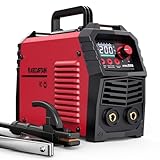
| Occasional low-cost fabrication | Small inverter stick machine | Compact equipment and inexpensive basic consumables | More skill required for thin material |
Ownership Realities: What Wears Out First?
In stick welding, the consumable electrode is the first item to disappear, while the stinger cable, work clamp, and electrode holder suffer repeated heat and flexing. Keep rods dry according to the manufacturer’s instructions; moisture-sensitive low-hydrogen electrodes can produce weld defects when stored carelessly.
MIG users regularly replace contact tips, nozzles, liners, and wire. A worn contact tip can cause erratic arc starts and inconsistent wire feeding. TIG users inspect the tungsten, ceramic cup, collet, and gas hose. Contaminated tungsten should be reground rather than repeatedly used, and grinding should be done so the marks run lengthwise along the electrode.
For every process, clean mill scale, paint, oil, and rust from the joint. Poor preparation is a common cause of porosity and lack of fusion. Also match the process to the metal thickness: a 160-amp machine may weld 6 mm steel in suitable conditions, but it is not automatically appropriate for continuous work at that thickness. Duty cycle, input power, ventilation, and protective equipment matter as much as the headline amperage.
The Short Answer
If the question is “when was arc welding invented,” the answer is 1800 for the first electric-arc experiment, the early 1880s for practical carbon-arc welding, and the late 1880s for consumable metal-electrode welding. Coated rods in the early 1900s created the foundation of stick welding; TIG followed in 1941, and MIG reached practical development around 1948. Each milestone solved a limitation of the previous method, turning an unstable open arc into the versatile family of welding processes used today.