What's inside
- What “handheld laser cutter” means in practice
- Portable metal laser options compared
- Which portable system fits your situation?
- Cut speed is not the same as useful productivity
- Shielding gas: the cost and quality decision
- Safety equipment is part of the machine
- Ownership realities: what wears first
- Bottom line
- Related Guides
- What “handheld laser cutter” means in practice
- Portable metal laser options compared
- Which portable system fits your situation?
- Cut speed is not the same as useful productivity
- Shielding gas: the cost and quality decision
- Safety equipment is part of the machine
- Ownership realities: what wears first
- Bottom line
- Related Guides
As an Amazon Associate I earn from qualifying purchases. This post may contain affiliate links at no extra cost to you.
The best handheld laser cutter for metal is usually a wheeled 1,500–3,000 W fiber-laser welding machine with a cutting mode—not a battery-powered tool—and it should be chosen by its tested cut chart, gas system, handpiece weight, and enclosure or safety controls.
As an Amazon Associate we earn from qualifying purchases at no extra cost to you.



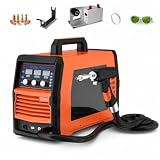
What we cover
- What “handheld laser cutter” means in practice
- Portable metal laser options compared
- Which portable system fits your situation?
- Cut speed is not the same as useful productivity
- Shielding gas: the cost and quality decision
- Safety equipment is part of the machine
- Ownership realities: what wears first
- Bottom line
- Related Guides
What “handheld laser cutter” means in practice
Most portable systems marketed as a hand held metal laser cutter are 3-in-1 fiber-laser machines. They weld, clean, and cut with interchangeable software settings and nozzles. The laser source and chiller remain in a cabinet, while the operator moves a connected handpiece across the workpiece.
These machines are portable around a workshop, but they are not cordless. A typical unit needs single-phase or three-phase mains power, compressed shielding gas, ventilation, and a controlled laser area. For occasional cutting of thin stainless or mild-steel sheet, a 1,000–1,500 W system may be adequate. Regular cutting, thicker plate, or faster production favors 2,000–3,000 W equipment with a proper CNC fiber cutter instead of a manually guided handpiece.
Portable metal laser options compared
| System type | Typical rated cutting range | Approximate cutting speed | Handpiece weight | Shielding gas | Best use |
|---|---|---|---|---|---|
| 1,000 W 3-in-1 fiber handheld | Carbon steel 0.5–4 mm; stainless 0.5–3 mm | About 20–1,000 mm/min, depending on material and thickness | 0.7–1.0 kg | Nitrogen or argon; roughly 10–20 L/min | Repair work, prototypes, thin sheet, light fabrication |
| 1,500 W 3-in-1 fiber handheld | Carbon steel up to about 6 mm; stainless up to about 5 mm | About 20–1,500 mm/min | 0.8–1.2 kg | Nitrogen or oxygen selected by material; roughly 12–25 L/min | General workshop cutting and welding |
| 2,000 W 3-in-1 fiber handheld | Carbon steel up to about 8 mm; stainless up to about 6 mm | About 20–2,000 mm/min | 0.9–1.3 kg | Nitrogen, oxygen, or argon; roughly 15–30 L/min | Frequent fabrication and thicker sheet |
| 3,000 W handheld-capable fiber system | Carbon steel up to about 10–12 mm in favorable settings; thinner stainless for clean edges | About 20–3,000 mm/min | 1.0–1.5 kg | Gas choice is critical; often 20–35 L/min | High-output work where portability still matters |
| Desktop or enclosed CNC fiber cutter | Commonly 1–20 mm, depending on laser power and machine design | Often 1,000–6,000 mm/min on thin sheet | Not hand-guided | Nitrogen, oxygen, or air with regulated pressure | Repeatable profiles, production cutting, safer unattended positioning |
These are practical market ranges rather than universal guarantees. A manufacturer’s maximum thickness may assume a new protective lens, ideal gas purity, slow travel, and a particular grade of steel. Ask for a cutting chart showing your exact alloy, thickness, nozzle, gas, pressure, and speed before treating a headline number as a buying specification.
Which portable system fits your situation?
- Occasional repairs and thin sheet: Choose a 1,000–1,500 W 3-in-1 fiber system if most work is below 3–4 mm. It costs less, draws less power, and is easier to handle.
- A general fabrication shop: A 1,500–2,000 W unit is the more balanced choice for stainless and mild steel from roughly 1–6 mm. Confirm that the supplied handpiece has a comfortable trigger, strain relief, and replaceable protective windows.
- Frequent cutting or thicker plate: Select 2,000–3,000 W only if the electrical supply, gas delivery, extraction, and safety enclosure can support it. If most jobs are flat profiles, a CNC fiber cutter will usually produce straighter, more repeatable results.
- Very limited space: Measure the complete footprint, including gas cylinders, door clearance, chiller ventilation, and cable bend radius. “Portable” normally means casters, not a machine that fits on a bench.
- Low operator experience: Favor a system with keyed enable control, interlocked enclosure compatibility, clear fault messages, and supplier training. Manual cutting has a short learning curve for starting an arc, but a long one for producing consistent edges.
Cut speed is not the same as useful productivity
A machine may advertise a high speed on 1 mm stainless while requiring multiple passes or leaving heavy dross on thicker material. Hand-guided cutting also loses time to marking, clamping, repositioning, and correcting a wandering line.
For example, a 1,500 W system cutting a 1 m perimeter at 800 mm/min has a theoretical laser-on time of 1.25 minutes. Add piercing, starting and stopping, repositioning, and cleanup, and a realistic job may take 3–5 minutes. If the same part is produced repeatedly, a CNC machine can recover its higher purchase cost through repeatability and reduced finishing, even if its nominal laser speed is similar.
Shielding gas: the cost and quality decision
Gas protects the molten cut from oxidation and pushes debris away from the kerf. Nitrogen generally gives bright edges on stainless steel and aluminum, while oxygen can increase cutting speed in mild steel but leaves an oxidized edge. Argon is common for welding and some sensitive materials, but it is often more expensive for routine sheet cutting.
At 20 L/min, a 10,000-litre compressed-gas cylinder contains approximately 500 minutes of gas before accounting for pressure-regulator losses and unusable residual pressure. A two-hour cutting session at that flow consumes about 2,400 litres, so cylinder logistics can matter more than the advertised laser power. Test the regulator, hose, fittings, and gas purity; unstable flow produces inconsistent kerfs and spatter.
Safety equipment is part of the machine
Industrial cutting fiber lasers are commonly Class 4 laser systems. The invisible infrared beam can cause permanent eye injury and can ignite materials. A handheld head also creates a risk of reflected radiation from shiny stainless steel, aluminum, and copper.
- Use a certified laser-controlled enclosure or designated laser area with access control and appropriate interlocks.
- Wear laser eyewear matched to the laser wavelength and optical density specified by the equipment manufacturer; ordinary safety glasses are not sufficient.
- Use suitable flame-resistant clothing, gloves, protective footwear, and hearing protection where required.
- Provide fume extraction designed for metal-laser work. Stainless steel and coated materials can produce hazardous fumes.
- Keep combustibles, reflective scrap, and loose flammable dust away from the cutting zone, and provide suitable fire equipment.
- Use a keyed start, emergency stop, beam-enable control, and an independent safety procedure. Do not bypass interlocks.
Check local occupational-safety and electrical requirements before installation. A machine advertised as “portable” does not remove the need for a controlled laser workspace.
Ownership realities: what wears first
The protective window in the cutting or welding head is usually the first inexpensive consumable to degrade. Smoke, spatter, dirty gas, incorrect stand-off distance, and touching the window with bare fingers can cause cloudy spots and power loss. Keep spare windows, nozzles, ceramic rings, and focusing lenses available, and clean only according to the manufacturer’s procedure.
Nozzles become damaged by collisions or misalignment. A slightly bent nozzle can make the beam appear weak even when the laser source is healthy. Check nozzle concentricity after a crash, keep the workpiece flat, and avoid dragging the head through slag.
Chillers require clean water or approved coolant, correct level, and adequate airflow. Dust buildup in the cabinet can shorten fan and electronics life. Fiber cables should never be sharply bent or trapped under the machine. Keep a log of operating hours, lens changes, coolant checks, and gas problems; it makes intermittent faults much easier to diagnose.
Bottom line
For most small workshops, a 1,500 W handheld laser cutter for metal is the sensible starting point: it can handle common stainless and mild-steel sheet, remains manageable to operate, and avoids paying for power that thin material cannot use. Move to 2,000–3,000 W when thickness and production volume justify the electrical, gas, extraction, and safety requirements. If accurate repeated profiles matter more than reaching awkward repair locations, choose an enclosed CNC fiber cutter instead of a hand-guided system.