What's inside
As an Amazon Associate I earn from qualifying purchases. This post may contain affiliate links at no extra cost to you.
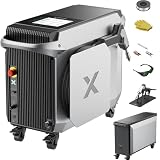
For most small fabrication shops in 2026, a 1500W handheld laser welder is the right entry point: it reliably welds stainless to about 3 mm and aluminum to about 2 mm in a single pass, while 2000W–3000W machines are only worth the added cost and cooling burden if you routinely weld aluminum over 3 mm or run long continuous seams.
As an Amazon Associate we earn from qualifying purchases at no extra cost to you.


What we cover
What 1500W Actually Welds (and What It Doesn’t)
Manufacturer brochures list “max thickness” numbers that assume multi-pass technique and perfect joint fit-up. The single-pass penetration numbers below reflect what continuous-wave fiber units typically deliver on clean, tight butt joints:
| Rated Power | Stainless (single pass) | Mild Steel | Aluminum | Typical Price Range |
|---|---|---|---|---|
| 1000W | 2 mm | 2.5 mm | 1 mm | $2,000–$3,500 |
| 1500W | 3 mm | 4 mm | 2 mm | $3,500–$6,000 |
| 2000W | 4 mm | 5 mm | 3 mm | $5,000–$8,000 |
| 3000W | 5–6 mm | 7 mm | 4 mm | $8,000–$14,000 |
Aluminum is the limiter. Its reflectivity and thermal conductivity mean a 1500W unit that breezes through 3 mm stainless struggles to fuse 2.5 mm aluminum cleanly. If your workload is aluminum enclosures or marine fittings above 3 mm, budget for 2000W minimum — or accept multi-pass welds with preheat.
Air-Cooled vs. Water-Cooled: The Duty Cycle Reality
This is the spec most buyers overlook. Air-cooled handheld units (common at 800W–1500W) are lighter — often 15–20 kg total versus 60+ kg for water-cooled systems — but their duty limits are real:
- Air-cooled: typically 30–60 seconds of welding, then a rest period; best for tacking, repair work, and short seams. Effective duty cycle often lands around 20–40%.
- Water-cooled: near-continuous welding (80–100% duty cycle), but you maintain a chiller or built-in radiator, replace coolant annually, and can’t operate in freezing shops without antifreeze-rated coolant.
A practical example: welding a 300 mm seam at typical handheld travel speed takes roughly 20–30 seconds. On an air-cooled 1500W unit, you get one or two of those per minute. On a water-cooled unit, you weld until the wire feeder runs out.
Pick by Situation
| Your Situation | Recommended Setup | Why |
|---|---|---|
| Mobile repair, railings, on-site work | Air-cooled 1200–1500W | One-person carry, runs on standard 220V, short welds anyway |
| Small shop, mostly stainless sheet ≤3 mm | Water-cooled 1500W (e.g., IPG LightWELD 1500-class, or Raycus/JPT-source equivalents) | Full duty cycle, best cost-to-capability balance |
| Aluminum production, 3 mm+ | Water-cooled 2000–3000W | Single-pass penetration; 1500W will frustrate you |
| Hobbyist, occasional welding | Air-cooled 1000–1500W | Lowest cost and storage footprint; duty limits rarely matter |
| Replacing TIG on cosmetic work | 1500W with wobble head and wire feed | Clean seams, minimal finishing, easier learning curve than TIG |
Safety Gear a Small Shop Actually Needs
Handheld laser welders are Class 4 lasers. Unlike TIG, the hazard isn’t just the arc — it’s specular reflections that can damage eyes across the room. Minimum kit:
- Laser safety glasses rated OD 6+ at 1060–1080 nm — the fiber laser wavelength, not welding shade numbers. Standard welding helmets don’t block it unless fitted with a rated laser lens.
- A welding helmet with a laser-rated filter (several manufacturers now ship helmets with OD-rated windows; verify the rating is marked).
- A designated laser-controlled area: welding curtains rated for IR, matte (non-reflective) surroundings, and a door interlock or warning light. Polished stainless sheets reflect the beam like mirrors.
- Fume extraction: laser welding produces fine metal particulate; a fume extractor or good source-capture ventilation is mandatory indoors.
- Standard welding PPE: FR jacket, gloves, no exposed skin — UV and spatter still apply.
Ownership Realities Nobody Mentions in Listings
- Nozzle tips and protective lenses are consumables. Copper nozzles ($5–$20 each) wear or spatter-foul; protective cover lenses ($10–$30) get pitted. Budget $300–$600/year in consumables for regular use.
- Shielding gas matters. Argon is standard; nitrogen works for stainless at lower cost. Flow around 15–20 L/min. Gas cost often exceeds consumable cost.
- Wire feed isn’t optional for gaps. Autogenous (no-wire) welding only works on tight joints under ~0.2 mm mismatch. A wire feeder handles real-world fit-up.
- The fiber cable is fragile. Kink or crush the umbilical and you’re facing a four-figure repair. Route it away from floor traffic.
- Learning curve is real but short. Most TIG-capable welders produce acceptable laser welds within a few days; consistent cosmetic work takes a few weeks of practice.
Frequently Asked Questions
Can a 1500W laser welder replace a TIG machine?
For sheet metal under 3 mm in a shop setting, mostly yes — it’s faster and produces a smaller heat-affected zone. For heavy sections, pipe, or positions where a handheld gun can’t reach, TIG and MIG still win.
Do I need 220V power?
Most 1500W units run on 220–240V single-phase; 3000W machines typically want three-phase or a dedicated high-amperage circuit. Check your shop’s panel before buying.
Is laser welding safe to learn without formal training?
Technically yes, but the invisible beam hazard makes training strongly recommended — many suppliers and community colleges now offer short certification courses covering beam safety and technique.