What's inside
As an Amazon Associate I earn from qualifying purchases. This post may contain affiliate links at no extra cost to you.
The best spot welder for most buyers in 2026 is a handheld capacitor-discharge unit rated around 100–150 joules if you’re building 18650 battery packs, and a bench unit with tongs and 200+ joules if you’re joining 0.8mm or thicker mild steel. The dividing line isn’t price — it’s what the electrodes can physically fuse, and choosing wrong means welds that pull apart or money spent on capacity you never use.
As an Amazon Associate we earn from qualifying purchases at no extra cost to you.


What we cover
The Two Categories of Spot Welder (and Why They Don’t Overlap)
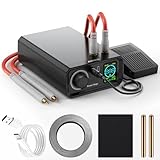
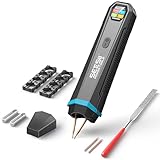
Handheld pen-style welders exist for one job: welding thin nickel strip (0.1–0.2mm) onto cylindrical cells without cooking the battery internals. They fire extremely short pulses — often under 50ms — so heat stays at the weld nugget instead of soaking into the cell. A welder that works great on sheet metal will damage an 18650 cell, and a tab welder can’t touch steel at all. Bench and tong units run longer, higher-energy pulses for structural sheet metal work: automotive panels, enclosures, brackets.
Joule output is the spec that matters most. Rough guidance:
- Under 100 J: nickel strip up to ~0.12mm, light hobby pack-building
- 100–200 J: nickel up to 0.2mm, nickel-plated steel strip, occasional copper-nickel sandwich tabs
- 200 J and above (bench units): mild steel 0.6–1.2mm, stainless sheet, automotive repair
Picks by Situation
Battery tab welding: the handheld field
For occasional pack builds, compact capacitor welders in the $40–80 range handle 0.1mm nickel comfortably but struggle past 0.15mm — fine for a hobby e-bike pack, frustrating at scale. Mid-range handhelds ($80–150) with adjustable pulse energy and dual-pulse output reach 0.2mm nickel reliably, which is the strip thickness most DIY powerwall and scooter packs actually need. Dual pulse matters: a short first pulse breaks surface oxides and seats the electrode, the main pulse makes the nugget. Single-pulse units produce more inconsistent welds on plated strip.
If you’re building packs weekly, look at foot-pedal units driven by a car battery or LiPo pack rather than self-contained capacitors — consistent output across hundreds of welds per session, and cheaper consumables.
Sheet metal and automotive: bench units
Tong-style bench welders in the $150–400 range are the entry point for bodywork: they clamp two sheets and fire, typically fusing 0.6–1.0mm mild steel pairs. For thicker material or production-like repetition, transformer-based units with adjustable weld time and electrode pressure handle up to ~1.2mm+ per side. What separates a good bench unit from a cheap one isn’t peak power — it’s repeatable pressure and adjustable timing, because pressure consistency determines nugget size as much as current does.
Spec Comparison: What the Numbers Actually Mean
| Type | Typical energy | Max nickel strip | Max mild steel (pair) | Pulse control | Price range (2026) |
|---|---|---|---|---|---|
| Budget handheld (self-contained capacitor) | ~50–100 J | 0.12–0.15mm | None | Fixed or few levels, single pulse | $40–80 |
| Mid-range handheld, dual pulse | 100–200 J | 0.2mm | None | Adjustable energy, dual pulse | $80–150 |
| Battery-powered pedal unit | 150–300 J | 0.2mm + Cu-Ni sandwich | Thin shim only | Adjustable timing, very consistent | $100–250 + donor battery |
| Bench tong welder | 1.5–3.5 kVA class | Overkill — damages cells | 0.6–1.0mm + 0.6–1.0mm | Timer dial, adjustable pressure | $150–400 |
| Transformer bench unit | 4+ kVA class | Overkill | 1.2mm + 1.2mm and up | Timer + pressure + throat depth options | $400–900 |
Decision Matrix
| Your situation | Recommended type |
|---|---|
| One or two battery packs a year, 0.15mm nickel | Budget handheld |
| Regular pack builds, 0.2mm nickel or nickel-plated steel | Dual-pulse handheld or pedal unit |
| High-volume building, all-day sessions | Pedal unit off a car battery — no capacitor recharge lag |
| Occasional car panel or bracket repair | Bench tong welder |
| Regular fabrication on 1mm+ steel | Transformer bench unit with deep throat |
| Both batteries AND sheet metal | You need two machines — no single unit spans both safely |
Electrode Life and Ownership Realities
The consumable nobody mentions in listings is the electrode tips. On handheld tab welders, copper pen tips mushroom and pit; expect to dress them with a file every 200–500 welds and replace them every few thousand. Cheap units ship with soft copper that degrades in a few hundred welds — spares are $5–15, so factor that in rather than judging by machine price alone. On bench tong welders, electrode caps are a standard consumable; a unit using common cap sizes will be far cheaper to run than one with proprietary tips.
What wears first elsewhere: self-contained capacitor units lose punch as their internal battery or capacitors age — a unit that welded 0.15mm nickel new may only manage 0.12mm after a year of hard use. Bench units mostly fail at the trigger contactor and tong pivot points, both fixable.
Setup Mistakes That Cause Weak Welds
- Dirty surfaces: nickel strip and cells must be clean; wipe with isopropyl and use fresh strip. Oxidized strip is the #1 cause of welds that peel off.
- Too little pressure on handheld pens: press firmly until the pulse fires — a light touch gives sparks and surface burns instead of a fused nugget.
- Chasing one big pulse instead of dual pulse: cranking energy to max blows holes through 0.1mm strip. Two moderate welds beat one violent one.
- Pull-test everything: a good nickel weld tears a small piece of strip away rather than peeling clean. Peel = increase energy or pressure, not strip quality complaints.
- Never weld directly on the cell’s positive terminal cap area on some cells without checking: keep welds on the flat negative can bottom or use proper tab placement to avoid internal shorts.
FAQ
Can a handheld battery spot welder do thin sheet metal in a pinch?
No — the pulse duration is too short. Even 0.3mm steel sheet won’t fuse properly; you’ll get surface marks at best.
Is pure nickel or nickel-plated steel strip easier to weld?
Plated steel welds easier (steel has higher resistance, heats faster) but carries more resistance in the pack. If you need plated steel for cost reasons, you’ll want a dual-pulse unit to do it reliably.
How much nickel thickness do I actually need?
For packs under ~30A continuous, 0.15mm pure nickel is fine with parallel paths. Above that, 0.2mm or copper-nickel sandwich — which pushes you into mid-range welder territory anyway.