What's inside
As an Amazon Associate I earn from qualifying purchases. This post may contain affiliate links at no extra cost to you.
What we cover
Best Portable Multiprocess Welders for On-Site Work
The best portable multiprocess welder for on-site work is the Miller Multimatic 215 if you need a relatively light, self-contained machine with a proper carrying case; choose the ESAB Rebel EMP 205ic AC/DC when aluminum TIG and broader process capability matter more than weight, or the Lincoln Electric POWER MIG 215 MPi when you want a more capable shop-to-site unit and can manage its heavier package. For regular field use, compare the complete carry load and power source—not just the welder’s headline weight.
Portable enough for the job? Compare the machines
Weights below are approximate manufacturer-published machine weights, not the weight of a cylinder, leads, spool gun, or filled case. Specifications and included accessories can vary by market and package, so confirm the exact configuration before buying.
As an Amazon Associate we earn from qualifying purchases at no extra cost to you.

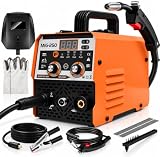

| Welder | Approx. machine weight | Processes | Input power | What that means on site |
|---|---|---|---|---|
| Miller Multimatic 215 | About 56 lb (25.4 kg) | MIG, flux-cored, DC TIG, stick | 120/240 V | One-person carry is possible for many users; a dual-voltage supply helps when outlets vary. |
| ESAB Rebel EMP 205ic AC/DC | About 49 lb (22.2 kg) | MIG, flux-cored, stick, DC TIG, AC TIG | 120/230 V | Relatively light for its process range; check the TIG torch and other accessories in the specific package. |
| Lincoln Electric POWER MIG 215 MPi | About 41 lb (18.6 kg) | MIG, flux-cored, stick, DC TIG | 120/230 V | Low machine weight is attractive, but the complete setup still needs leads, a suitable feeder configuration, and gas gear where required. |
| Everlast PowerMTS 211Si | About 48 lb (21.8 kg) | MIG, flux-cored, stick, DC TIG | 120/240 V | A compact dual-voltage option; verify the supplied torch, adapters, and local service arrangements. |
These are not identical packages or direct performance equivalents. Duty cycle, output, and included equipment vary; compare the relevant manufacturer data for your process and material thickness. A 120 V outlet is convenient, but it does not provide the same welding output as a suitable 240 V circuit. A dual-voltage label is flexibility, not a promise of full output on either supply.
Choose by the worksite, not the feature count
For service calls and frequent carrying: Miller Multimatic 215
The Multimatic 215 is a strong fit when the machine regularly moves between a truck, driveway, and repair location. Its 120/240 V capability helps with mixed power availability, and its process selection covers common repair work. Miller offers a protective case and cart options, but those add bulk and cost; check whether the package you are considering includes them. If you climb ladders or carry gear over rough ground, a machine handle alone is not a complete transport plan.
For aluminum TIG and varied precision work: ESAB Rebel EMP 205ic AC/DC
Choose the Rebel when AC TIG is a real requirement, especially for aluminum, rather than a feature you might use someday. It combines that capability with MIG, flux-cored, stick, and DC TIG, while keeping machine weight around 49 lb. The trade-off is a more involved loadout: TIG torch, shielding gas, regulator, and suitable tungsten and filler may be needed. Its carrying arrangement and protective enclosure make sense for mobile work, but confirm the exact package and accessories before budgeting.
For a lighter shop-to-site machine: Lincoln Electric POWER MIG 215 MPi
At roughly 41 lb, the Lincoln is appealing when weight is the first constraint and you want multiple processes in a compact unit. Think of it as a portable machine that can move between work areas—not as a complete grab-and-go welding kit. Add the weight of the leads, gun, gas bottle, and any separate case or cart before deciding it is easier to transport than a heavier machine with better-integrated carrying options.
For value and dual-voltage flexibility: Everlast PowerMTS 211Si
The PowerMTS 211Si is worth considering when its process mix and input flexibility suit the work, and its purchase price leaves room for the accessories you actually need. For remote jobs, weigh support and consumable availability alongside initial cost. A low machine price is less useful if a damaged torch or proprietary part keeps the welder out of service.
Generator compatibility: check the numbers before loading up
Generator operation depends on the welder’s input requirements, the generator’s continuous output, the selected process and settings, and the quality of its power. “Works with a generator” is not enough to size a supply. Use the manufacturer’s generator guidance and input specifications for the exact model; do not infer a safe generator size from the machine’s maximum welding output.
- Check continuous capacity, not just peak watts. Starting surges and other tools sharing the generator can reduce the power available to the welder.
- Match the voltage and connection. A 240 V-capable welder needs a generator outlet and circuit appropriate to its input requirements. Use correctly rated cords and avoid undersized extensions.
- Allow headroom. A generator operating near its limit may cause voltage drops, nuisance shutdowns, or unstable performance. Follow the welder manufacturer’s guidance on generator type and minimum capacity.
- Plan for the actual process. High-output stick or MIG work can demand more input than light tacking. If you will weld thick material, verify the intended operating point before choosing the generator.
If the manufacturer does not publish a clear generator recommendation, ask its technical support rather than relying on a generic wattage rule. Generator compatibility is model- and setup-specific.
Budget for the field-ready package
A machine’s published weight understates what a crew carries. For gas-shielded MIG, the load may include a cylinder, regulator, gun, work clamp, leads, wire, and PPE. Stick avoids shielding-gas equipment and is often the simpler choice for remote repairs, though it still needs suitable electrodes, a holder, and leads. TIG brings a torch, gas, and more small consumables to protect from dirt and loss.
Before buying, make a short loadout list and weigh the packed kit. A 45-pound welder can become a much heavier single carry once accessories are added. A cart is useful on flat ground; a shoulder strap or compact case may be better for steps and uneven terrain. Confirm that the proposed case protects the controls and connectors, not only the outer shell.
- Carry a spare contact tip, nozzle, and wire-drive consumables that match the gun and wire size.
- Keep welding wire dry and sealed; moisture and dirt can contribute to feed problems and poor weld quality.
- Bring a correctly rated extension cord only when needed, and keep connections protected from water and physical damage.
- Pack a wire brush, pliers, and a small cleaning kit. Debris in the feed path and worn tips are common causes of frustrating field interruptions.
- For TIG, protect tungsten and filler rod from contamination, and secure the gas cylinder upright during transport and use.
A practical decision rule
Choose the Multimatic 215 for frequent general repairs when a supported carrying setup and dual-voltage flexibility are priorities. Choose the Rebel EMP 205ic AC/DC when AC TIG is essential and you can carry its more specialized accessories. Choose the POWER MIG 215 MPi when low machine weight and a broad process mix matter, but compare its full package weight with the other options. Consider the Everlast when value is central and you have checked service, parts, and accessory needs in your region.
For occasional work close to a garage, nearly any of these can be portable enough. For repeated carry-ins, the best portable multiprocess welder is the one whose complete load you can move safely, whose input supply matches the site, and whose included or readily available accessories cover the process you will actually use.