
Our Top Picks


What's inside
As an Amazon Associate I earn from qualifying purchases. This post may contain affiliate links at no extra cost to you.
A repair shop that only has one voltage is a shop that turns work away. The bench may have a 240-volt circuit, but the customer’s barn, the plant room and the far end of the yard usually do not, and the welder that cannot run from a standard outlet stays behind while the job goes to someone else. Dual-voltage MIG welders solve that split: full output where the heavy circuit exists, and a reduced but genuinely useful output everywhere else.
This guide is for equipment repair shops, mobile welding services, farm and fleet maintenance crews, and fabrication shops that take repair calls off site. The machines below were chosen from the names and specifications shown on their Amazon product pages, including input voltage, output range, wire capability and the accessories each listing includes.
What we cover
Quick Picks
As an Amazon Associate we earn from qualifying purchases
| Product | Best for | Key spec from title |
|---|---|---|
| Lincoln Electric Power MIG 211i | A portable dual-voltage MIG for shop and site repair | 211A dual-voltage MIG welder, 120/230V |
| Miller Millermatic 211 PRO | A professional dual-voltage MIG with Auto-Set | Dual-voltage MIG welder with Auto-Set |
| YESWELDER MIG-205DS PRO | A five-process dual-voltage MIG on a modest outlay | 200A dual-voltage MIG welder, 5 in 1 |
| Weldpro 200A MIG Welder | A compact dual-voltage MIG with spot timer | 200A MIG welder, 110V/220V, flux-core MIG |
How to Choose
Compare the output on each voltage, side by side
The headline amperage on a dual-voltage MIG is almost always the 240-volt figure, and the 120-volt figure is the one that decides what the machine can do away from the shop. A 211-amp machine may deliver around 140 amps on a household outlet, which still covers sheet metal, brackets and light frames, but it will not run a heavy single-pass weld on thick plate. Before ordering, find both numbers in the listing and check them against the thickest material you expect to repair off site. If only one output is stated, assume the lower-voltage figure is well below the headline.
Check the plug, adapter and breaker together
Dual-voltage machines ship with different plug arrangements, and the difference matters on the first field job. Some include an adapter that lets the machine plug into a standard household outlet, others expect a separate adapter, and a few ship with a plug that fits neither outlet in the building. Read the listing for the plug and adapter, then check the input current at each voltage against the breakers available. A machine that trips a 15-amp circuit every few minutes is worse than a smaller machine that runs steadily on the same supply.
Decide how much automation helps your crew
Synergic and Auto-Set controls choose wire speed and voltage from a material and thickness setting, which speeds up changeovers and helps a less experienced technician produce a sound weld. Manual controls give a skilled welder finer command over the arc, especially on worn or contaminated repair metal where the preset is only a starting point. A shop with one experienced welder may prefer manual dials, while a crew of mixed experience benefits from a machine that can set itself up and still allow manual adjustment when the joint demands it.
Weigh portability against duty cycle
Dual-voltage MIG welders for repair work range from compact inverter units near 35 pounds to heavier transformer machines, and the weight decides whether the machine actually travels. A light machine that a technician carries one-handed gets used on site; a heavy one stays on the bench and the site job goes unwelded. Against that, check the duty cycle at the amperage the shop welds at most: a portable machine with a short duty cycle forces cooling breaks on long seams. The right balance is a machine light enough to carry and strong enough to finish a repair without constant pauses.
The 4 Best Options
Lincoln Electric Power MIG 211i
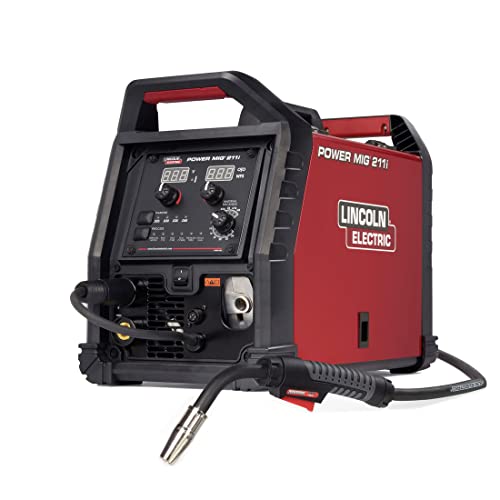
The Lincoln Electric Power MIG 211i suits a repair shop that needs one MIG welder for the bench and the truck, because it pairs 211 amps of dual-voltage output with a 41-pound inverter body that one person can carry. Its three-step setup asks for process, wire diameter and material thickness, then sets the machine, which keeps changeovers short when jobs queue up. Flux-cored capability covers outdoor work where gas would blow away, and the spool-gun option leaves aluminium open for later. For a shop that repairs trailers, gates and equipment in more than one location, it is a strong, proven all-rounder.
Specs
- 211A maximum output
- 120V and 230V dual-voltage input
- 20 to 211 amp output range
- MIG and flux-cored welding
- Spool gun capable
- 41 lb machine weight
- 30 percent duty cycle at 175A
- Model K6080-1
Best for: Portable dual-voltage MIG repair in the shop and on site.
Watch out for: Confirm the adapter for a standard household outlet is included in the listing, and check the gas regulator before the first gas MIG job.
ASIN: B0BJ2PYHN9
Miller Millermatic 211 PRO
The Miller Millermatic 211 PRO fits a repair shop that wants professional-grade controls in a dual-voltage machine, because its Auto-Set feature, Dyna-Pulse capability and colour LCD panel take much of the guesswork out of setup while still allowing manual fine-tuning. Its 15-foot MIG gun reaches around large equipment without moving the machine, and spool-gun detection makes aluminium work straightforward when that job arrives. The USB port allows software updates, so the machine can gain features rather than going out of date. It is the most advanced machine in this guide, and the one to choose when setup speed and weld quality matter most.
Specs
- Dual-voltage 120/240V input
- Auto-Set and Dyna-Pulse features
- Flux-core and gas MIG welding
- Spool gun detection
- 15 ft MIG gun
- USB-enabled software updates
- Part number 907839
Best for: Shops that want fast, repeatable setup with professional controls.
Watch out for: Confirm the gas cylinder and regulator are arranged separately, and check that the shop’s 240-volt outlet matches the machine’s plug.
ASIN: B0FFWV5DJG
YESWELDER MIG-205DS PRO
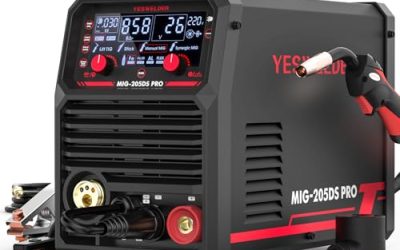
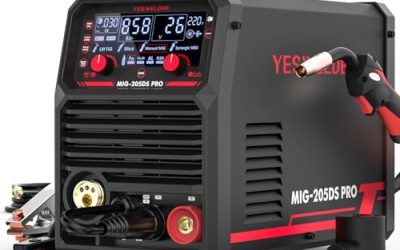
The YESWELDER MIG-205DS PRO suits a repair shop that wants five processes from one dual-voltage machine without a large outlay. Gas MIG handles clean indoor steel, flux-core covers outdoor work, spool-gun MIG opens up aluminium, and lift TIG and stick cover the jobs that arrive alongside the main repair. Its 200-amp output and dual-voltage input cover brackets, frames and panels, while the synergic MIG mode sets wire speed and voltage together for quicker changeovers. For a small shop that cannot justify a separate machine for each process, it packs a lot of capability into one case.
Specs
- 200A maximum output
- 110V and 220V dual-voltage input
- Gas MIG, flux-core MIG, spool-gun MIG, lift TIG and stick
- Synergic and manual MIG modes
- 30 to 205 amp output range at 220V
- 60 percent duty cycle at 140 amps
- Spool gun compatible
Best for: Small shops that want five processes in one dual-voltage machine.
Watch out for: The spool gun and lift TIG torch are separate purchases, so check the listing contents and budget for them if those processes are needed.
ASIN: B07TVCWDGW
Weldpro 200A MIG Welder

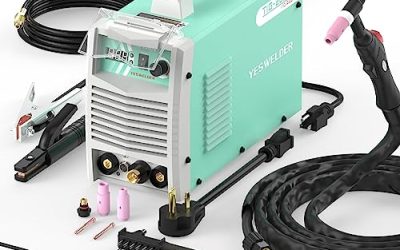
The Weldpro 200A MIG Welder fits a repair shop that needs a compact dual-voltage MIG with a few genuinely useful extras, including a spot timer for repeatable tack welds on panels and frames. Its 200-amp output and 110/220-volt input cover light and medium steel repair, while the five-process design adds MMA, TIG and stick capability for jobs that fall outside MIG. The IGBT inverter keeps the case compact enough to carry, and spool-gun compatibility leaves aluminium open as an option. It is a practical choice for a shop that wants a second machine or a mobile unit without a large spend.
Specs
- 200A maximum output
- 110V and 220V dual-voltage input
- Flux-core MIG, MMA, TIG and stick welding
- Spot timer
- IGBT inverter design
- Spool gun compatible
Best for: Compact dual-voltage MIG work with a spot timer for tack welding.
Watch out for: Confirm the gas regulator and hose are in the listed bundle, since gas MIG setup parts are the most commonly missing items.
ASIN: B08JD27ZGR
Which One Fits Your Situation
You split time between the bench and customer sites
Choose the Lincoln Electric Power MIG 211i. At 41 pounds with dual-voltage input and a simple three-step setup, it travels well and still delivers 211 amps back at the shop. Its flux-core capability covers outdoor repair, and the spool-gun option keeps aluminium on the table for later.
Setup speed and arc control matter most
Choose the Miller Millermatic 211 PRO. Auto-Set and Dyna-Pulse shorten setup on varied repair jobs, the 15-foot gun reaches around large equipment, and the USB updates keep the machine current. Arrange the gas cylinder and regulator separately, and confirm the 240-volt plug fits the shop outlet.
One machine must cover five processes
Choose the YESWELDER MIG-205DS PRO. Gas MIG, flux-core, spool-gun MIG, lift TIG and stick in one dual-voltage case cover almost any repair that arrives, and the synergic mode speeds up changeovers. Budget separately for the spool gun and TIG torch if those processes are needed.
You need a compact second machine for the van
Choose the Weldpro 200A MIG Welder. Its compact inverter case, dual-voltage input and spot timer suit mobile repair and tack work, and the five-process design handles the odd jobs that follow the main repair. Check the gas setup parts in the listing before ordering.
Common Mistakes
- Expecting full output on a household outlet and then struggling with heavy joints on a 120-volt circuit.
- Buying a dual-voltage machine without the adapter for a standard outlet, then finding it cannot plug in on site.
- Choosing a machine for its peak amperage while ignoring the duty cycle at the amperage actually used.
- Welding outdoors with shielding gas and getting porous beads when wind strips the gas from the joint.
- Leaving the gas cylinder unsecured in the van or the shop, where a fall can damage the valve and create a hazard.
Frequently Asked Questions
What is a dual-voltage MIG welder?
It is a MIG welder that accepts two input voltages, usually 120 volts and 240 volts, and adjusts its maximum output to suit. On the lower voltage it still welds thin and medium material, while the higher voltage unlocks full output for thicker sections. Check the listing for the output at each voltage.
Can I run a dual-voltage MIG welder from a normal outlet?
Yes, for light and medium work, provided the circuit can supply the input current the listing states. A 20-amp circuit is often needed for full low-voltage output. Heavy work needs the 240-volt circuit, so check the breaker and the plug adapter before taking the machine on site.
Is a dual-voltage MIG welder good for aluminium?
It can be, if it is spool-gun capable or spool-gun ready and the right wire and shielding gas are used. Aluminium wire feeds poorly through a long MIG gun liner, so a spool gun keeps the feed short and reliable. Check the listing for spool-gun compatibility before ordering for aluminium work.
Does a dual-voltage MIG welder need gas?
Gas-shielded MIG needs a shielding gas cylinder and regulator for clean indoor welds, but most dual-voltage MIG welders also run flux-core wire, which shields itself and suits outdoor work. Choose the wire and gas to match the job, and follow the machine’s polarity instructions when switching between them.
Related guides
More from Amazon
Programs that pair well with the guide above. Offers and eligibility are set by Amazon and may change.
A free business account with business pricing and bulk-buying tools for work, shop or home office.
Create a business accountFree shipping on eligible items, Prime Video and more. Eligible new members can start with a free trial.
Start a Prime free trialAudiobooks and podcasts to listen to on the go. Eligible new members can start with a free trial.
Try Audible freeAd-free music streaming. Eligible new subscribers can start with a free trial.
Try Music Unlimited freeAs an Amazon Associate we earn from qualifying purchases.
Write Your Review
No reviews yet. Be the first to share your experience!