
Key takeaways
- Find the best dual voltage tig welders for equipment repair shops, with 110/220V input, AC/DC output and duty cycle guidance from Amazon listings in this guide.
What's inside
As an Amazon Associate I earn from qualifying purchases. This post may contain affiliate links at no extra cost to you.
Repair work rarely stays on one circuit. One morning the welder is on the bench beside a 220-volt outlet, and by the afternoon it is on a farm, in a plant room, or at a customer’s site where only a standard household outlet exists. A dual-voltage TIG welder bridges that gap, running at reduced output on 110 volts and at full output on 220 volts, so the same machine can take a light repair anywhere and a heavy one back at the shop.
This guide is for equipment repair shops, mobile welders, agricultural and fleet maintenance teams, and small fabrication shops that split their time between the bench and the field. The machines below were chosen from the names and specifications shown on their Amazon product pages, including input voltage, output range, processes and the accessories each listing actually includes.
What we cover
Quick Picks
As an Amazon Associate we earn from qualifying purchases
| Product | Best for | Key spec from title |
|---|---|---|
| YESWELDER TIG-205DS | A first dual-voltage TIG with a foot pedal included | 205A HF TIG/stick, 110 and 220V dual voltage |
| Everlast PowerTIG 200DV | Full-featured AC/DC repair work on two voltages | 200A dual voltage pulse AC/DC welder |
| ARCCAPTAIN TIG200P DC | Low-cost DC pulse repair with dual-voltage input | 200A DC TIG welder with pulse, 110V/220V |
| Weldpro Digital TIG 200GD | AC/DC TIG with a CK17 torch for aluminium and steel | 200A AC/DC TIG/stick welder with pulse, CK17 torch |
How to Choose
Work out what each voltage actually gives you
Dual voltage sounds like two machines in one, but the output changes with the input, and that change decides what the welder can repair. On 220 volts a 200-amp machine may reach its full rating; on 110 volts the same machine might top out near 140 or 165 amps, which still covers sheet metal, brackets and thin pipe but not heavy lugs. Read the listing for both figures before ordering, and match the lower-voltage output to the thinnest and thickest work you expect away from the shop. A machine that only states one output number is hiding the figure you need most.
Confirm the outlet, plug and breaker before you buy
A dual-voltage welder is useless if its plug does not fit the outlets where it will work. Some machines ship with an adapter for a standard household outlet, others expect the buyer to supply one, and the listing does not always make that clear. Check the plug type, the input current at each voltage, and whether the circuit needs a 20-amp or 30-amp breaker. In a customer’s building, an undersized circuit trips mid-weld and leaves a half-finished joint. When in doubt, have an electrician check the shop’s circuits and carry the right adapter for field work.
Let the metal list decide AC/DC, not the budget
Steel and stainless steel weld on DC, and a DC-only dual-voltage machine is cheaper, lighter and simpler to set up. Aluminium needs AC to clean the oxide from the surface, and no amount of skill or filler will substitute for it. Repair shops that turn away aluminium work can live happily with DC, but a shop that already sees aluminium housings, fuel tanks or brackets should spend the extra on AC/DC. The cost difference is small beside the revenue from jobs the machine can now accept, and the AC controls also help on thin stainless.
Judge the package, not just the power source
Two machines with the same output can feel very different once the accessories are counted. A foot pedal changes how precisely heat is controlled at the end of a bead, a long torch cable changes how far the operator can reach around a machine, and a regulator with a flowmeter changes how quickly the gas is set up correctly. Compare the listed bundle line by line: torch, pedal, ground clamp, electrode holder, gas hose and regulator. A machine that looks like a bargain often needs a pedal and a better torch before it is ready for paid repair work.
The 4 Best Options
YESWELDER TIG-205DS

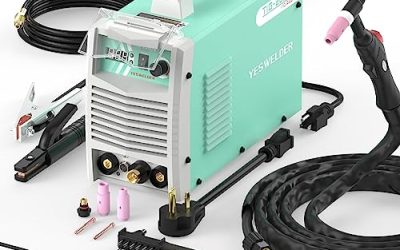
The YESWELDER TIG-205DS makes sense for a repair shop buying its first dual-voltage TIG welder, because the listing includes a foot pedal and covers the essentials without a long menu of settings to learn. Its 205-amp output handles brackets, frames and panels, while the high-frequency start keeps arc strikes clean on steel and stainless. Running on 110 or 220 volts, it can take a light repair at a customer’s site and return to the shop for heavier work, which is exactly the flexibility a small repair operation needs from a single machine.
Specs
- 205A maximum output
- 110V and 220V dual-voltage input
- HF TIG, stick and arc welding
- Foot pedal included in the listing
- DC output range of 15 to 200 amps
- 60 percent duty cycle at 205 amps on 220V
Best for: First dual-voltage TIG purchase for steel and stainless repair.
Watch out for: It is a DC machine, so it cannot weld aluminium; confirm the shop’s metal mix before ordering.
ASIN: B08882MFWP
Everlast PowerTIG 200DV

The Everlast PowerTIG 200DV suits a repair shop that wants one machine to cover nearly everything, from thin stainless to aluminium housings, on either shop voltage. Its AC/DC pulse output, dual-voltage input and IGBT inverter design give a technician the controls to tune heat input and cleaning action rather than working around a fixed arc. At 200 amps it has the headroom for heavier brackets and thicker sections, and the pulse controls help on the thin, heat-sensitive parts that repair work produces in such quantity. It is the most capable machine in this guide, and the one to choose when versatility matters more than the lowest outlay.
Specs
- 200A maximum output
- 110V and 220V dual-voltage input
- Pulse AC/DC TIG and stick welding
- IGBT inverter design
- Dual-voltage auto-detect input
Best for: Shops that want full AC/DC pulse capability on both voltages.
Watch out for: Check the listed accessories and confirm the torch and pedal are included in the bundle shown, since Everlast bundles vary.
ASIN: B01BLUV02O
ARCCAPTAIN TIG200P DC

The ARCCAPTAIN TIG200P DC fits a repair shop that needs a compact, affordable dual-voltage machine for steel and stainless, and has no aluminium in the queue. Its 200-amp DC pulse output covers thin sheet, tube and brackets, while the high-frequency start, spot mode and 2T/4T trigger give a technician useful control without a complicated panel. Dual-voltage input means it can move between the bench and a site with only a household outlet, and its light, compact case makes that move easy. For a second machine or a mobile kit, it is hard to fault on the specification sheet.
Specs
- 200A maximum output
- 110V and 220V dual-voltage input
- DC TIG with pulse, spot TIG and stick
- High-frequency start
- 2T and 4T trigger modes
- LED digital display
Best for: Portable DC pulse repair on steel and stainless at a low outlay.
Watch out for: No AC output, so aluminium is out; also confirm whether a foot pedal is in the listed bundle.
ASIN: B0FH2SWCSH
Weldpro Digital TIG 200GD
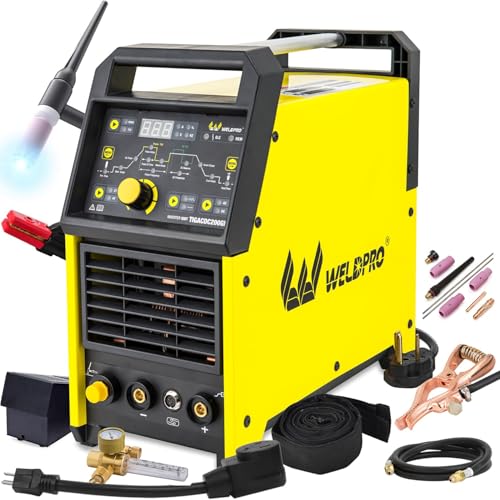
The Weldpro Digital TIG 200GD suits a repair shop that wants AC/DC capability with a better torch than most machines at this level include. Its listing names a CK17 Superflex torch, which is more flexible and easier to manoeuvre around awkward repair joints than the stiff torch supplied with many budget machines. With 200 amps of AC/DC TIG, pulse control, stick welding and dual-voltage input, it covers aluminium, steel and stainless, and the three-year warranty stated in the listing gives a shop some reassurance about support if a board or fan fails in service.
Specs
- 200A maximum output
- 220V and 110V dual-voltage input
- AC/DC TIG and stick welding with pulse
- CK17 Superflex torch included in the listing
- 3-year warranty stated in the listing
Best for: AC/DC repair work where torch flexibility matters.
Watch out for: Confirm the foot pedal is included in the listing shown, and check the input plug against the shop’s outlets.
ASIN: B084PY4C59
Which One Fits Your Situation
You are buying your first TIG welder for a repair shop
Choose the YESWELDER TIG-205DS. The foot pedal is included, the high-frequency start is forgiving, and 205 amps covers most steel repair. Its DC-only output is the main limit, so if aluminium already appears in the shop, step up to one of the AC/DC machines below instead.
Aluminium and steel both come through the door
Choose the Everlast PowerTIG 200DV. Its AC/DC pulse output and dual-voltage input cover the widest range of repair metals and locations in this guide. The extra controls take a little learning, but they are the reason the machine can take jobs the DC-only units must refuse.
You need a light machine for site calls
Choose the ARCCAPTAIN TIG200P DC. It is compact, dual-voltage and pulse-capable for steel and stainless, so it travels well in a van and sets up quickly on a household outlet. Keep it for steel work only, and leave aluminium jobs to the shop’s AC machine.
Torch comfort matters more than a low outlay
Choose the Weldpro Digital TIG 200GD. The CK17 Superflex torch is easier to position on cramped repair joints, and the AC/DC pulse range covers aluminium, steel and stainless. Check the pedal situation in the listing before ordering, since that is the accessory most likely to be separate.
Common Mistakes
- Assuming full output is available on 110 volts, then struggling with heavy joints on a household circuit.
- Buying a machine without checking whether the listing includes a foot pedal, then paying separately for one.
- Choosing DC-only to save money while aluminium repairs keep arriving and being turned away.
- Ignoring the input current and breaker size, so the machine trips the circuit halfway through a weld.
- Welding aluminium without pure argon and a clean surface, then blaming the machine for porous, weak beads.
Frequently Asked Questions
What does dual voltage mean on a TIG welder?
It means the machine accepts two input voltages, usually 110 volts and 220 volts, and adjusts its output to suit. On the lower voltage the maximum amperage is reduced, so thin work is fine but heavy sections need the higher-voltage circuit. Check the listing for the output at each voltage before buying.
Can a dual-voltage TIG welder run on a standard household outlet?
Yes, on 110 or 120 volts, for light and medium work, provided the circuit and breaker can supply the input current the listing states. A 20-amp circuit is often needed. Heavy work at full output needs the higher-voltage circuit, so plan the shop wiring around the thickest jobs.
Is AC/DC worth it for a repair shop?
Yes, if aluminium appears in the repair queue at all. AC output is the only way to TIG weld aluminium, and a DC-only machine cannot be upgraded later. If the shop works strictly on steel and stainless, DC-only is cheaper and simpler, and the money saved can go to consumables.
Do I need a foot pedal with a dual-voltage TIG welder?
A foot pedal is highly recommended for repair work, where heat must taper at the end of a bead on thin or worn material. Some listings include one and some do not, so read the bundle description carefully. Without a pedal, heat control depends on the panel settings alone, which is slower on varied joints.
Related guides
More from Amazon
Programs that pair well with the guide above. Offers and eligibility are set by Amazon and may change.
A free business account with business pricing and bulk-buying tools for work, shop or home office.
Create a business accountFree shipping on eligible items, Prime Video and more. Eligible new members can start with a free trial.
Start a Prime free trialAudiobooks and podcasts to listen to on the go. Eligible new members can start with a free trial.
Try Audible freeAd-free music streaming. Eligible new subscribers can start with a free trial.
Try Music Unlimited freeAs an Amazon Associate we earn from qualifying purchases.
Write Your Review
No reviews yet. Be the first to share your experience!