
Our Top Picks
 ARCCAPTAIN 200A MIG Welder 110V 220V 6 in20.9" x 8.5" x 16.1"3.5 x 2.4 x 2.8 inches0.9 poundsCheck on Amazon
What's inside
As an Amazon Associate I earn from qualifying purchases. This post may contain affiliate links at no extra cost to you.
Gas-shielded MIG is the workhorse of the repair shop for one reason: it lays down clean, fast welds on steel without the slag and smoke of flux-core wire, and a technician can move from a cracked bracket to a torn panel without changing process. The real decision is not whether to buy gas MIG, but how much output, wire control and duty cycle the shop needs, and whether the machine will also run flux-core when a job moves outdoors or the gas runs out mid-shift.
This guide is for equipment repair shops, fleet and farm maintenance crews, mobile repair technicians and small fabrication shops that repair steel equipment every day. The machines below were chosen from the names and specifications shown on their Amazon product pages, so the output, input, wire sizes and gas capability described here are the ones listed for sale.
What we cover
Quick Picks
As an Amazon Associate we earn from qualifying purchases
| Product | Best for | Key spec from title |
|---|---|---|
| Hobart Handler 140EZ | Simple gas MIG setup for light steel repair | 140A MIG welder, 120V, flux-core, spool gun ready |
| Lincoln Electric Easy-MIG 140 | A proven 140-amp gas MIG for general shop repair | 140A flux-cored and gas MIG welder, 115V |
| ARCCAPTAIN MIG200 | A versatile 200-amp gas MIG for mixed repair work | 200A 6 in 1 gas MIG and gasless flux-core MIG |
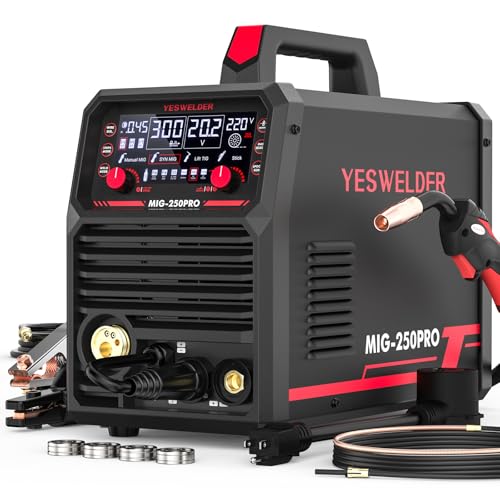
| YESWELDER MIG-250 PRO | High-output gas MIG with pulsed MIG for thicker jobs | 250A MIG welder, gas MIG, pulsed MIG, 110V/220V |
How to Choose
Start with the thickness you weld most, not the thickest job you remember
A gas MIG welder’s output range decides which jobs it finishes cleanly in a single pass. Thin sheet and light brackets need a low end near 30 amps and a stable arc, while quarter-inch plate needs roughly 180 amps or more with proper joint preparation. Shops that buy for the one heavy job they did last year end up with a machine that is awkward on the thin work they do every week. List the three thicknesses the bench sees most, then choose a machine whose listed range covers all three without running at its absolute limit on any of them.
Check gas capability, not just the word MIG
Every machine in this guide can run gas-shielded MIG, but the details differ in ways that cost time. Confirm the listing includes a gas regulator and hose, or budget for them separately, and check that the machine accepts the solid wire sizes the shop stocks, commonly 0.023, 0.030 and 0.035 inch. A machine that also runs flux-core wire earns its place when a repair moves outdoors, where wind blows shielding gas away from the joint. Keep a cylinder of shielding gas chained upright, check the regulator for leaks, and ventilate the bay, since gas MIG still produces fume.
Read the duty cycle at your working amperage
Duty cycle is the share of ten minutes a machine can weld at a stated output before cooling down, and repair work exposes a weak one quickly. A long seam on a trailer deck or a series of brackets in a row keeps the trigger pulled far longer than a single tack. Compare machines at the same amperage: a rating at 90 amps tells you nothing about behaviour at 140 amps. If the listing only states one figure, treat it as a starting point and plan cooling breaks into the job, rather than discovering the limit halfway through a customer’s machine.
Look hard at the wire drive and gun
Gas MIG lives or dies on wire feeding. A flimsy drive with a single small roller slips, birds-nests and wastes more time than any other fault on a repair bench. Look for a listing that names a metal drive system, a clear wire-speed control and a gun with a sensible cable length, about ten feet, so the operator can reach around a machine without dragging the welder. Check which drive rolls and contact tips are included, and whether the gun accepts the consumables the shop already stocks. A smooth, consistent feed is what turns a good machine into a fast one.
The 4 Best Options
Hobart Handler 140EZ

The Hobart Handler 140EZ suits a repair shop that wants gas MIG without a learning curve, because its EZ Mode setup and infinite voltage control simplify dialling in a weld on light steel. Running on 120 volts with a 30 to 140 amp range, it covers sheet metal, brackets, panels and light frames, and it accepts shielding gas as well as flux-core wire when a job moves outside. The spool-gun-ready design also leaves the door open for aluminium work later, and the HM-100 MIG gun in the package is a known, serviceable unit rather than a disposable extra.
Specs
- 140A maximum output
- 120V input
- 30 to 140 amp output range
- Gas MIG and flux-core capable
- Spool gun ready
- HM-100 MIG gun included in the listing
Best for: Shops that want a simple, dependable gas MIG for light steel repair.
Watch out for: It is a 120-volt machine, so heavy plate needs multiple passes and preparation; confirm the gas regulator is included in the listed bundle.
ASIN: B0DPXWWCBL
Lincoln Electric Easy-MIG 140

The Lincoln Electric Easy-MIG 140 fits a repair bench that values a long-proven design and wide parts support over extra features. It welds steel from thin gauge up to about 5/16 inch with the right preparation, runs on a standard 115-volt outlet, and handles both flux-cored and gas-shielded MIG, so a technician can switch wire and gas to suit the job. Its two-dial control panel is easy to hand to any member of the crew, and the Magnum 100L gun, regulator and included accessories make it a complete first gas MIG for a shop that repairs gates, trailers, brackets and light equipment.
Specs
- 140A maximum output
- 115V input
- Flux-cored and gas-shielded MIG welding
- Spool-gun ready
- Magnum 100L gun included in the listing
- Welds material from 24 gauge to 5/16 inch
Best for: General repair shops that want a proven gas MIG with broad support.
Watch out for: Check the listing for the included wire and gas regulator, and confirm the shop circuit can supply the input current the machine needs.
ASIN: B002R8B75U
ARCCAPTAIN MIG200
The ARCCAPTAIN MIG200 suits a repair shop that needs more output and more processes from one machine, without stepping up to a large industrial unit. Its 200-amp, dual-voltage output covers thicker brackets and frames than a 140-amp machine, and the synergic MIG mode sets wire speed and voltage together, which speeds up changeovers between jobs. Gas MIG gives clean beads indoors, flux-core covers outdoor work, and the lift TIG, stick and spot modes handle the odd jobs that arrive with the main repair. The LED display and burn-back adjustment round out a package built for varied daily work.
Specs
- 200A maximum output
- 110V and 220V dual-voltage input
- Gas MIG, gasless flux-core MIG, stick, lift TIG and spot welding
- Synergic MIG control
- LED digital display with burn-back adjustment
- Spool gun compatible
Best for: Mixed repair work that needs 200 amps and several processes in one machine.
Watch out for: A gas regulator may not be in every bundle, so check the listing contents before ordering, and confirm the spool gun is a separate purchase if aluminium is planned.
ASIN: B0B1TGZ8XN
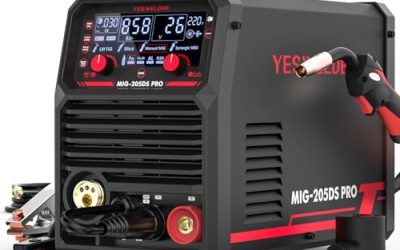
YESWELDER MIG-250 PRO
The YESWELDER MIG-250 PRO fits a repair shop where the work keeps getting thicker: trailer frames, loader buckets, heavy brackets and equipment that a 140-amp machine can only tackle with slow, repeated passes. Its 250-amp output and pulsed MIG mode give a technician more penetration and better control on heavy sections, while the dual-voltage input keeps it usable on a standard outlet for lighter jobs. With gas MIG, flux-core, spool-gun MIG, lift TIG and stick in one unit, it can stay on the bench all week, and the digital display makes it easier to return to settings that worked on a previous job.
Specs
- 250A maximum output
- 110V and 220V dual-voltage input
- MIG, pulsed MIG, flux-core, spool-gun MIG, lift TIG and stick
- Advanced digital display
- Spool gun compatible
Best for: Heavy steel repair that needs 250 amps and pulsed MIG control.
Watch out for: The spool gun and TIG torch are listed as separate purchases, so budget for them if those processes are needed.
ASIN: B08CBCB4M5
Which One Fits Your Situation
Most of your repair work is light steel and sheet
Choose the Hobart Handler 140EZ. Its 30 to 140 amp range, EZ Mode setup and 120-volt input cover the panels, brackets and light frames a repair shop sees daily, without demanding a special circuit. Keep flux-core wire on hand for the occasional outdoor job, and the machine stays useful well beyond the bench.
You want the most proven machine for general repair
Choose the Lincoln Electric Easy-MIG 140. It has a long service history, straightforward two-dial controls and broad parts availability, which matters when a gun or drive part wears out mid-week. Its gas and flux-core capability covers both indoor and outdoor repair, and the spool-gun option leaves aluminium open for later.
Your jobs vary in thickness and process every day
Choose the ARCCAPTAIN MIG200. The 200-amp dual-voltage output, synergic control and six processes in one machine mean a technician rarely has to swap machines between jobs. Check the regulator in the bundle first, since that is the part most likely to need a separate order.
Heavy frames and thick plate dominate the bench
Choose the YESWELDER MIG-250 PRO. Its 250-amp output and pulsed MIG mode handle the thick sections that smaller machines can only approach with multiple passes, and the dual-voltage input still lets it run lighter work on a standard outlet. Budget separately for the spool gun and TIG torch if those are needed.
Common Mistakes
- Buying a gas MIG welder and forgetting the cylinder, regulator and solid wire, so the first job waits on a gas supplier.
- Welding outdoors with shielding gas and wondering why the beads are porous when wind strips the gas away.
- Running a 140-amp machine at its limit on thick plate instead of preparing the joint and making multiple passes.
- Ignoring wire-feed quality and blaming the welder for bird-nesting caused by a worn drive roll or wrong tip size.
- Skipping ventilation and cylinder safety, even though gas MIG still produces fume and a loose cylinder is a hazard.
Frequently Asked Questions
What gas does a gas MIG welder need?
Most steel repair uses a shielding gas mix, commonly argon with carbon dioxide, while pure carbon dioxide is also used for some mild-steel work. The machine’s listing and manual state the gas and regulator fitting, so check both before ordering a cylinder. Never substitute a gas the manufacturer does not list for the wire in use.
Can a gas MIG welder also run flux-core wire?
Yes, most of the machines in this guide run both. Gas MIG uses solid wire with shielding gas for clean indoor welds, while flux-core wire shields itself and suits outdoor or windy work. Switching needs the right polarity, wire and drive-roll setup, so follow the machine’s instructions for each changeover.
How thick can a 140-amp gas MIG welder repair?
A 140-amp machine handles sheet metal to about 1/8 inch in a single pass, and thicker material with joint preparation and multiple passes. It suits panels, brackets and light frames. For regular work on quarter-inch plate or heavier, a 200-amp or 250-amp machine finishes the job faster and with fewer passes.
Does gas MIG need a special circuit?
A 120-volt gas MIG welder runs from a standard household outlet, though a 20-amp circuit is often recommended for full output. Dual-voltage machines need a 220-volt circuit to reach their maximum amperage. Check the input current in the listing and confirm the breaker before the machine arrives.
Related guides
More from Amazon
Programs that pair well with the guide above. Offers and eligibility are set by Amazon and may change.
A free business account with business pricing and bulk-buying tools for work, shop or home office.
Create a business accountFree shipping on eligible items, Prime Video and more. Eligible new members can start with a free trial.
Start a Prime free trialAudiobooks and podcasts to listen to on the go. Eligible new members can start with a free trial.
Try Audible freeAd-free music streaming. Eligible new subscribers can start with a free trial.
Try Music Unlimited freeAs an Amazon Associate we earn from qualifying purchases.
Write Your Review
No reviews yet. Be the first to share your experience!