
Our Top Picks
 ARCCAPTAIN 200A MIG Welder 110V 220V 6 in20.9" x 8.5" x 16.1"3.5 x 2.4 x 2.8 inches0.9 poundsCheck on Amazon
What's inside
As an Amazon Associate I earn from qualifying purchases. This post may contain affiliate links at no extra cost to you.
A mobile contractor choosing a flux-core-capable MIG welder is deciding how much independence the machine gives you off site. Flux-core wire shields its own weld pool, so you can lay beads outdoors in a breeze without dragging a gas cylinder across a muddy yard, and that freedom shapes fences, gates, and trailer frames. The real decision sits in the details: dual-voltage input for whatever outlet a site provides, a wire drive that feeds consistently after knocks in a truck bed, enough amperage for the thickest steel on the job list, and a weight you can carry.
This guide is for mobile welding contractors, fence and gate installers, farm repair hands, and trailer builders who weld on site. It also suits maintenance crews who need one machine that runs gasless flux-core outdoors and switches to solid wire with gas for cleaner beads. Every welder below was picked from the names and specifications on its Amazon product page, with weight, input voltage, wire sizes, and flux-core capability checked against the listing.
What we cover
Quick Picks
As an Amazon Associate we earn from qualifying purchases
| Product | Best for | Key spec from title |
|---|---|---|
| YESWELDER MIG-205DS PRO | All-round mobile jobs with five processes in one case | 200-amp 110/220V dual-voltage MIG welder, 5 in 1 gas MIG/flux core MIG/spool gun MIG/lift TIG/stick |
| YESWELDER MIG-250 PRO | Bigger site repairs needing 250-amp output | 250-amp 110/220V MIG welder, MIG/pulsed MIG/flux core/spool gun MIG/lift TIG/stick 6-in-1 |
| ARCCAPTAIN MIG200 | Windy outdoor work with synergic setup | 200-amp 110V/220V MIG welder, 6 in 1 gas MIG/gasless flux core MIG/stick/lift TIG/spot welding/spool gun |
| Hobart Handler 140 | Simple, rugged 120-volt repairs on light steel | 140-amp MIG welder 115V, flux-core capable, welds up to 1/4 in. mild steel |
How to Choose
Site power and input voltage come first, before amperage
Mobile work means you weld wherever the job is, and that outlet might be a standard 120-volt household socket, a 240-volt dryer or welder receptacle, or a generator with limited capacity. A dual-voltage machine adapts to all three, while a 120-volt-only welder caps your output on thicker steel no matter how skilled your hand is. Before buying, list the thickest material on your regular jobs and check what the machine delivers on 120 volts alone, because a welder that only reaches its headline amperage on 240 volts will leave you underpowered on half your sites. Confirm the plug adapters included in the box match the receptacles you actually encounter.
Flux-core wire behaviour decides outdoor weld quality
Gasless flux-core wire tolerates wind and dirty steel far better than solid wire with shielding gas, which is exactly why it dominates mobile repair work. The trade-off is more spatter, more smoke, and slag that needs chipping, so the machine should let you tune wire speed and voltage finely enough to keep the arc stable without excessive spatter. Check which wire diameters the drive accepts, since 0.030-inch wire suits thin panels and 0.035-inch wire covers most structural repair, and confirm the machine ships with the correct drive roll and polarity setup for flux-core. A welder that swaps polarity easily between gas and gasless wire saves real time when a job changes mid-day.
Portability is weight, size, and how it survives the truck
A mobile welder gets lifted in and out of a truck bed, carried across uneven ground, and stored beside tools that shift in transit, so weight and case strength matter as much as amperage. Machines in the twenty-to-thirty-pound range move with one hand and a shoulder strap, while heavier units need a cart or a second pair of hands at every stop. Look at the handle design, the cable storage, and whether the casing protects the wire drive and control knobs from knocks. A compact welder that arrives at the site undamaged and ready to strike an arc beats a heavier machine that stays in the truck because nobody wants to haul it.
Cheap mobile welders cut corners on the wire drive and torch
The wire feed system is where budget machines most often disappoint, with plastic drive components, weak tension springs, and short torches that kink when the machine sits at an awkward angle. Inconsistent feeding shows up as bird-nesting inside the case, burnback into the contact tip, and beads that start and stop without warning. When comparing machines, look for a metal drive assembly, a torch lead long enough to reach the work without dragging the machine along, and drive rolls matched to the wire sizes you use. A slightly heavier machine with a dependable feed system will finish more jobs in a day than a lighter one that jams on the second weld.
The 4 Best Options
YESWELDER MIG-205DS PRO

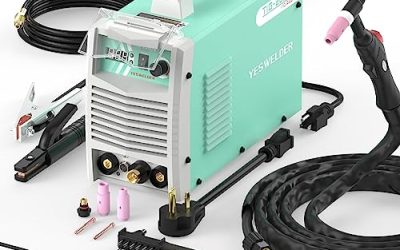
The YESWELDER MIG-205DS PRO fits a contractor who wants one machine to cover gas MIG, gasless flux-core, spool-gun aluminum, lift TIG, and stick across a varied job list. Its five-in-one layout means a fence repair in the morning and a stainless bracket in the afternoon need no second welder, and dual-voltage input adapts to whatever power a site provides. The synergic control simplifies setup when you move between wire types, while manual mode keeps full control for experienced hands.
Specs
- 200-amp maximum output
- 110/220V dual-voltage input
- 5 in 1: gas MIG, flux core MIG, spool gun MIG, lift TIG, stick
- Synergic and manual MIG modes
- Spool gun compatible
- Accepts 2-pound and 10-pound wire spools
- 30 to 205 amps output range
- LED digital display
Best for: Contractors who need five processes in one portable machine.
Watch out for: The TIG torch and spool gun are sold separately, so confirm what is actually in the box before assuming the machine does everything on day one.
YESWELDER MIG-250 PRO
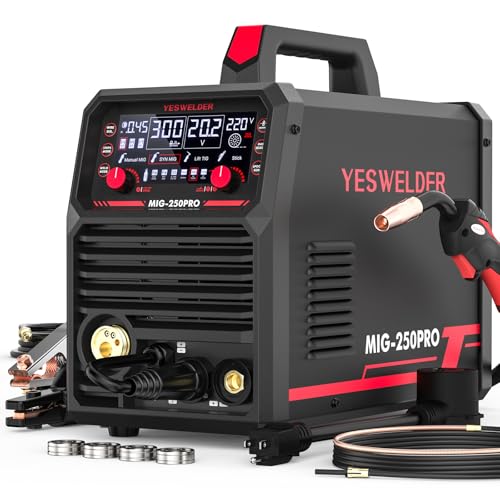
The YESWELDER MIG-250 PRO fits a mobile contractor whose jobs regularly include thicker steel, such as trailer frames, equipment brackets, and structural repairs that a 200-amp machine strains to penetrate. Its 250-amp output and six-in-one process list cover MIG, pulsed MIG, flux-core, spool-gun MIG, lift TIG, and stick, with an advanced digital display that keeps voltage and wire speed visible in bright daylight. The pulsed MIG mode helps on thin material where a standard spray transfer would burn through.
Specs
- 250-amp maximum output
- 110/220V dual-voltage input
- 6 in 1: MIG, pulsed MIG, flux core, spool gun MIG, lift TIG, stick
- Advanced digital display
- Synergic MIG mode with manual override
- Spool gun compatible
- Accepts 2-pound and 10-pound wire spools
- Flux-core capable without shielding gas
Best for: Heavy site repairs where 250-amp output earns its keep.
Watch out for: The spool gun and TIG torch are separate purchases, and the machine is heavier than compact 200-amp units, so plan how it travels in the truck.
ARCCAPTAIN MIG200
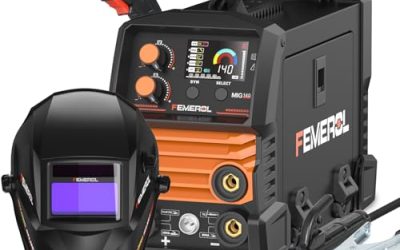
The ARCCAPTAIN MIG200 fits a contractor who works outdoors in wind and wants the machine to do the setup thinking. Its synergic control matches wire speed to voltage once you pick the wire size, which speeds up changeovers between flux-core and solid wire, and the six-in-one layout adds stick, lift TIG, spot welding, and spool-gun capability. Gasless flux-core runs cleanly in a breeze, while the LED display and burn-back adjustment keep the arc consistent across a long day of short, scattered welds.
Specs
- 200-amp maximum output
- 110V/220V dual-voltage input
- 6 in 1: gas MIG, gasless flux core MIG, stick, lift TIG, spot welding, spool gun
- Synergic MIG control
- LED digital display
- Burn-back adjustment
- Solid wire sizes 0.023, 0.030, and 0.035 inch
- Flux-core wire sizes 0.023, 0.030, and 0.035 inch
Best for: Outdoor contractors who want fast synergic setup and gasless welding.
Watch out for: The TIG torch and spool gun are not included, so check the exact bundle contents before ordering for aluminum or TIG work.
Hobart Handler 140
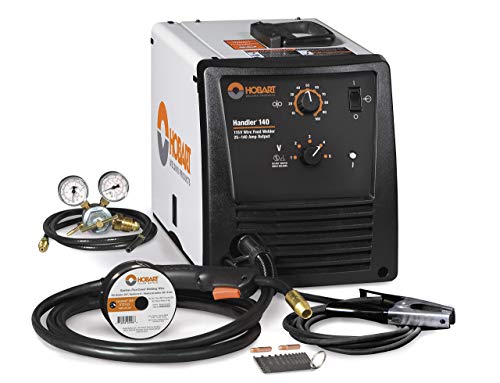
The Hobart Handler 140 fits a contractor who values a simple, proven 120-volt machine for light steel repairs, farm gates, and maintenance work where a bigger welder is unnecessary weight. It runs flux-core wire without gas and solid wire with gas, welds mild steel up to a quarter inch thick, and uses a straightforward tapped voltage control that stays predictable in dusty or cold conditions. Its long track record in home and farm shops means replacement guns, drive rolls, and consumables are easy to find.
Specs
- 140-amp maximum output
- 115V input
- Flux-core and solid-wire MIG capable
- Welds up to 1/4 inch mild steel
- Spool gun ready for aluminum
- Dual-gauge regulator included
- Five-position voltage control
- Built-in gas solenoid valve
Best for: Light steel site repairs on standard 120-volt power.
Watch out for: It runs on 120 volts only, so thick structural steel beyond a quarter inch needs a larger dual-voltage machine.
Which One Fits Your Situation
You take on varied jobs and want one machine for all of them
Choose the YESWELDER MIG-205DS PRO, because its five processes cover gas MIG, flux-core, spool-gun aluminum, lift TIG, and stick without a second machine in the truck. Dual-voltage input handles whatever outlet the site provides, and synergic mode speeds up setup when you switch wire types between jobs. That range keeps the truck lighter and the day simpler, since one machine and one set of consumables cover nearly every ticket.
Your repair list includes thick trailer frames and equipment steel
Choose the YESWELDER MIG-250 PRO, because 250 amps of output penetrates thicker sections that leave a 200-amp machine struggling, and pulsed MIG gives you a way to weld thinner panels on the same job. The six-in-one layout keeps stick and lift TIG available for awkward repairs. The extra output also shortens repair time on thick sections, since fewer passes are needed to fill the joint.
You weld outdoors in wind and change wire types often
Choose the ARCCAPTAIN MIG200, because gasless flux-core ignores the breeze that blows shielding gas away, and synergic control re-matches wire speed to voltage each time you swap wire. Burn-back adjustment and the LED display keep short, scattered site welds consistent. That quick setup matters when a day holds a dozen small jobs in different spots, and the gasless wire keeps working where a gas-shielded bead would fail.
You want a rugged, simple welder for light steel maintenance
Choose the Hobart Handler 140, because its tapped voltage control and 120-volt input make it dependable for gates, railings, and farm repairs without setup fuss. Flux-core capability means no gas cylinder on the truck, and its parts support is well established. Its straightforward controls stay predictable in dust and cold, and the flux-core option means no gas cylinder rides along on the truck.
Common Mistakes
- Buying a gas-only MIG welder for outdoor mobile work, then watching the wind blow shielding gas away from every bead.
- Skipping the polarity change when switching between solid wire and flux-core wire, which produces poor penetration and heavy spatter.
- Loading the wrong drive roll for the wire diameter, causing slipping, bird-nesting, and wasted time on site.
- Running a welder on a long, light-gauge extension cord that starves it of voltage and makes the arc sputter.
- Welding galvanized or painted steel outdoors without ventilation and respiratory protection, letting zinc and paint fumes build up around the work.
Frequently Asked Questions
Is flux-core welding good enough for mobile contractor work?
Yes, for most steel repair and fabrication it is the practical choice, because the wire carries its own shielding and tolerates wind, rust, and paint far better than gas-shielded MIG. Beads need slag removal and produce more spatter, yet penetration on structural steel is strong. For visible work where appearance matters, switch to solid wire with gas when conditions allow.
Do I need dual-voltage input for mobile welding?
Dual voltage is worth having, because sites vary between standard 120-volt outlets and 240-volt circuits, and a dual-voltage machine uses whichever is available. A 120-volt-only welder limits you to lighter steel, while a dual-voltage unit reaches full output when a 240-volt receptacle exists. Check what each machine delivers on 120 volts before judging it.
What wire size should a mobile contractor stock?
Stock 0.030-inch and 0.035-inch flux-core wire, since 0.030-inch handles sheet metal and light brackets while 0.035-inch covers most structural repair and trailer work. Keep the matching drive rolls and contact tips for each size in the truck. Running the wrong roll for the wire diameter is one of the fastest ways to jam a feed system on site.
Can these welders run off a generator?
Many dual-voltage inverter welders run on a generator, but the generator must supply clean, stable power with enough running watts for the welder at your working amperage. Check the welder manual for generator requirements and avoid undersized or unregulated generators that can damage inverter electronics. When in doubt, test the combination on scrap before starting a paying job.
Related guides
More from Amazon
Programs that pair well with the guide above. Offers and eligibility are set by Amazon and may change.
A free business account with business pricing and bulk-buying tools for work, shop or home office.
Create a business accountFree shipping on eligible items, Prime Video and more. Eligible new members can start with a free trial.
Start a Prime free trialAudiobooks and podcasts to listen to on the go. Eligible new members can start with a free trial.
Try Audible freeAd-free music streaming. Eligible new subscribers can start with a free trial.
Try Music Unlimited freeAs an Amazon Associate we earn from qualifying purchases.
Write Your Review
No reviews yet. Be the first to share your experience!