What's inside
- Is aluminium flux cored welding wire widely available?
- Head-to-head: aluminium wire options
- Which option fits your situation?
- 4043 versus 5356: the material trade-off
- Wire compatibility matters more than spool diameter
- What strength and cleanup should you expect?
- A quick cost-per-use calculation
- Where Lincoln fits into the search
- Buying checklist
- Related Guides
- Is aluminium flux cored welding wire widely available?
- Head-to-head: aluminium wire options
- Which option fits your situation?
- 4043 versus 5356: the material trade-off
- Wire compatibility matters more than spool diameter
- What strength and cleanup should you expect?
- A quick cost-per-use calculation
- Where Lincoln fits into the search
- Buying checklist
- Related Guides
As an Amazon Associate I earn from qualifying purchases. This post may contain affiliate links at no extra cost to you.
Aluminium flux cored wire is a niche product rather than a normal substitute for solid aluminium MIG wire: for most repairs and fabrication, a spool of compatible solid 4043 or 5356 wire with 100% argon is easier to source, cleaner, and more predictable.
The phrase “flux cored aluminium wire” covers several different products that are often confused. Some are aluminium-filled brazing or soldering wires intended for a torch, some are specialty cored wires for industrial welding equipment, and some listings use “flux cored” loosely for aluminium-coloured wire. Before buying, confirm the process, alloy, shielding requirement, wire diameter, and machine compatibility on the manufacturer’s technical data sheet.
As an Amazon Associate we earn from qualifying purchases at no extra cost to you.


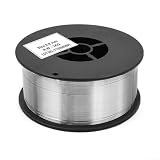

What we cover
- Is aluminium flux cored welding wire widely available?
- Head-to-head: aluminium wire options
- Which option fits your situation?
- 4043 versus 5356: the material trade-off
- Wire compatibility matters more than spool diameter
- What strength and cleanup should you expect?
- A quick cost-per-use calculation
- Where Lincoln fits into the search
- Buying checklist
- Related Guides
Is aluminium flux cored welding wire widely available?
Conventional flux-cored arc welding is dominated by steel wires. Aluminium is more difficult because its tenacious oxide layer melts at a much higher temperature than the underlying metal, while aluminium itself conducts heat rapidly. A flux formulation must also avoid leaving corrosive or difficult-to-remove residues.
As a result, standard welding suppliers commonly stock solid aluminium MIG wire, aluminium brazing rod, and steel flux-cored wire, but they may not stock a true aluminium FCAW wire. A product advertised as flux cored aluminium wire may instead be:
- A torch-brazing wire with a flux core, not a wire-feed welding consumable.
- A specialty wire requiring a particular industrial power source and shielding gas.
- A solid aluminium wire described inaccurately by a marketplace seller.
- A wire for joining aluminium-coated or dissimilar metals rather than welding aluminium plate.
Do not substitute a torch-brazing product in a MIG welder. Check that the label explicitly states wire-feed welding, the required polarity, shielding gas, amperage range, and compatible base metals.
Head-to-head: aluminium wire options
| Wire or process | Typical diameters | Typical spool or package | Shielding and equipment | Best use | Main trade-off |
|---|---|---|---|---|---|
| Solid 4043 aluminium MIG wire | 0.8, 0.9, 1.0, 1.2 mm | 0.45–2.0 kg | 100% argon; spool gun or push-pull setup preferred | General fabrication, castings, automotive panels | Lower strength than 5356; needs careful feeding |
| Solid 5356 aluminium MIG wire | 0.8, 0.9, 1.0, 1.2 mm | 0.45–2.0 kg | 100% argon; spool gun or push-pull setup preferred | Higher-strength fabrications, marine work where appropriate | Less forgiving on some castings; alloy selection matters |
| True aluminium flux-cored welding wire | Often around 1.0–1.6 mm, but varies | Specialty packages, commonly 1–5 kg | May require specified gas, polarity, and industrial feeder | Specialised production work | Limited availability, higher cost, residue cleanup |
| Flux-cored aluminium brazing wire | Approximately 1.6–3.2 mm | Rods or small coils, often 0.1–0.5 kg | Hand torch; not automatically MIG-compatible | Light repairs and low-load joints | Not equivalent to fusion welding; joint strength depends heavily on fit-up |
| Steel FCAW wire | 0.8–1.6 mm | 0.45–15 kg | CO2 or mixed gas, or self-shielded depending on type | Carbon and low-alloy steel | Unsuitable for aluminium |
The exact numbers vary by manufacturer, but the comparison shows why a generic “aluminium flux cored wire” listing is not enough. A 1 kg spool may be physically compatible with a feeder yet still be wrong for the alloy, polarity, or shielding method.
Which option fits your situation?
| Your situation | Most sensible choice | Why |
|---|---|---|
| Occasional home repair, lowest overall cost | Small spool of solid 4043 aluminium wire plus a spool gun | More readily available and less cleanup than specialist cored wire |
| Thin aluminium sheet, beginner operator | 0.8–0.9 mm solid wire with pulsed-capable equipment if available | Better control of heat input; flux residue is avoided |
| Frequent structural or marine fabrication | Qualified 5356 or project-specified alloy | Wire choice must follow the base alloy, service conditions, and design requirements |
| No spool gun and a long torch lead | Consider a push-pull feeder or change process | Soft aluminium wire commonly bird-nests in a conventional steel-wire liner |
| Very small repair without a MIG machine | Flux-cored aluminium brazing wire used with its specified torch | Lower equipment cost, but it is a brazing repair rather than normal FCAW |
| Production shop considering specialty cored wire | Obtain a manufacturer procedure and sample qualification first | Availability, deposition behaviour, residue, and strength can vary substantially |
4043 versus 5356: the material trade-off
4043 is a common general-purpose aluminium-silicon filler. It wets readily, usually produces a smoother-looking bead, and is often a practical choice for cast aluminium and general fabrication. Its deposited weld metal is not normally selected when maximum strength is the priority.
5356 is an aluminium-magnesium filler with higher tensile strength in many applications and is widely used for suitable wrought aluminium alloys. It is not automatically the best choice for every job: compatibility with the base alloy, service temperature, corrosion environment, and design code still matter. Some aluminium alloys should not be welded with a casually selected filler.
Neither choice becomes suitable merely because it is labelled “flux cored.” If a supplier offers a flux cored aluminium welding wire, request its deposited-metal chemistry, tensile data, recommended base alloys, polarity, gas flow, and cleaning instructions.
Wire compatibility matters more than spool diameter
Aluminium wire is soft and easily deformed. A standard steel MIG setup can damage it between the drive rolls and contact tip, particularly when the operator increases roll pressure to cure slipping. A compatible setup normally includes:
- A spool gun or push-pull gun with a short, supported wire path.
- U-groove drive rolls matched to aluminium wire.
- A liner intended for aluminium, often a low-friction polymer liner.
- A contact tip with the correct bore and wire diameter.
- 100% argon for ordinary solid aluminium MIG unless the wire manufacturer specifies otherwise.
- A clean, dry wire-storage arrangement to limit contamination and oxide buildup.
Use only the polarity and gas listed for the specific cored product. Self-shielded steel FCAW settings cannot be copied to an aluminium product, and a machine’s ability to accept a 1 kg spool does not prove that its feeder can handle soft aluminium wire.
What strength and cleanup should you expect?
Solid aluminium MIG wire leaves no slag, although the joint still needs oxide removal and post-weld cleaning. A true flux-cored product may improve arc chemistry or shielding in its intended application, but it can leave flux residue, trapped deposits, fumes, or corrosive remnants. The weld may look sound while residue remains along the toe or inside a crevice.
Clean aluminium mechanically immediately before welding with a dedicated stainless-steel brush. Remove oil with a suitable solvent, allow it to evaporate, and keep the cleaned area away from dirty gloves and grinding dust. If flux is used, follow the wire maker’s removal procedure; this may involve brushing, hot-water washing, or a specified chemical cleaner. Do not assume that wiping with a dry rag neutralises residue.
For load-bearing work, appearance is not a strength test. Joint design, penetration, porosity, heat control, base-alloy condition, and welder skill can matter more than a small difference in wire tensile strength. Use a qualified welding procedure where safety or compliance is involved.
A quick cost-per-use calculation
Specialty aluminium cored wire can cost roughly $35–$90 per kilogram in small quantities, while common solid aluminium wire may be about $20–$50 per kilogram, depending on diameter and brand. Suppose a repair deposits 150 g of metal. At 85% deposition efficiency, the required wire is:
0.150 kg ÷ 0.85 = 0.176 kg of wire.
A $60/kg specialty spool therefore contributes about $10.56 of wire to the repair. A $30/kg solid-wire spool contributes about $5.28. The difference is modest for one job, but the specialty option may also require a dedicated liner, contact tips, residue cleaning, and shipping. For occasional work, equipment compatibility and reliable availability usually outweigh a theoretical productivity advantage.
Where Lincoln fits into the search
Searches for “flux cored wire Lincoln” or “Lincoln Electric flux cored wire” often return Lincoln Electric’s extensive range of steel flux-cored products. Those products are not automatically aluminium-compatible. Lincoln Electric also sells solid aluminium MIG wires and equipment in appropriate product families, so identify the exact alloy and process rather than relying on the brand name or a shortened listing title.
If a listing says “Lincoln aluminum flux cored wire,” verify it against Lincoln Electric’s current catalogue or technical data. A genuine product document should identify the AWS classification or equivalent specification, alloy, diameter, spool dimensions, polarity, gas, and recommended application. If those details are absent, treat the listing as unverified.
Buying checklist
- Confirm that it is welding wire, not torch-brazing wire.
- Match the alloy to the aluminium being joined.
- Check diameter against the feeder, liner, and contact tip.
- Verify spool dimensions, hub size, and maximum spool weight.
- Confirm polarity, gas type, flow range, and amperage range.
- Ask how flux residue must be removed and whether post-weld corrosion is a concern.
- Prefer a small trial spool before committing to a large package.
- For safety-critical work, obtain procedure data and qualify a sample joint.
For most readers, the best purchase is not a vaguely labelled flux cored aluminum wire. It is a clearly specified solid 4043 or 5356 wire matched to a suitable aluminium-feeding system. Choose a true flux-cored product only when its manufacturer documents the process and the benefits justify its limited availability, higher ownership cost, and additional cleanup.