What's inside
As an Amazon Associate I earn from qualifying purchases. This post may contain affiliate links at no extra cost to you.
The best Lincoln welding wire for strong, clean welds is usually ER70S-6 solid wire for clean mild steel, Innershield flux-cored wire for outdoor or windy work, ER308LSi for 304 stainless steel, or ER4043 aluminum wire when the base metal and welder are properly matched.
Choosing the right Lincoln welding wire is less about brand alone than matching four variables: base metal, wire diameter, shielding gas, and the output range of your wire welding machine. A wire that performs well on thin sheet can be frustrating on structural plate, while the wrong gas or polarity can produce porosity, excessive spatter, or weak fusion.
As an Amazon Associate we earn from qualifying purchases at no extra cost to you.


What we cover
Quick picks by welding situation
| Situation | Recommended Lincoln wire type | Useful diameter | Gas or polarity |
|---|---|---|---|
| Clean mild-steel sheet and general fabrication | SuperArc L-56, ER70S-6 solid wire | 0.023 or 0.030 in | 75% argon/25% CO2, DCEP |
| General mild-steel brackets, frames, and repairs | SuperArc L-56, ER70S-6 | 0.030 or 0.035 in | 75/25 gas, DCEP |
| Outdoor mild-steel work where wind disrupts gas | Innershield NR-211-MP flux-cored wire | 0.030 or 0.035 in | Self-shielded, usually DCEN |
| 304 or 304L stainless steel | SuperArc L-308LSi stainless wire | 0.030 or 0.035 in | Tri-mix or suitable stainless MIG gas, DCEP |
| Aluminum sheet and general aluminum fabrication | SuperGlaze 4043 aluminum wire | 0.030 or 0.035 in | 100% argon, DCEP |
Best Lincoln welding wire for mild steel
Best all-purpose choice: SuperArc L-56
Lincoln Electric SuperArc L-56 is an ER70S-6 solid MIG wire designed for carbon and mild steel. Its deoxidizers help it tolerate light mill scale and surface contamination better than a lower-deoxidizer wire, although cleaning the joint is still important. It produces a relatively smooth arc and is a practical choice for shop fabrication, woodworking-table frames, carts, stands, gates, and equipment repairs.
Use solid L-56 with a shielding gas such as 75% argon and 25% carbon dioxide for a controlled arc and lower spatter than straight CO2. Straight CO2 can provide deeper penetration and lower gas cost, but it generally creates a harsher arc with more spatter. Keep the gas flow near 20 to 30 cubic feet per hour in a draft-free shop; excessive flow can draw air into the shielding stream.
Choosing between 0.023, 0.030, 0.035, and 0.045 inch
For thin sheet, 0.023-inch wire gives a lower minimum amperage and helps reduce burn-through. A typical useful range is approximately 18 to 20 gauge steel, depending on joint design and machine capability. The 0.030-inch size is the most versatile option for many small and medium MIG machines, covering thin sheet through roughly 1/8-inch material with multiple passes when necessary.
Lincoln welding wire 035, meaning 0.035-inch diameter wire, is better suited to heavier brackets, tubing, and plate. It requires more amperage and a machine with adequate duty cycle. It is often a sensible choice for 1/8-inch steel and thicker work, but it is less forgiving on thin automotive-style panels. The 0.045-inch size is generally for higher-output machines and heavier fabrication rather than compact 120-volt equipment.
| Wire diameter | Practical starting range | Best use | Common limitation |
|---|---|---|---|
| 0.023 in | Approximately 30–130 A | Thin sheet and low-output machines | Slow deposition on thick steel |
| 0.030 in | Approximately 40–180 A | General-purpose fabrication | May lack deposition rate for heavy plate |
| 0.035 in | Approximately 60–220 A | Frames, tubing, brackets, and 1/8-inch-plus steel | Too hot for many thin panels |
| 0.045 in | Approximately 100–300 A | Heavy fabrication and high-output machines | Needs a larger feeder and substantial power |
These are practical planning ranges, not universal machine settings. Always use the voltage and wire-feed chart supplied with the particular welder. A machine’s rated output, inductance, duty cycle, and available input power can change the useful range significantly.
When flux-cored Lincoln wire is the better choice
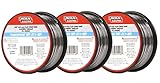
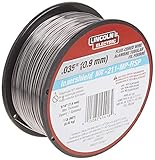
Lincoln Innershield NR-211-MP is a self-shielded flux-cored wire commonly used for mild steel when portability, outdoor work, or resistance to light drafts matters. It does not require a gas cylinder, regulator, or gas hose, making it useful for repairs away from the shop. It is also a good option for a wire welding machine that supports flux-cored operation but has no gas equipment.
Flux-cored welding creates slag, smoke, and more visible spatter than solid-wire MIG welding. Remove slag between passes with a chipping tool and wire brush. Use the polarity specified on the spool or machine chart; many self-shielded wires run DCEN, while solid MIG wire normally runs DCEP. Reversing polarity can produce an unstable arc and poor penetration.
Stainless and aluminum: match the alloy before the diameter
Stainless steel
For common 304 or 304L stainless fabrication, Lincoln SuperArc L-308LSi is an appropriate starting point. The “308” classification is intended for 300-series stainless applications, while the silicon-bearing formulation supports smooth feeding and wetting. Do not use ordinary mild-steel wire simply because the parts are stainless; the weld metal can have unsuitable corrosion and performance characteristics.
Use a stainless-compatible shielding gas recommended by the wire manufacturer. A tri-mix containing helium, argon, and carbon dioxide is commonly used for stainless MIG work, while excessive carbon dioxide can increase oxidation and spatter. Clean the joint with a dedicated stainless brush and avoid contaminating it with carbon-steel grinding dust.
Aluminum
Lincoln SuperGlaze 4043 is a common choice for welding many cast and wrought aluminum alloys. It generally wets easily and is often selected for general-purpose aluminum work, but filler selection must follow the alloy, service temperature, strength requirements, and cracking concerns. A 4043 wire is not automatically correct for every aluminum grade.
Aluminum wire is soft and can bird-nest in a conventional steel liner. Use a spool gun or push-pull system where supported, a short and properly aligned cable path, a suitable liner, and U-groove drive rolls. Use 100% argon and clean aluminum with a stainless brush reserved for aluminum. Aluminum requires substantially more heat conduction than steel, so settings and travel speed usually need to be adjusted accordingly.
How to set up welding machine wire correctly
- Identify the base metal and thickness. Remove paint, oil, rust, and loose mill scale from the joint. Measure the thickest section rather than guessing from appearance.
- Select the wire diameter. Use 0.023 or 0.030 inch for thin material, 0.035 inch for heavier general fabrication, and 0.045 inch only when the machine and feeder are rated for it.
- Install the correct liner and contact tip. The tip marking should match the wire diameter. A tip that is too tight can cause intermittent feeding; one that is badly worn can make the arc wander.
- Set polarity and gas. Solid MIG wire normally uses DCEP and shielding gas. Self-shielded flux core commonly uses DCEN, but verify the specific spool instructions.
- Begin with the manufacturer’s chart. Test on a piece of the same thickness. Adjust wire feed and voltage together: a wire-feed change affects amperage, while voltage mainly changes arc length and fluidity.
- Inspect the bead. A good starting bead has consistent width, ties into both edges, and avoids excessive convexity, undercut, or scattered pinholes.
For example, a 0.030-inch L-56 setup on 1/8-inch mild steel may begin around the machine’s chart setting near 18–20 volts and an appropriate wire-feed speed for that welder. Do not copy a wire-feed number from another machine: feed-speed calibration and voltage response vary between models.
Ownership costs and maintenance realities
A larger spool is usually cheaper per pound, but it is not always the best value. Suppose a 10-pound spool costs $45 and deposits about 6 pounds of usable weld metal after transfer losses. That is approximately $7.50 per deposited pound before gas, electricity, tips, and labor. A smaller spool may cost more per pound but prevent waste if the wire will sit for months and develop surface rust.
Store steel wire in a dry cabinet or sealed container. Replace the contact tip when feeding becomes inconsistent or the arc starts wandering. Clean drive rolls and the gun liner when metal dust accumulates, and keep the nozzle free of spatter so shielding gas can reach the puddle. The liner, contact tip, nozzle, and drive-roll surfaces normally wear before the motor or power source.
Common mistakes include welding through paint, using too much gas flow, dragging a solid-wire MIG nozzle too far from the joint, forcing soft aluminum wire through a steel setup, and selecting 0.035-inch wire for a machine that cannot deliver stable low-end output. A correctly matched 0.030-inch wire often produces better results than a larger wire operated outside its useful range.
Bottom line
Choose SuperArc L-56 in 0.030 inch for the broadest mild-steel usefulness, 0.023 inch for thin sheet, and 0.035 inch when your machine has the output for heavier steel. Choose Innershield NR-211-MP when gas-free outdoor work matters, L-308LSi for compatible stainless applications, and SuperGlaze 4043 with an aluminum-capable feeding system for suitable aluminum alloys. The strongest, cleanest weld comes from matching the wire for welding machine, gas, polarity, diameter, and material thickness as a complete system.