What's inside
As an Amazon Associate I earn from qualifying purchases. This post may contain affiliate links at no extra cost to you.
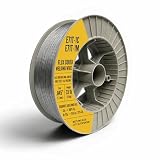
For the cleanest, strongest general-purpose welds on mild steel, choose an E71T-1 gas-shielded flux-cored wire in 0.035-inch diameter with 75% argon/25% carbon dioxide; move to 0.045 inch for heavier plate and higher deposition, or 0.030 inch for thinner material and lower-heat work.
As an Amazon Associate we earn from qualifying purchases at no extra cost to you.


What we cover
What to buy at a glance
The best wire depends less on brand than on the AWS classification, diameter, shielding-gas listing, and the thickness range you regularly weld. For ordinary structural mild steel, E71T-1C or E71T-1M wire is the practical starting point. The “C” designation indicates carbon-dioxide shielding, while “M” indicates mixed-gas shielding, commonly argon with carbon dioxide.
| Wire choice | Typical working range | Shielding gas | Strength classification | Best use |
|---|---|---|---|---|
| 0.030 in E71T-1 | 90–180 A, approximately 16–23 V | 75/25 Ar/CO2 or CO2, if specified | 70 ksi minimum tensile strength (480 MPa) | 18-gauge to 1/4-in mild steel, smaller machines |
| 0.035 in E71T-1 | 120–230 A, approximately 18–25 V | 75/25 Ar/CO2; some wires also permit CO2 | 70 ksi minimum tensile strength (480 MPa) | General fabrication and repair |
| 0.045 in E71T-1 | 180–300 A, approximately 22–29 V | 75/25 Ar/CO2 or the manufacturer’s specified gas | 70 ksi minimum tensile strength (480 MPa) | 1/4-in to 1/2-in plate and production work |
| 0.052 in E71T-1 | 220–350 A, approximately 24–31 V | Usually mixed gas or CO2, according to classification | 70 ksi minimum tensile strength (480 MPa) | Heavy plate, long welds, high deposition |
These are useful starting ranges, not universal machine settings. Always follow the wire manufacturer’s data sheet: the same diameter can have different recommended voltage, wire-feed speed, polarity, and gas flow.
Head-to-head: 0.030, 0.035, and 0.045 inch
0.030 inch: control over penetration
Small-diameter wire reaches a stable arc at lower current, making it the easiest choice for thinner mild steel, short welds, and compact welders. It reduces the risk of burning through 18-gauge or 14-gauge material, but it deposits metal more slowly. On 1/4-inch plate, several passes may be needed, and an underpowered machine can struggle to maintain fusion.
0.035 inch: the best all-around compromise
For most home shops and repair benches, 0.035 inch offers the widest useful range. It can run controlled short-circuit or more forceful spray-like transfer, depending on the wire and settings. It is productive on 1/8-inch and 3/16-inch steel while remaining manageable on 1/4-inch plate with multiple passes.
0.045 inch: deposition and thick steel
Larger wire puts down more metal per minute and is better suited to long fillet welds, equipment repairs, and heavier plate. It needs more current and a machine with sufficient duty cycle. On thin stock, it is difficult to control without excessive heat input, so it is a poor “one spool for everything” choice.
Shielding gas changes the result
Gas-shielded flux-cored welding generally uses either 75% argon/25% carbon dioxide or 100% carbon dioxide. A 75/25 mix usually produces a smoother arc, less spatter, and easier slag separation. It is the safer default when the wire permits both gases.
CO2 costs less per cylinder fill and can provide deeper penetration, but it commonly produces a harsher arc and more spatter. Do not assume that any E71T-1 wire can use either gas. The final classification matters: a wire marked for “C” may be qualified with CO2, while an “M” wire is qualified with mixed gas. Using the wrong gas can change arc behavior, bead shape, porosity, and qualification compliance.
Begin around 25–35 cubic feet per hour indoors, then adjust for drafts, nozzle size, and joint geometry. Too little flow allows atmospheric contamination; too much can draw air into the shielding stream. Gas-shielded flux-cored wire is not a good choice outdoors in wind unless the work is effectively screened.
Strength, slag, and cleanliness
Most general-purpose E71T-1 wires have a minimum tensile classification of 70 ksi, or about 480 MPa. That number does not guarantee a stronger joint by itself. Joint preparation, penetration, preheat where appropriate, travel speed, and complete slag removal determine whether the finished weld performs properly.
Compared with solid MIG wire, flux-cored wire normally produces more visible slag but offers useful advantages on mild steel: higher deposition, better tolerance of light surface contamination, and a forceful arc that can penetrate a prepared joint. Slag should lift or chip away cleanly after the weld cools. If it is trapped between passes, the usual causes are inadequate cleaning, an incorrect travel angle, insufficient heat, or an excessively wide weave.
Choosing by your actual situation
| Your situation | Recommended starting choice | Why |
|---|---|---|
| New operator, occasional repairs | 0.035-in E71T-1, 75/25 gas | Forgiving diameter and smoother arc make setup easier |
| Mostly sheet and light tubing | 0.030-in E71T-1 | Lower current helps limit burn-through |
| Frequent 1/4-in fabrication | 0.035 or 0.045-in E71T-1 | Choose 0.045 in if the welder supports its current and duty cycle |
| Long welds on heavy plate | 0.045 or 0.052-in wire | Higher deposition reduces welding time |
| Outdoor or windy work | Self-shielded flux-cored wire instead | Gas-shielded wire loses protection when wind disturbs the gas envelope |
| Lowest equipment cost | Gas-compatible E71T-1 with CO2, if approved | CO2 equipment can cost less, though the arc is typically harsher |
Setup procedure that prevents common failures
- Confirm the classification. Check the spool for E71T-1C, E71T-1M, or another exact designation. Match it to the shielding gas and polarity listed by the manufacturer.
- Set electrode positive when specified. Many gas-shielded wires use DC electrode positive, but the spool label takes priority.
- Install the correct drive-roll groove and contact tip. Flux-cored wire is less rigid than solid wire. A worn or oversized tip causes erratic feeding and arc starts.
- Set gas flow and inspect for leaks. A leaking regulator, loose hose, or damaged O-ring can cause porosity even when the flowmeter appears correct.
- Clean the joint and remove mill scale where fusion matters. Flux helps, but it is not permission to weld through heavy rust, paint, oil, or thick scale.
- Use a short stickout. A starting point is roughly 3/4 inch, adjusted to the wire maker’s instructions. Excessive stickout preheats the wire and reduces arc control.
- Chip and brush every pass. Do not bury dark, glassy slag under the next bead. Inspect the edges for undercut and lack of fusion before continuing.
A practical wire-consumption calculation
Suppose a repair requires 30 inches of 1/4-inch fillet weld and your selected 0.035-inch wire deposits approximately 4.5 pounds per hour at the planned settings. If actual arc-on time is 3 minutes, consumed weld metal is approximately:
4.5 lb/hour × 3/60 hour = 0.225 lb
Allowing for starts, stops, discarded wire, and multiple passes, buying a 10- or 11-pound spool gives substantial margin for setup coupons and rework. The calculation also shows why a larger wire is valuable for repeated long welds but unnecessary for occasional short repairs.
Ownership realities
The first consumables to wear are usually the contact tip, nozzle, and drive-roll surface rather than the spool itself. Flux residue and spatter can restrict gas coverage, so clean the nozzle regularly and replace tips when the bore becomes visibly enlarged. Store opened wire dry and sealed; moisture can contribute to porosity and unstable starts.
Keep the spool covered when not in use, especially in a damp shop. A wire that feeds inconsistently may need a liner inspection, drive-tension adjustment, or replacement rather than higher voltage. Excessive drive tension can deform flux-cored wire and create feeding problems farther down the liner.
Final recommendation
Buy 0.035-inch E71T-1 gas-shielded flux-cored wire qualified for 75/25 argon-carbon-dioxide if you need one versatile option for mild-steel fabrication. Select 0.030 inch when thin material and heat control dominate, and 0.045 inch when your machine, duty cycle, and workpieces justify higher deposition. The correct diameter, gas, polarity, and disciplined slag removal matter more than choosing a premium-looking spool.