
Our Top Picks
 ARCCAPTAIN 200A MIG Welder 110V 220V 6 in20.9" x 8.5" x 16.1"3.5 x 2.4 x 2.8 inches0.9 poundsCheck on Amazon

What's inside
As an Amazon Associate I earn from qualifying purchases. This post may contain affiliate links at no extra cost to you.
A small metalworking shop puts a flux core MIG welder through mixed work: thin brackets in the morning, thicker plate after lunch, and repeat jobs that need the same settings days later. That mix is the real decision. A digital display earns its place when it shows voltage and wire feed speed clearly enough to repeat a setting, and a machine earns its place when its duty cycle survives a long seam without cutting out. Dual-voltage input matters too, because some shop corners only have a standard outlet while the heavier work wants a 220-volt circuit.
This guide is written for small metalworking shops, mobile repair welders, and fabrication beginners who need flux core capability with a readable display. Each machine below was chosen from the names and specifications shown on its Amazon product page, so the outputs, voltages, and display features listed here match what the listing itself states.
What we cover
Quick Picks
As an Amazon Associate we earn from qualifying purchases.
| Product | Best for | Key spec from title |
|---|---|---|
| YESWELDER MIG-205DS PRO | Repeat jobs that need saved settings | 200-amp output, 110/220V dual voltage |
| ARCCAPTAIN MIG200 | A first digital-display machine for a small shop | 200-amp output, 110V/220V, LED display |
| ARCCAPTAIN iControl MIG205 Pro | Operators who want app control and a large screen | 205-amp output, 120V/240V, large LED display |
| Weldpro 200A MIG Welder | Shops that want an LCD readout and a spot timer | 200-amp output, 110V/220V, LCD display |
How to Choose
Input voltage and duty cycle
Start with the power you actually have. A dual-voltage machine that runs on 110 volts for light brackets and 220 volts for plate gives a small shop flexibility, but the output drops on the lower input, so check the amperage the listing states for each voltage. Duty cycle is the second number that matters: it tells you how many minutes out of ten the machine can weld at a stated amperage before it must cool. A 60 percent duty cycle at 140 amps covers most shop seams, while a machine that only manages short bursts at full output will stall a long fabrication job. Match both numbers to your longest weld, not your average one.
Reading the digital display like a setup sheet
A digital display only helps if it shows the numbers that decide a weld. Look for voltage and wire feed speed shown together, because those two settings define the arc, and look for a display that stays readable with a helmet on and in bright shop light. Some screens add synergic control, which suggests a voltage once you set wire size and material thickness, and that shortcut helps when several people share one machine. Write down the voltage and wire speed that work for each material and thickness, and treat the display as the setup sheet your shop returns to.
Wire feed, drive rolls, and flux core wire
Flux core wire is softer than solid wire, so the feed system matters more than the brand badge. Check that the machine accepts the wire diameter your jobs need, usually 0.030 or 0.035 inch for shop work, and that the drive rolls match that size rather than forcing the wire through the wrong groove. A smooth, consistent feed keeps the arc steady and the spatter down, while a slipping drive roll shows up as a sputtering arc and a ruined seam. Also confirm the spool size the cabinet accepts, since a machine limited to small spools means more changeovers during a busy week.
Where budget machines cut corners
Low-cost welders rarely fail at the headline amperage; they fail at the details a shop notices after a month. Short ground leads and thin work clamps waste time when the machine has to sit close to the work, and a flimsy MIG gun overheats on longer beads. Some machines ship without a gas regulator, so gas MIG work needs an extra purchase before the first weld. Ventilation is a safety matter here too: flux core welding produces fume that needs extraction or fresh air, and a cramped corner with no airflow is the wrong home for any of these machines. Compare the full package, not the headline number.
The 4 Best Options
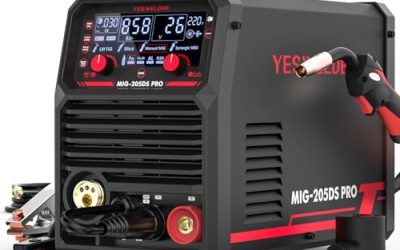
YESWELDER MIG-205DS PRO

The MIG-205DS PRO suits a small shop that runs mixed jobs and wants one machine to cover them. Its five processes stretch from gas MIG and flux core through spool gun aluminum, lift TIG, and stick, so a bracket repair and a small aluminum job can share the same bench. Synergic control suggests voltage and wire speed from the wire and material settings, which shortens setup when different operators share the machine, and the LED digital display keeps those numbers visible. At 200 amps with dual-voltage input, it handles the plate and sheet work a small metalworking shop sees most weeks.
Specs
- 200-amp maximum output
- 110/220V dual-voltage input
- 5-in-1: Gas MIG, Flux Core MIG, Spool Gun MIG, Lift TIG, Stick
- LED digital display
- Synergic MIG control
- 60 percent duty cycle at 140 amps
Best for: A small shop that wants one machine for MIG, flux core, and occasional aluminum work.
Watch out for: The TIG torch and spool gun are separate purchases, so confirm what is in the box before ordering.
ARCCAPTAIN MIG200
The MIG200 fits a shop buying its first digital-display welder and wanting six processes without a complicated menu. Gas MIG, gasless flux core, stick, lift TIG, spot welding, and spool gun aluminum cover the jobs a small metalworking business takes on, from quick repairs to light fabrication. The LED digital display shows voltage and wire feed speed together, and burn back adjustment helps keep the wire from sticking at the end of a weld. Dual-voltage input means it can run from a standard outlet for light work or a 220-volt circuit when the job thickens.
Specs
- 200-amp maximum output
- 110V/220V dual-voltage input
- 6-in-1: Gas MIG, Gasless Flux Core MIG, Stick, Lift TIG, Spot Welding, Spool Gun
- LED digital display
- Burn back adjustment
- Synergic control
Best for: A first digital-display machine for a shop that needs flux core and gas MIG in one unit.
Watch out for: The kit does not include gas gauges, so plan a separate regulator purchase for gas MIG work.
ARCCAPTAIN iControl MIG205 Pro
The MIG205 Pro is the pick for an operator who likes settings on a screen and a phone. Its large LED display is built for reading at a glance, and the app control lets the operator adjust and save settings away from the machine, which helps when the welder is mounted on a cart or tucked under a bench. Six processes cover gas MIG, gasless flux core, stick, lift TIG, spot welding, and spool gun aluminum, and the 40-watt wire feeder pushes wire at up to 640 inches per minute. Dual fans keep the machine cool during longer runs.
Specs
- 205-amp maximum output
- 120V/240V dual-voltage input
- 6-in-1: Gas MIG, Gasless MIG, MMA Stick, Lift TIG, Spot Welding, Spool Gun Aluminum
- Large LED digital display with app control
- 40W wire feeding system, up to 640 ipm wire feed speed
- Synergic mode
Best for: An operator who wants app control and a large screen for repeat settings.
Watch out for: The lift TIG torch and spool gun are sold separately, so budget for them if you need those processes.
Weldpro 200A MIG Welder

Weldpro’s 200-amp MIG welder suits a shop that values a plain LCD readout and a spot timer over extra modes. The five processes cover flux core MIG, gas MIG, stick, lift TIG, and spool gun work, and the LCD panel shows the settings without a deep menu. A spot timer helps with repeat plug welds and tack sequences, the kind of small, repeated task that fills a fabrication day. Dual-voltage input and IGBT inverter internals keep it portable enough to move between benches, and the spool gun compatibility opens up aluminum work later.
Specs
- 200-amp maximum output
- 110V/220V dual-voltage input
- 5-in-1: MIG, Flux Core MIG, MMA, TIG, Stick with spot timer
- LCD display
- IGBT inverter
- Aluminum spool gun compatible
Best for: A shop that wants an LCD readout and a spot timer for repeat tack and plug welds.
Watch out for: Check the listing’s included-components list before ordering, so the torch, clamp, and regulator you expect are actually in the box.
Which One Fits Your Situation
Your shop runs mixed steel jobs all week
The YESWELDER MIG-205DS PRO is the fit here. Five processes and synergic control let one machine move from flux core brackets to gas MIG panels without a swap, and the digital display makes repeat settings easy to recover. Its 200-amp output covers the plate and sheet thickness a general metalworking shop welds most often.
You want the simplest digital machine to learn on
Choose the ARCCAPTAIN MIG200. Six processes sound like a lot, but the LED display and synergic control keep setup to a few choices, and the flux core mode works without a gas bottle. It is the easiest of the four to hand to a newer operator while still covering repair and light fabrication work.
You like adjusting settings from your phone
Pick the ARCCAPTAIN iControl MIG205 Pro. The app control and large LED display suit an operator who sets up away from the machine or saves settings for repeat jobs, and the 640 ipm wire feed speed keeps up with faster work. The dual fans also help on longer runs when the machine stays hot.
Most of your day is tacks, plugs, and short seams
Take the Weldpro 200A MIG Welder. The spot timer is built for exactly this rhythm, and the LCD display shows the setting at a glance between tacks. Five processes keep flux core and gas MIG on hand, and the portable inverter body moves between benches without a cart, so the next joint is never far away.
Common Mistakes
- Buying on headline amperage alone and ignoring the duty cycle at the amperage you actually weld at.
- Running flux core wire through drive rolls sized for a different diameter, which causes slipping and a sputtering arc.
- Welding in a closed corner with no fume extraction, then wondering why the shop air turns hazy.
- Forgetting to check whether the spool gun, TIG torch, or gas regulator is included before the machine arrives.
- Setting voltage and wire speed from memory instead of writing down the numbers that worked, then re-tuning the same joint every time.
Frequently Asked Questions
Can a flux core MIG welder run without gas?
Yes. Flux core wire carries its own shielding in the core, so gasless flux core welding needs no cylinder, which suits outdoor repairs and drafty shops. The trade-off is more spatter and smoke than gas MIG, so keep the work area ventilated and clean the nozzle often. All four machines here run flux core wire without gas.
What does the digital display actually show?
It shows the welding settings that decide the arc, usually voltage and wire feed speed, and on some machines the amperage as well. That lets you record a working combination for a material and thickness, then return to it exactly. A display does not set the weld for you; it makes a good setting repeatable.
Is dual voltage worth it for a small shop?
Usually yes. A 110-volt outlet runs light brackets and repairs anywhere in the shop, while the 220-volt input unlocks the full output for plate and longer seams. If your shop only has standard outlets near the bench, dual voltage keeps you working while you plan a heavier circuit.
How thick can these welders handle?
Each machine here tops out at 200 or 205 amps, which covers sheet metal through plate in the range a small metalworking shop welds most days. The exact thickness depends on the joint, the wire, and whether you use gas or flux core. For plate at the heavy end, run the machine on its 220-volt input.
Related guides
More from Amazon
Programs that pair well with the guide above. Offers and eligibility are set by Amazon and may change.
A free business account with business pricing and bulk-buying tools for work, shop or home office.
Create a business accountFree shipping on eligible items, Prime Video and more. Eligible new members can start with a free trial.
Start a Prime free trialAudiobooks and podcasts to listen to on the go. Eligible new members can start with a free trial.
Try Audible freeAd-free music streaming. Eligible new subscribers can start with a free trial.
Try Music Unlimited freeAs an Amazon Associate we earn from qualifying purchases.
Write Your Review
No reviews yet. Be the first to share your experience!