What's inside
- Best mantel electric fireplaces by buying situation
- Head-to-head: what separates the leading types?
- Specifications that matter more than the advertised BTU number
- Thermostat controls and safety features to prioritize
- Installation: furniture assembly, not always “plug and play”
- A simple coverage calculation before you buy
- Ownership realities: what wears first?
- Best mantel electric fireplaces by buying situation
- Head-to-head: what separates the leading types?
- Specifications that matter more than the advertised BTU number
- Thermostat controls and safety features to prioritize
- Installation: furniture assembly, not always “plug and play”
- A simple coverage calculation before you buy
- Ownership realities: what wears first?
As an Amazon Associate I earn from qualifying purchases. This post may contain affiliate links at no extra cost to you.
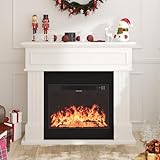
The best mantel electric fireplaces are the ones that match your room’s available width, required heater coverage, and tolerance for installation work: choose a Dimplex Revillusion-based mantel for the most convincing flame presentation, a Real Flame mantel for furniture-style proportions, or a Duraflame infrared-quartz mantel when heating value and lower cost matter most.
As an Amazon Associate we earn from qualifying purchases at no extra cost to you.



What we cover
- Best mantel electric fireplaces by buying situation
- Head-to-head: what separates the leading types?
- Specifications that matter more than the advertised BTU number
- Thermostat controls and safety features to prioritize
- Installation: furniture assembly, not always “plug and play”
- A simple coverage calculation before you buy
- Ownership realities: what wears first?
Best mantel electric fireplaces by buying situation
| Situation | Best fit | Why it works | Important compromise |
|---|---|---|---|
| Most realistic flame effect | Dimplex Revillusion mantel or insert | High-definition flame projection, glowing ember appearance, and a more open-fire visual than basic LED log sets | Usually costs more and still produces heat through a conventional electric heater |
| Traditional living-room furniture | Real Flame wood-style mantel fireplace | Well-proportioned surround, enclosed firebox, remote control, and thermostat operation | Flame depth varies by model; some rely more on a flat LED display |
| Value heating for a medium room | Duraflame infrared-quartz mantel | Commonly rated for about 1,000 square feet under favorable conditions and often includes adjustable temperature control | “Up to” coverage depends heavily on insulation, ceiling height, and whether it is supplemental heat |
| Small room or apartment | Compact mantel or wall-adjacent console, 23–30 inches wide | Uses a standard 120-volt outlet and takes less floor space | Smaller heater outputs generally suit bedrooms, offices, or dens better than open-plan rooms |
| Frequent daily use | A unit with a replaceable LED light assembly, accessible filter, and solid anti-tip hardware | Lower ownership frustration and easier cleaning over several heating seasons | May be less decorative than a heavily detailed furniture mantel |
Head-to-head: what separates the leading types?
Dimplex Revillusion-style mantels: best flame realism
Dimplex’s Revillusion technology is designed to make the flame image appear behind a realistic-looking log set rather than on a simple flat screen. The result is usually more convincing from an angle, particularly when the room lights are dimmed. Look for models with independently adjustable flame brightness, ember brightness, and heat. Those controls let you use the fireplace as an accent light without running the heater.
The main reason to choose this type is visual quality, not a radically stronger heater. Most residential electric fireplaces deliver roughly 4,400 to 5,100 BTUs on their high setting because a 120-volt, 1,500-watt circuit limits output. A Revillusion mantel therefore makes the most sense when appearance is your first priority and the fireplace is supplemental heat.
Real Flame mantels: best furniture balance
Real Flame produces traditional and transitional fireplace surrounds with features such as remote controls, thermostats, multiple flame settings, and sometimes crackling-sound effects. Their appeal is that the mantel can look like a piece of furniture when the flames are off. That matters in a living room where a black glass insert or ultra-modern wall unit would look out of place.
Check the firebox opening carefully before buying. A broad mantel can still contain a relatively narrow viewing window, and trim around the opening reduces the visible flame area. Also confirm whether the mantel is MDF or solid wood. MDF can look excellent when painted, but swollen edges from water exposure are difficult to repair.
Duraflame infrared-quartz mantels: best practical heating value
Duraflame mantel fireplaces commonly combine infrared quartz heating with a flame display. Infrared heating is often marketed as helping preserve room humidity compared with some conventional heating methods, but it does not bypass the electrical limit: a typical high setting still uses about 1,500 watts and should be treated as supplemental heat.
These units are attractive for dens, finished basements, and family rooms where thermostat control matters more than cinematic flame depth. Coverage claims of approximately 1,000 square feet should be treated as a best-case estimate. A drafty 1,000-square-foot room with high ceilings may feel comfortable only near the fireplace, while a well-insulated 500-square-foot room may heat evenly.
Specifications that matter more than the advertised BTU number
| Specification | Useful target | Why it matters |
|---|---|---|
| Overall width | 23–30 in. compact; 48–60 in. furniture mantel | Determines wall fit, visual scale, and whether the unit can sit beside existing furniture |
| Overall height | 28–36 in. for low consoles; 38–42 in. for traditional mantels | Affects television viewing height and whether the mantel feels proportional to the room |
| High heat output | Approximately 1,500 watts or 4,400–5,100 BTUs | Typical maximum on a standard 120-volt household circuit |
| Electrical load | About 12.5 amps at 120 volts | Leaves little capacity on a 15-amp circuit; sharing the outlet with a space heater is unsafe |
| Clearance above heater outlet | Follow the manual; commonly at least 3–12 in. of unobstructed space | Prevents heat damage to a television, shelf, or decorative objects |
| Unit weight | Roughly 60–150 lb, depending on mantel materials | Indicates whether two-person assembly and anchoring are necessary |
Thermostat controls and safety features to prioritize
A thermostat is more useful than a simple low/high heat switch. With a thermostat, the heater cycles on and off to maintain a selected temperature instead of running continuously. The best controls display the set temperature clearly and allow the flame effect to remain on while heat is disabled.
- Overheat protection: Automatically shuts off the heater if airflow is blocked or internal temperature rises too far.
- Thermal cutout: A secondary protection device that should not be treated as a substitute for keeping vents clear.
- Tip-over or anti-tip hardware: Particularly important for tall, narrow mantels and homes with children or pets.
- Cool-touch controls: Helpful when the control panel is mounted near the heater outlet.
- Child lock: Prevents accidental activation, though it does not replace supervision.
- Timer: Useful for scheduled shutoff, but do not use it to justify leaving a damaged or obstructed unit operating.
Never connect a 1,500-watt fireplace to an extension cord, power strip, or adapter unless the manufacturer explicitly permits it. Plug it directly into a properly grounded wall outlet. If the plug, outlet, or cord becomes hot, stop using the fireplace and have the electrical system checked by a qualified electrician.
Installation: furniture assembly, not always “plug and play”
Most mantel fireplaces do not require a chimney, gas line, or dedicated vent. They generally need assembly, a level floor, and a nearby grounded outlet. That does not mean every installation is effortless.
- Measure the route first. Record door widths, stair turns, and the final wall width. A 60-inch mantel may fit the room but not the hallway.
- Check the outlet location. Avoid placing the cord directly under the heater outlet or where it will be pinched by the mantel base.
- Assemble on a blanket. This reduces scratches to painted MDF and prevents small fasteners from disappearing into carpet.
- Level the cabinet. A slight twist can make doors, trim, or the firebox appear misaligned.
- Install the anti-tip bracket. Anchor it to a stud or use an appropriate masonry or rated hollow-wall fastener.
- Test heat and flame separately. Confirm that the flames operate without heat and that the thermostat cycles correctly before regular use.
If the unit is being placed below a television, measure the heat outlet location rather than relying on the mantel top as a safe shelf. A television mounted directly above a heat outlet can experience unnecessary heat exposure even when the fireplace manufacturer permits the arrangement.
A simple coverage calculation before you buy
Use the advertised coverage as a starting point, then reduce it for difficult conditions. For example, suppose a fireplace claims 1,000 square feet. A room with poor insulation might reasonably be treated as 60% of that claim:
1,000 sq. ft. × 0.60 = approximately 600 sq. ft. of realistic supplemental coverage.
If the room is open to a hallway or has an eight-foot-plus ceiling, reduce expectations further. An electric mantel is best viewed as a comfort booster for the occupied zone, not as a replacement for a home’s central heating system.
Ownership realities: what wears first?
Dust buildup around the intake and exhaust grilles is the most common maintenance issue. Unplug the fireplace, let it cool, and vacuum the vents with a soft brush at least once each heating season. Clean the glass with a dry or lightly damp microfiber cloth; abrasive cleaners can cloud plastic viewing panels.
The flame LEDs usually last much longer than incandescent bulbs, but the first parts to become troublesome may be the remote control, fan bearing, display panel, or heater relay. Keep the remote away from heat and replace batteries when the range becomes inconsistent. A faint fan hum is normal on many models, while grinding, rattling, repeated shutdowns, or a burning smell warrants discontinuing use.
Choose the best mantel electric fireplace by ranking your priorities: Dimplex for flame realism, Real Flame for a convincing furniture surround, and Duraflame for practical supplemental heating at a generally accessible market price. Whichever type you choose, accurate measurements, a dedicated outlet, clear ventilation, and secure anti-tip anchoring will matter more to long-term satisfaction than a small difference in advertised flame modes.