What's inside
- Top 3 Picks
- Quick Comparison
- How We Chose
- 1. TROMIRY U-Shaped Sectional – Best for Large Living Rooms That Need Maximum Seating
- 2. Korser 110″ L-Shaped Modular Sectional – Best for Flexible, Reconfigurable Layouts
- 3. GRUSIGN Cloud Sectional – Best for Maximum Softness and Lounging
- 4. TYBOATLE Faux Leather Blue Couch – Best for Leather-Look Seating with Built-In Charging
- 5. Korser 89″ Three-Seater Chenille Sofa – Best for Small and Mid-Size Rooms on a Budget
- 6. ERYE 95″ L-Shaped Cloud Sectional – Best for a Budget Cloud Look with a Chaise
- How to Choose
- Frequently Asked Questions
- The Short Version
- Top 3 Picks
- Quick Comparison
- How We Chose
- 1. TROMIRY U-Shaped Sectional – Best for Large Living Rooms That Need Maximum Seating
- 2. Korser 110″ L-Shaped Modular Sectional – Best for Flexible, Reconfigurable Layouts
- 3. GRUSIGN Cloud Sectional – Best for Maximum Softness and Lounging
- 4. TYBOATLE Faux Leather Blue Couch – Best for Leather-Look Seating with Built-In Charging
- 5. Korser 89″ Three-Seater Chenille Sofa – Best for Small and Mid-Size Rooms on a Budget
- 6. ERYE 95″ L-Shaped Cloud Sectional – Best for a Budget Cloud Look with a Chaise
- How to Choose
- Frequently Asked Questions
- The Short Version
As an Amazon Associate I earn from qualifying purchases. This post may contain affiliate links at no extra cost to you.
The best sofa for most living rooms is the TROMIRY 112-inch U-shaped sectional in dark grey chenille. It seats five to six adults, wraps a corner without cutting the room in half, and sits in the mid-range price tier — the sweet spot for households with a living room between roughly 250 and 400 square feet that need maximum seating per dollar. If your room is smaller than about 200 square feet, the Korser 89-inch three-seater chenille sofa is the smarter buy: same family-friendly fabric class, a footprint that leaves real walkways, and the budget tier. If comfort is the priority and price is secondary, the GRUSIGN Cloud boneless sectional delivers the deep, sink-in seating that has defined the “cloud sofa” category. And if you want a leather-look surface with built-in charging, the TYBOATLE faux leather three-seater covers that use case at the premium tier. The rest of this guide breaks down dimensions, fabric durability, cushion support and layout fit so you can match one of these six to the room you actually have.
What we cover
- Top 3 Picks
- Quick Comparison
- How We Chose
- 1. TROMIRY U-Shaped Sectional – Best for Large Living Rooms That Need Maximum Seating
- 2. Korser 110″ L-Shaped Modular Sectional – Best for Flexible, Reconfigurable Layouts
- 3. GRUSIGN Cloud Sectional – Best for Maximum Softness and Lounging
- 4. TYBOATLE Faux Leather Blue Couch – Best for Leather-Look Seating with Built-In Charging
- 5. Korser 89″ Three-Seater Chenille Sofa – Best for Small and Mid-Size Rooms on a Budget
- 6. ERYE 95″ L-Shaped Cloud Sectional – Best for a Budget Cloud Look with a Chaise
- How to Choose
- Frequently Asked Questions
- The Short Version
Top 3 Picks
Best Overall: TROMIRY U-Shaped Sectional
The 112-inch U-shape is the most seating you can put in a mid-size living room without turning it into a furniture showroom. The U configuration creates a natural conversation bowl, the chenille cover hides everyday wear better than flat-weave linen or a smooth microfiber, and the dark grey reads as neutral against almost any wall color. It is the pick for a family room or a main living room where four or more people sit down at once. Its main constraint is depth: a U-shaped sofa needs corner placement and roughly 36 inches of walkway on the open side, so it is the wrong choice for a narrow galley-style room.
Best Budget: Korser 89-Inch Three-Seater Chenille Sofa
At 89 inches wide, this is the classic three-seater footprint — the size that fits a 10-by-12 or 11-by-13 living room and still leaves room for a coffee table and two walkways. The mid-century modern silhouette keeps the visual weight low, and chenille in this price tier gives you a soft hand and reasonable abrasion resistance without the cost of performance weaves. It is the right answer for apartments, first homes, guest rooms and anyone furnishing a room for under the mid-range band.
Best Premium: GRUSIGN Cloud Boneless Sectional
“Boneless” describes a construction style rather than a marketing gimmick: the seating is built from compression-packed foam blocks with no traditional sinuous spring or webbing deck, which produces the soft, low, marshmallow-like sit associated with cloud sofas. The GRUSIGN version is modular and L-shaped, so you can reconfigure the chaise side, and the deep seat suits lounging more than upright conversation. It costs premium money, and it asks for more care — compression foam needs periodic fluffing and rotation to keep its shape.
Quick Comparison
Every sofa below is judged on the same four axes: the room size it fits, the fabric class it uses, the cushion construction behind the seat, and where it lands in the market. Price is expressed as a tier rather than a figure because retail pricing on furniture moves constantly with promotions and colorway availability.
| Product | Best For | Key Specs | Price Tier |
|---|---|---|---|
| TROMIRY U-Shaped Sectional | Large rooms needing 5-6 seats | 112 in wide, U-shaped, dark grey chenille, deep seat, corner configuration | Mid-range |
| Korser 110″ L-Shaped Modular Sectional | Flexible layouts, reconfigurable rooms | 110 in wide, L-shape with chaise, corduroy, modular pieces, deep seat, “boneless” soft build | Mid-range |
| GRUSIGN Cloud Sectional | Maximum softness and lounging | Modular L-shape, right-facing chaise, oversized deep seat, compression-foam “boneless” build | Premium |
| TYBOATLE Faux Leather Blue Couch | Leather look plus built-in charging | 3-seater, blue faux leather, integrated USB ports, smooth easy-clean surface | Premium |
| Korser 89″ Three-Seater Chenille Sofa | Small and mid-size rooms on a budget | 89 in wide, 3-seater, mid-century modern frame, deep seats, chenille cover | Budget |
| ERYE 95″ L-Shaped Cloud Sectional | Budget cloud look with a chaise | 95 in wide, L-shape, right-facing chaise lounge, modular, compression-packed “boneless” build | Budget |
Read the table by elimination. If your room is under 200 square feet, cross off everything over 95 inches. If you need six seats, only the U-shape and the two L-shapes qualify. If you want a leather-look surface, only one entry applies. If you want the cloud feel at the lowest entry price, the ERYE is the one to look at first.
How We Chose
The shortlist was built from published product specifications, manufacturer listings and established category standards rather than from any physical evaluation of the units. Each candidate had to clear four filters. First, specification completeness: a sofa only made the list if its width, configuration and upholstery class were stated clearly enough for a buyer to measure against a room. Second, category fit: the six picks deliberately span three configurations (U-shape, L-shape with chaise, straight three-seater) and three price tiers, so that no reader is forced into a shape that does not match their space. Third, use case coverage: family seating, solo lounging, rental-friendly footprints and leather-look preferences are each represented, because a single “best” sofa cannot serve all four. Fourth, upgrade path: where two products overlap, the list distinguishes them by what you get for the extra money — deeper seats, modularity, compression-foam construction, or integrated charging. No product here is claimed to have been assembled, sat on, or measured in person; the numbers come from the listings and from the sizing conventions used across the furniture industry.
1. TROMIRY U-Shaped Sectional – Best for Large Living Rooms That Need Maximum Seating
As an Amazon Associate we earn from qualifying purchases at no extra cost to you.

The TROMIRY 112-inch U-shaped sectional is the answer for the household that keeps running out of seats. A U configuration wraps three sides of a coffee table area, which means it seats more people in the same floor space than a straight sofa plus two chairs, and it does so without scattering furniture across the room. The dark grey chenille cover is the practical half of the appeal: chenille is a tufted, textured yarn that hides lint, crumbs and the faint sheen that develops on flat-weave fabrics after a few years of daily use.
This is a sofa for the primary living room of a house or a large apartment, not for a studio. It assumes you have a corner to anchor it to and at least one long wall of 10 feet or more. It also assumes you actually want a conversation layout — the U-shape encourages people to face each other, which is excellent for movie nights and gatherings and slightly less good if your room’s only real function is a single recliner facing a screen.
Key Specs
- Width: 112 inches, the widest configuration in this roundup
- Shape: U-shaped sectional, three-sided seating around a central area
- Upholstery: dark grey chenille, a textured tufted-yarn fabric
- Seating capacity: typically five to six adults at 24-30 inches of seat width per person
- Seat depth: deep-seat class, generally 22-26 inches on this style of sectional
- Recommended room: roughly 250-400 square feet with a usable corner
- Color logic: dark grey hides everyday soiling better than light greys, creams or pastels
Strengths
The core strength is seats per square foot. A U-shaped sectional uses the corner that a straight sofa wastes, and because the returns run along two walls, the seating mass sits at the perimeter of the room and leaves the center open for a rug and a table. That is a better traffic pattern than the alternative of a long straight sofa with two armchairs pulled into the middle of the floor.
Chenille is also a genuinely sensible choice in this tier. The tufted texture scatters light, so it does not show the flattening and shine that smooth microfiber develops at the seat cushions. It is soft to sit on in both warm and cool rooms, and it does not have the cold, sticky feel that some budget faux leathers have against bare legs. Dark grey further reduces the visibility of the two things that age a sofa fastest: body oils at the headrest and crumbs in the seat crease.
Finally, the U-shape is a strong host configuration. When people sit on three sides, conversation happens without anyone twisting around, and there is no “back row” the way there is with a long sofa plus a loveseat.
Pros
- Highest seating capacity in this roundup at 112 inches wide
- Uses corner space that straight sofas leave empty
- Chenille texture resists visible wear better than flat weaves
- Dark grey is forgiving against pets, kids and daily use
- Perimeter seating keeps the center of the room open
Cons
- Requires a room of roughly 250 square feet or more to avoid feeling crowded
- U-shape is difficult to place in a narrow or galley-style room
- One large piece is harder to move through tight hallways than modular sections
- Chenille can pill in high-friction spots if not maintained
- Not reconfigurable — the shape is fixed once assembled
How It Compares
Against the Korser 110-inch L-shaped modular sectional, the TROMIRY wins on raw seating and loses on flexibility. The Korser’s modular pieces can be rearranged or split across two rooms and its chaise can move from left to right, which matters if you rent and expect to move. The TROMIRY’s advantage is that a U-shape simply seats more people in a fixed room. If your living room is a permanent, generous space and the goal is “everyone gets a seat,” the TROMIRY is the pick. If your layout might change, take the modular L-shape instead. Against the ERYE 95-inch L-shaped cloud sectional, the TROMIRY is larger, more upright and better for conversation, while the ERYE is softer and cheaper but seats fewer people.
2. Korser 110″ L-Shaped Modular Sectional – Best for Flexible, Reconfigurable Layouts

The Korser 110-inch modular sectional with chaise solves a problem that fixed sofas cannot: it lets the sofa change when your room does. Modular construction means the unit arrives as separate pieces that lock or rest together, so the chaise can sit on the left for one apartment and on the right for the next, and a piece can be pulled away entirely if you move somewhere smaller. The corduroy cover is the second half of its personality — a soft, ribbed, plush fabric with a distinctly cozy look that has become one of the defining upholstery textures of the current decade.
This sofa suits renters, people who rearrange furniture seasonally, and anyone whose living room has an awkward corner that a chaise could either fill or avoid depending on orientation. It also suits households that want a low, deep, lounging-oriented sit rather than a firm upright one. It is less well suited to formal living rooms, where the fluffy corduroy and low profile will read as casual.
Key Specs
- Width: 110 inches in the standard L configuration
- Shape: L-shaped sectional with chaise, modular components
- Upholstery: corduroy — a ribbed, plush pile fabric
- Seat: deep-seat class, typically 22-26 inches
- Construction: soft “boneless”-style build with a low, sink-in feel
- Reconfiguration: chaise side can be swapped; pieces can be separated
- Recommended room: roughly 220-350 square feet
Strengths
Modularity is the headline. A fixed L-shaped sofa locks you into one orientation for its entire life; a modular one is forgiving of a move, a remodel or a change in how you use the room. That flexibility is worth real money to renters, who otherwise face the choice of selling a sofa at a loss or forcing it into a room where the chaise blocks the only walkway.
Corduroy is also more durable than its softness suggests. The ribbed structure means the fabric has depth, so light scuffs and the flattening that comes with use distribute across the ribs rather than showing as a single shiny patch. It is a pile fabric, though, which means it traps dust and pet hair more than a tight weave, and it needs a vacuum with an upholstery attachment on a regular schedule to stay looking new.
The deep, low seat is a genuine lounging advantage. Sitting cross-legged or lying sideways on a 24-inch seat depth is comfortable; on an 20-inch seat depth it is not. The trade-off is that getting up from a very low, very soft sofa takes more effort, which matters for older users or anyone with knee issues.
Pros
- Modular pieces can be rearranged, separated or moved
- Chaise orientation can be changed to suit the room
- Corduroy is soft, warm and more forgiving of scuffs than flat weaves
- Deep seat supports lounging and cross-legged sitting
- Low profile keeps sightlines open in mid-size rooms
Cons
- Ribbed pile traps dust and pet hair and needs regular vacuuming
- Low, soft seating is harder to rise from than a firm upright sofa
- Modular joints can shift slightly over time if the pieces are not re-tightened
- Casual look suits family rooms better than formal living rooms
- 110 inches still requires a room of about 220 square feet or more
How It Compares
Next to the TROMIRY U-shaped sectional, the Korser trades one or two seats for adaptability. If you will stay in the same house for a decade and want maximum occupancy, the TROMIRY is better value. If there is any chance you will move, downsize or flip the room’s layout, the Korser’s modular design pays for itself the first time you avoid replacing a sofa. Compared with the GRUSIGN Cloud sectional, the Korser is the mid-range version of the same soft, low, modular idea — the GRUSIGN has a more premium construction and an oversized deep seat, while the Korser keeps the concept at a mid-range tier with a corduroy cover instead of the GRUSIGN’s finish.
3. GRUSIGN Cloud Sectional – Best for Maximum Softness and Lounging

The GRUSIGN Cloud sectional is the premium entry in this roundup and the one aimed squarely at comfort-first buyers. “Boneless” refers to a construction method: instead of a spring deck under the seat, the unit uses compression-packed foam blocks that expand once the packaging is opened. The result is the soft, low, evenly yielding surface that the cloud-sofa category is known for. The modular L-shape with a deep, oversized right-facing chaise makes it a lounging platform first and a formal seating piece second.
This is the sofa for someone who watches movies lying down, reads sideways, and treats the living room as the primary relaxation room of the house. It suits open-plan rooms of roughly 250 square feet and up, where the sectional can float or anchor a corner without crowding the kitchen or dining zone. It is not the right pick for a formal front room, for anyone who needs firm back support for long sitting sessions, or for a household where the sofa doubles as a guest bed without any additional support.
Key Specs
- Shape: modular L-shaped sectional with right-facing chaise
- Construction: compression-packed foam, “boneless” style with no traditional spring deck
- Seat: oversized deep-seat class, generally 26 inches or more on cloud-style builds
- Profile: low back and low arms, which is what creates the open, sprawling look
- Arrival format: compressed and boxed; expands over roughly 24-72 hours after unboxing
- Reconfiguration: modular pieces can be rearranged
- Recommended room: roughly 250-400 square feet, open-plan friendly
Strengths
The comfort proposition is real and specific. Compression foam distributes weight across the whole seat rather than concentrating it at the springs, which is why these sofas feel like they absorb you rather than support you. For lounging, that is exactly the goal. The oversized deep seat also makes the sofa usable in more positions: sitting upright with a laptop, reclining sideways, or lying full-length along the chaise.
The modular build adds practical value at this price. Because the pieces separate, the sofa can pass through a doorway that a one-piece 110-inch frame never could, and it can be reshaped if you move. Compression construction also means it ships in compact boxes, which is a meaningful advantage for upper-floor apartments with tight stairwells and no freight elevator.
The low back and low arms are a visual advantage in open-plan spaces. A high-backed sofa creates a wall in the middle of a room; a low cloud sectional keeps sightlines open between the living zone and whatever sits behind it.
Pros
- Softest, most yielding seat in this roundup
- Oversized deep chaise supports full-length lounging
- Modular pieces fit through narrow doorways and stairwells
- Ships compressed, which simplifies delivery in apartments
- Low profile preserves sightlines in open-plan rooms
Cons
- Premium tier pricing
- Compression foam requires periodic fluffing and rotation to keep its shape
- Very soft seating offers limited back support for long upright sitting
- Low arms mean no side support for leaning or resting a drink
- Expansion takes a day or more after unboxing before the sofa reaches full size
How It Compares
Against the ERYE 95-inch L-shaped cloud sectional, the GRUSIGN is the same idea executed at a higher tier: a larger footprint, an oversized chaise, and a more premium modular build, at premium pricing. If you want the cloud feel and the budget is tight, the ERYE gets you most of the way there for less. If you want the cloud feel as the centerpiece of a room you plan to keep for years, the GRUSIGN is the more substantial piece. Against the Korser 110-inch modular sectional, the GRUSIGN is softer and more expensive, while the Korser’s corduroy gives a similar cozy look with a slightly more structured feel at mid-range pricing.
4. TYBOATLE Faux Leather Blue Couch – Best for Leather-Look Seating with Built-In Charging

The TYBOATLE three-seater stands out in this group for two reasons: it is the only faux leather option, and it is the only sofa with integrated USB charging. That combination targets a specific buyer — someone who wants the clean, wipeable, pet-hair-shedding surface of leather without the cost of genuine hide, and who wants to charge a phone or tablet without a cable snaking across the floor to a wall outlet. The blue colorway is a deliberate style choice rather than a neutral, which makes it a focal piece in a room rather than a background one.
It suits a modern apartment living room, a media room, or a home office that doubles as a lounge. It suits households with pets and kids who want a surface they can wipe down in thirty seconds rather than shampoo. It does not suit anyone who wants a deep, sink-in cloud sit, or anyone furnishing a room in warm, traditional or rustic style, where bright blue faux leather will read as out of place.
Key Specs
- Seating: three-seater, the straight-sofa configuration
- Upholstery: faux leather in blue — a polyurethane or PU surface over a fabric backing
- Charging: integrated USB ports built into the frame
- Seat: standard-to-deep class, typically 20-24 inches
- Cleaning: wipe with a damp cloth; no upholstery shampoo required for most spills
- Color logic: blue is a statement color, not a neutral
- Recommended room: roughly 150-250 square feet
Strengths
The practical case for faux leather in a family room is strong and often undersold. Pet hair does not weave into the surface the way it does with chenille or corduroy — it sits on top and wipes or vacuums off. Spills bead rather than soak, which buys you time. Crumbs do not disappear into a pile. For a household with a shedding dog and a toddler, that difference shows up every single day.
The USB charging is a small feature with outsized daily utility. In a room where the nearest outlet is behind the sofa or across the rug, a built-in port removes an entire class of cable clutter and adapter loss. It is not a reason to buy the sofa on its own, but it is a genuine differentiator against the other five picks, none of which offer it.
The blue colorway also solves a design problem. Rooms furnished entirely in grey and beige can feel flat; a saturated blue sofa anchors the space and gives the eye somewhere to land. It works particularly well against white walls, light wood floors and brass or black metal accents.
Pros
- Faux leather wipes clean and sheds pet hair instead of trapping it
- Integrated USB charging reduces cable clutter
- Blue colorway makes a strong style statement
- Straight three-seater footprint fits mid-size rooms
- Spills bead on the surface, buying cleanup time
Cons
- Premium tier pricing for a faux leather surface
- PU leather can crack or peel at flex points after several years of heavy use
- Feels cold in winter and sticky against bare skin in humid weather
- Blue limits the wall colors and rug patterns it pairs with
- Firmer sit than the cloud-style sofas in this list
How It Compares
Compared with the Korser 89-inch three-seater chenille sofa, the TYBOATLE is the same straight-sofa configuration at a higher price, with a very different surface. The Korser gives you a soft, warm, fabric sit and a mid-century silhouette at budget pricing; the TYBOATLE gives you wipe-clean durability, a bolder color and built-in charging at premium pricing. Choose the Korser if comfort and price matter most and you do not mind vacuuming. Choose the TYBOATLE if you have pets, kids, or a habit of eating on the sofa, and you want a surface that takes thirty seconds to reset. Against the GRUSIGN Cloud sectional, the TYBOATLE is a firm, structured, easy-clean seat versus a soft, sprawling lounging platform — two opposite philosophies at similar price tiers.
5. Korser 89″ Three-Seater Chenille Sofa – Best for Small and Mid-Size Rooms on a Budget
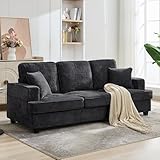
The Korser 89-inch three-seater is the value pick of this roundup and the one most likely to fit the room you actually have. At 89 inches, it lands in the classic three-seat footprint that works in a 10-by-12 or 11-by-13 living room without eating the whole floor. The mid-century modern frame — tapered legs, clean lines, a low-ish back — keeps visual weight down, and chenille upholstery in a budget tier gives you a soft hand and decent abrasion resistance for the money.
This is the sofa for a first apartment, a starter home, a spare room or a rental where you want something that looks intentional rather than temporary. It suits couples and small families of three. It also suits anyone who has measured their room and concluded that a 110-inch sectional simply will not work. It does not suit a household that regularly seats five or more, and it is not the pick if you want a chaise for lying down.
Key Specs
- Width: 89 inches — the most universally fitting footprint in this list
- Seating: three-seater, straight configuration
- Style: mid-century modern frame with tapered legs and a low back
- Upholstery: chenille, a textured tufted-yarn fabric
- Seat: deep-seat class for its size, generally 22-24 inches
- Recommended room: roughly 120-200 square feet
- Clearance needed: about 30-36 inches of walkway in front for comfortable traffic
Strengths
The 89-inch width is the single most useful spec here. It fits through standard 30-to-32-inch doorways with the legs removed, it leaves room for side tables or a floor lamp at each end in a 10-foot-wide room, and it does not force the coffee table into the walkway. In rental apartments, that dimensional modesty is the difference between a room that works and a room where you sidestep furniture to reach the window.
The mid-century frame is also a durability advantage at this price. Exposed tapered legs mean the sofa sits on a simple, repairable base rather than a skirted platform, and the low back reduces the amount of fabric that takes head-and-shoulder abrasion over the years. Chenille in a mid-tone or darker colorway will hold up through several years of daily use with basic care.
Budget pricing is the obvious draw, but it is worth noting what it does not cost you: this is a full three-seater with a deep seat, not a loveseat masquerading as a sofa. You are giving up size, modularity and premium cushion construction — not basic function.
Pros
- 89-inch width fits small and mid-size rooms and most doorways
- Lowest price tier in this roundup
- Mid-century silhouette looks deliberate rather than cheap
- Chenille texture hides everyday wear better than flat weaves
- Deep seat for its size supports comfortable lounging
Cons
- Seats only three; no chaise or corner seating
- Not modular, so it cannot be reconfigured or split
- Budget-tier cushion construction will soften faster under daily use
- Chenille can pill at the seat front and armrests over time
- Limited seating for households that host often
How It Compares
Against the TYBOATLE faux leather three-seater, this is the same straight-sofa format at a lower tier with a very different surface: soft chenille that needs vacuuming versus wipe-clean faux leather with USB ports. If you have pets and kids, the TYBOATLE’s surface is easier to live with; if you want warmth, softness and a lower price, the Korser wins. Against the ERYE 95-inch L-shaped cloud sectional, the Korser is six inches narrower, cheaper, firmer and simpler — the ERYE adds a chaise and a softer sit for a modest step up. If you have a corner to fill and want to lie down, the ERYE is the better use of the same budget. If your room is tight and a chaise would block a walkway, the 89-inch Korser is the safer buy.
6. ERYE 95″ L-Shaped Cloud Sectional – Best for a Budget Cloud Look with a Chaise

The ERYE 95-inch L-shaped sectional is the budget route into the cloud-sofa category. It uses the same general idea as the premium options — compression-packed foam, a modular L-shape, a right-facing chaise lounge, a low and sprawling profile — at the lowest price tier in this roundup. At 95 inches wide, it also threads the needle between a three-seater and a full-size sectional, which makes it viable in rooms where a 110-inch piece would dominate.
It suits a renter or first-time buyer who wants the soft, low, cozy sectional look without premium pricing, and who has a corner to place the chaise in. It suits a room of roughly 180-280 square feet. It does not suit a household that needs firm, upright seating, and it is not the pick for a formal living room or a room where the sofa will be sat on by five people at once.
Key Specs
- Width: 95 inches in the L configuration
- Shape: modular L-shaped sectional, right-facing chaise lounge
- Construction: compressed “boneless” foam build with no traditional spring deck
- Seat: deep-seat class, typically 22-26 inches on cloud-style builds
- Arrival format: compressed and boxed; expands over roughly 24-72 hours
- Reconfiguration: modular pieces allow limited rearrangement
- Recommended room: roughly 180-280 square feet with a usable corner
Strengths
The value proposition is straightforward: this is the cheapest way in this list to get a chaise and a cloud-style soft sit. A chaise adds a genuinely different kind of seating — you can lie down on it, which no straight sofa in this roundup allows — and it does so without requiring the 110-inch-plus footprint of the larger sectionals.
Compression construction brings practical delivery benefits. The pieces arrive boxed and expand after unboxing, which means the sofa can be carried up a narrow stairwell by one or two people rather than delivered by freight. For renters in walk-up buildings, that alone can decide the purchase.
The 95-inch width is also a good compromise size. It is wide enough to seat three comfortably along the main run, plus one or two on the chaise, but narrow enough to fit a room where a 110-inch sectional would leave no walkway. The low back keeps the room feeling open rather than closed in.
Pros
- Lowest-tier entry into the cloud sectional category
- Chaise lounge adds lie-down seating that straight sofas lack
- 95-inch width fits rooms that cannot take a 110-inch sectional
- Ships compressed, which simplifies delivery and stairwells
- Modular pieces allow some reconfiguration
Cons
- Compression foam will soften faster than higher-density cushion builds
- Right-facing chaise is fixed in orientation
- Very soft seat offers limited back support
- Low arms give no side support for leaning or resting a drink
- Expansion takes a day or more before reaching full size
How It Compares
Against the GRUSIGN Cloud sectional, the ERYE is the budget version of the same concept: smaller, less oversized, and built to a lower price point, but delivering the same soft, low, compression-foam experience. If comfort and budget are the two priorities and space is limited, the ERYE is the sensible buy; if you want the largest, deepest, most premium cloud build, the GRUSIGN is the upgrade. Against the Korser 89-inch three-seater, the ERYE costs a step more but adds a chaise and a softer sit — worth it if you have a corner and like to lie down, not worth it if the room is tight or you mostly sit upright.
How to Choose
Start With the Room, Not the Sofa
The most common sofa-buying mistake is choosing the piece first and discovering the fit problem on delivery day. Work in reverse: measure the room, subtract the walkways, and let the remaining rectangle tell you the maximum sofa footprint. A comfortable main walkway is 30-36 inches. A secondary path behind a sofa or along a wall can be 24 inches. Anything under 18 inches is not a walkway — it is a gap you will squeeze through sideways, and it will annoy you every day.
Also measure the sofa’s depth, not just its width. A standard three-seater is roughly 34-38 inches deep; a deep-seat cloud sectional can run 40-44 inches. In a 12-foot-wide room, an extra 6 inches of depth is the difference between a 36-inch walkway and a 30-inch one.
| Living Room Footprint | Max Sofa Width That Keeps Walkways | Best Configuration | Example From This List |
|---|---|---|---|
| Under 120 sq ft (small apartment) | Up to 78-80 in | Loveseat or compact 2-seater | Smaller than anything here — size down |
| 120-200 sq ft | 84-90 in | Straight 3-seater | Korser 89″ three-seater |
| 180-280 sq ft | 90-100 in | Compact L-shape with chaise | ERYE 95″ L-shaped sectional |
| 220-350 sq ft | 105-112 in | Full L-shape with chaise | Korser 110″ modular sectional |
| 250-400 sq ft | 110-115 in | L-shape or U-shape sectional | GRUSIGN Cloud / TROMIRY U-shape |
| 400+ sq ft (open plan) | 112 in+ or two pieces | U-shape plus accent chair | TROMIRY 112″ U-shaped sectional |
Measure the Path, Not Just the Room
A sofa that fits the room but not the hallway is a sofa that lives in the hallway. Before ordering, measure the narrowest point on the delivery route: the front door, the interior door into the living room, the stairwell turn, and the elevator opening if you live in a building. A standard interior door is 30-32 inches wide; a standard apartment elevator door is 36 inches. A fixed 112-inch sofa will not pass a tight stairwell turn. A modular sectional will, because it arrives as separate pieces — and a compression-packed sofa will, because the boxes are smaller still than the assembled pieces. This is the strongest practical argument for modular construction if you live above the first floor.
Fabric Durability: What the Numbers Actually Mean
Upholstery durability is measured by the Wyzenbeek double-rub test, which abrades fabric with a standard cloth until it shows wear. The widely used thresholds are 15,000 double rubs for light residential use, 25,000 for heavy residential use, and 30,000 or more for commercial settings. Most mid-tier residential sofas land in the 15,000-25,000 band. That number matters, but it is not the only thing that decides how a fabric ages in a real house.
| Fabric Class | Typical Abrasion Range | Pet Hair & Cleanup | What Wears First |
|---|---|---|---|
| Chenille | 15,000-25,000 double rubs | Traps hair; needs regular vacuuming | Pilling at seat front and armrests |
| Corduroy (ribbed pile) | 15,000-25,000 double rubs | Traps hair and dust in the ribs | Crushing and flattening of the pile |
| Faux leather (PU) | Not measured the same way; surface-based | Sheds hair; wipes clean in seconds | Cracking and peeling at flex points |
| Tight woven performance fabric | 30,000-50,000 double rubs | Resists staining; hair sits on the surface | Fading in direct sun |
| Linen and linen blends | 10,000-15,000 double rubs | Traps hair; stains absorb quickly | Permanent creasing and staining |
The practical takeaway: if you have a shedding dog and a toddler, faux leather or a tight performance weave will cost you less in cleaning time than any pile fabric. If you want softness and warmth and are willing to vacuum weekly, chenille and corduroy are excellent and far more forgiving of visible scuffs than linen.
Cushion Support: Foam Density and What Sags First
Seat cushions are graded by foam density in pounds per cubic foot. A 1.8 lb/ft³ foam is the residential standard and will feel supportive for roughly three to five years of daily use before it softens noticeably. A 2.5 lb/ft³ high-resilience foam holds its shape considerably longer and is the specification to look for if the sofa will be the household’s primary seat. Above that, feather-and-down blends feel luxurious but need fluffing daily and pack down over time. Compression-packed “boneless” foam sits in its own category: extremely soft on arrival, but it relies on the foam regaining and holding its loft, so it needs periodic rotation and fluffing.
What wears first on almost every sofa is not the frame — it is the seat cushion core, followed by the front edge of the cushion where people slide off, and then the armrests where hands and heads rest. Back cushions lose loft before seat cushions lose support. If you want a sofa to look new for a decade, budget for replacing the seat foam or the cushion covers rather than replacing the whole piece.
The Seating Capacity Calculation
Plan for 24-30 inches of seat width per adult. Children need about 18-20 inches. Then subtract the arms and the frame. A 112-inch U-shaped sectional with arms roughly 10 inches total leaves about 102 inches of usable width across the back run — that is three to four adults, plus two more on each return of the U, for a total of five to six. An 89-inch straight three-seater with the same arm allowance leaves about 79 inches, which is two adults comfortably and three in a squeeze. This is why an 89-inch sofa advertised as a three-seater is often a comfortable two-and-a-half in practice.
The Cost-Per-Use Calculation
Furniture pricing is easier to judge per day than per purchase. Take a mid-range sectional at roughly $1,200 in the current market, assume an eight-year lifespan under daily use, and the math runs: $1,200 ÷ (8 × 365) = about $0.41 per day for the household, or roughly $0.14 per day per person in a three-person home. A budget three-seater at roughly $600 over six years works out to about $0.27 per day, or $0.09 per person per day. The mid-range piece costs more per day but generally holds its shape longer and looks presentable for more of its life. The honest comparison is not “cheap versus expensive” — it is cost per comfortable year.
Layout Fit by Room Shape
Room shape matters as much as square footage. A long, narrow living room — say 11 by 18 feet — punishes deep sectionals, because the chaise juts into the walking path between the entry and the far wall. In that room, a straight 89-inch three-seater along the long wall, with two accent chairs opposite, beats any sectional. A square room of 13 by 13 feet is the opposite case: a corner L-shape uses the dead corner and leaves a clean rectangle of floor in the middle. An open-plan space of 20 by 25 feet can absorb a 112-inch U-shape, but only if the sofa’s back faces the dining zone so it acts as a soft room divider rather than an obstacle in the middle of the floor.
Ownership Realities Nobody Mentions at Checkout
Three things decide whether you still like a sofa after two years. The first is cushion maintenance: seat cushions need rotating and flipping every few months if the sofa has removable, reversible cushions, and compression-foam sofas need fluffing more often than that. The second is the crevice problem — crumbs, coins, hair ties and pet hair collect in the gap between the seat and back cushions, and a vacuum crevice tool is the only practical answer. The third is sunlight: any upholstery will fade where direct sun lands, and faux leather is more vulnerable to cracking when it dries out under UV exposure, so a sunny bay window is the worst place for a PU sofa.
Common Mistakes to Avoid
- Buying the biggest sofa the room can hold. Leave at least one wall visually open or the room reads as a furniture warehouse.
- Ignoring seat height. Most sofas sit 17-19 inches from floor to seat top. If anyone in the household has knee or hip issues, aim for the upper end of that range, not a low cloud build.
- Skipping the doorway measurement. A 110-inch one-piece frame does not bend.
- Choosing color from a phone screen. Dark grey, blue and beige all shift significantly under a room’s actual lighting.
- Forgetting the rug. A rug should extend at least 6-12 inches beyond the sofa’s front edge, and ideally the front legs of all seating should sit on it. A rug that stops short of the sofa makes the room look unfinished.
- Assuming “modular” means endlessly rearrangeable. Most modular sofas allow a handful of sensible configurations, not infinite ones.
Frequently Asked Questions
What size sofa fits a 12 by 14 foot living room?
A 12 by 14 foot room is 168 square feet, which comfortably takes an 89-95 inch sofa or a compact L-shaped sectional. If you place the sofa along the 14-foot wall, an 89-inch three-seater leaves about 79 inches at one end — enough for a side table and a floor lamp, or a walkway to a window. A 110-inch sectional in this room only works if it sits in a corner and you accept a single 30-inch walkway rather than walkways on both sides.
Is chenille or corduroy better for pets and kids?
Both are pile fabrics, so both trap pet hair and need regular vacuuming with an upholstery attachment. Corduroy’s ribbed structure hides scuffs and light wear slightly better, while chenille tends to be smoother and easier to brush clean. Neither is as practical as faux leather or a tight performance weave if shedding pets are part of the household. If you want softness anyway, choose a mid-tone or darker colorway in either fabric, since light colors show every hair.
How deep should a sofa seat be for someone who is 5’4″ versus 6’2″?
A seat depth of 20-22 inches suits most people around 5’4″, because the back of the knees reaches the cushion edge without a gap. Someone around 6’2″ generally prefers 24-26 inches of seat depth for proper thigh support. Cloud-style sofas often run 26 inches or more, which is excellent for lounging but can leave shorter sitters with their feet off the floor unless they add a cushion behind them. Measure from the front edge of the seat to the back cushion, not to the frame.
Do modular sectionals actually fit through narrow doorways?
Yes, and that is their biggest practical advantage. Modular pieces typically arrive as separate boxes small enough to pass a 30-32 inch interior door and to be carried up a stairwell by two people. Compression-packed sofas go further, because the foam is vacuum-compressed for shipping and the boxes are smaller still. A fixed one-piece sectional of 110 inches or more generally cannot make a tight stairwell turn regardless of how strong the delivery crew is.
How long should sofa cushions last before they sag?
Standard residential foam at around 1.8 lb/ft³ typically softens noticeably after three to five years of daily use in the seats people favor. High-resilience foam at 2.5 lb/ft³ or higher commonly holds its shape for seven to ten years with periodic rotation. Compression-foam cloud sofas sit between the two: they stay soft by design, but they need fluffing and rotating to avoid developing permanent divots in the most-used seat.
Is a boneless or compression-foam sofa durable?
Compression foam is durable in the sense that it does not have springs to break or webbing to stretch, and it recovers well when rotated. Its weakness is loft retention: without periodic fluffing, the most-used seat compresses permanently and develops a visible dip. Treat it as a maintenance-dependent construction rather than a low-maintenance one, and expect the softness to be a feature you actively maintain rather than a property that stays constant.
Will a U-shaped sectional make a small living room feel cramped?
Usually yes, if the room is under about 220 square feet. A U-shape wraps three sides of the seating area, which works beautifully in a large room but crowds a small one and can block the only natural walking route. In small rooms, a straight three-seater with two light accent chairs gives the same seating count with far more visual breathing room.
Is faux leather a bad choice in a sunny room?
It is riskier than fabric in direct sun. Polyurethane leather can dry out and crack under sustained UV exposure, and the damage tends to appear at flex points such as the front edge of the seat and the top of the backrest. If the sofa will sit in a bright bay window, either choose a fabric or plan on blinds and a throw over the sunniest section during peak hours.
Should I buy the sofa or the rug first?
Buy the sofa first, then size the rug to it. The rug should extend at least 6-12 inches past the sofa’s front edge, and in a seating group the front legs of every piece should rest on the rug. Buying the rug first often leads to a rug that is either too small for the sofa or so large that it swallows the room’s proportions.
The Short Version
Match the sofa to the room and the household, and the decision becomes simple. For a large living room where five or six people sit down together, the TROMIRY 112-inch U-shaped sectional is the best overall pick — maximum seating, forgiving chenille, mid-range tier. For a small or mid-size room on a tight budget, the Korser 89-inch three-seater chenille sofa fits where larger pieces cannot and costs the least. For renters and anyone whose layout may change, the Korser 110-inch modular sectional buys flexibility that a fixed frame never will. For pure comfort and lounging, the GRUSIGN Cloud sectional is the premium choice, with the ERYE 95-inch L-shaped cloud sectional delivering the same soft, low, chaise-equipped idea at budget pricing. And if you want a surface you can wipe clean in thirty seconds, plus a built-in place to charge a phone, the TYBOATLE faux leather three-seater is the only option here that does it. Whichever you choose, measure the room, measure the doorway, and leave yourself a 30-inch walkway — those three numbers decide more about how much you enjoy a sofa than any fabric swatch.
