What's inside
As an Amazon Associate I earn from qualifying purchases. This post may contain affiliate links at no extra cost to you.
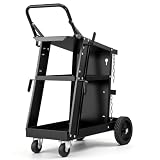
The best budget welding cart for most home workshops is a two-shelf steel cart rated for at least 180 lb, with a 9–12 inch cylinder cradle, 4–6 inch swivel casters, and enough handle clearance to lift and move the cart without striking the welder’s controls.
Cheap carts often look similar in photographs, but their useful capacity varies considerably. The important question is not whether a cart can hold a welder; it is whether the shelves, bottle restraint, wheels, and handle arrangement remain safe when the cart is fully loaded with a machine, cables, gas regulator, and consumables.
As an Amazon Associate we earn from qualifying purchases at no extra cost to you.



What we cover
Best budget welding cart choices by workshop situation
| Workshop situation | Best cart type | Minimum useful specification | Typical market range |
|---|---|---|---|
| Small garage or occasional repairs | Compact two-wheel cart | 24–30 in long, 14–18 in wide, 150 lb capacity | $60–$110 |
| Frequent MIG or flux-core welding | Three-shelf steel cart | 30–36 in long, 18–22 in wide, 200 lb capacity | $100–$180 |
| MIG machine plus plasma cutter | Heavy-duty multi-shelf cart | 225 lb capacity, 20 in or wider lower shelf | $150–$250 |
| Uneven concrete, thresholds, or outdoor use | Large-wheel cart with pneumatic or semi-pneumatic tires | 8–10 in wheels, locking front casters, braked axle | $120–$250 |
What makes a budget welding cart worth buying?
Capacity and shelf dimensions
Start with the combined weight of the equipment, not the advertised weight of the welder alone. A 45 lb inverter welder can become a 110 lb load after adding a full gas cylinder, regulator, wire spool, leads, helmet, clamps, and hand tools. A cart rated at 100 lb leaves little margin for vibration, uneven floors, or accidental impact.
For a general-purpose setup, look for a top shelf at least 20 inches wide by 16 inches deep. That accommodates most compact MIG, multiprocess, and TIG machines while leaving room for the power cord to exit without being pinched. A lower shelf around 24–30 inches wide and 16–20 inches deep is more useful than a narrow tray because it can hold a welding helmet, gloves, spare wire, and a small grinder.
Check the shelf lip as well. A 1–2 inch raised edge prevents tools from sliding off, but a high front lip can obstruct cable routing and make it difficult to lift a heavy machine. Slotted shelves are convenient for cleaning, while solid shelves better contain small accessories and grinding dust.
Cylinder security is more important than extra storage
A gas cylinder should sit in a dedicated cradle or recessed base, not merely on a flat shelf. The cradle should support the lower curve of the bottle and keep it from rolling toward the wheels. Look for a chain, strap, or rigid retaining bar positioned in the upper third of the cylinder.
Measure the cylinder diameter before ordering. Common small and medium welding bottles are roughly 7–9 inches in diameter, but a cart designed around a 7-inch bottle may not safely accept a larger 9-inch bottle. Allow at least 1 inch of clearance around the bottle for insertion and removal; excessive clearance is unsafe because the retaining strap must pull the cylinder firmly against the back support.
Two restraint points are preferable: a lower chain or strap near the shoulder of the base and a second restraint higher up. A single loose chain can stop a bottle from rolling but may not prevent it from tipping. Never rely on the regulator, hose, or machine frame to hold a cylinder upright.
Wheel quality and floor conditions
Small hard casters are inexpensive and maneuver well on smooth shop floors, but they catch on cracks, door thresholds, extension cords, and metal debris. For a stationary garage workshop, 4-inch rear wheels with 2–3 inch swivel casters are usually adequate. For rough concrete, choose 8-inch or larger wheels and keep the cylinder low to reduce tipping.
Locking swivel casters are useful only when their brakes are easy to reach. A cart can still move if the wheels lock but the frame rocks on an uneven floor. Large fixed rear wheels make a cart easier to pull over thresholds, while four swivel casters offer better positioning but can wander when pushed sideways.
Inspect wheel attachment hardware. Thin stamped brackets and small rivets are common failure points. Bolted caster plates are easier to tighten or replace than welded-on lightweight brackets. Shielded bearings matter in shops where grinding dust is frequent.
Handle clearance and cable routing
The handle should clear the welder’s front panel, gas regulator, and cable connectors. A useful handle is normally 5–8 inches behind the machine and at least 30 inches above the floor. If the handle sits directly against the welder, it can block the power switch, catch the gun lead, or make the machine awkward to remove.
Look for a handle with a crossbar that does not interfere with the gas hose. Cable hooks or side loops are valuable, but sharp-edged hooks can damage MIG liners and TIG hoses. Rounded welded loops or removable hooks are safer. The best layouts leave one side open for the work lead and torch connections rather than forcing every cable over the handle.
Head-to-head: compact two-wheel cart versus three-shelf cart
| Feature | Compact two-wheel cart | Three-shelf cart |
|---|---|---|
| Typical footprint | 24–30 × 14–18 in | 30–36 × 18–22 in |
| Practical loaded weight | 100–150 lb | 150–225 lb |
| Typical cylinder capacity | One 7–9 in bottle | One 7–9 in bottle, sometimes two small bottles |
| Best advantage | Small footprint and lower price | Better separation of machine, tools, and supplies |
| Main weakness | Limited storage and more tipping risk when overloaded | Heavier, harder to turn, and more assembly hardware |
Choose the compact design when the cart must fit beside a vehicle or workbench and the machine will be removed regularly. Choose the three-shelf design when the welder stays assembled and you routinely carry wire, abrasives, clamps, and protective equipment. An extra shelf is not automatically better: clutter placed high on the cart raises the center of gravity.
Assembly difficulty and the mistakes that matter
Most low-cost carts require 30–90 minutes of assembly. The difficult part is rarely the number of bolts; it is aligning the frame while keeping the cylinder cradle square. A useful assembly sequence is:
- Lay out every fastener and identify the longer bolts before starting.
- Attach the side panels and shelves with all bolts finger-tight.
- Install wheels and set the cart on a flat floor.
- Square the frame by measuring diagonally from corner to corner.
- Tighten the frame gradually, alternating sides rather than fully tightening one corner.
- Fit the cylinder chain or strap only after confirming that the bottle sits centered and cannot contact the wheels.
Do not substitute random bolts for missing hardware. A bolt that is too long can protrude into the cylinder area or interfere with a caster. After the first loaded move, inspect every fastener again; painted steel often compresses around washers during initial use.
Worked fit check before purchase
Suppose a welder is 18 inches wide and 15 inches deep. Adding 2 inches of side clearance and 2 inches behind the machine gives a minimum top shelf width of 20 inches and depth of 17 inches. If the machine weighs 48 lb, the cylinder weighs 55 lb when full, and accessories add 22 lb, the working load is:
48 + 55 + 22 = 125 lb.
A cart rated for 150 lb provides only 25 lb of nominal spare capacity. That is acceptable for a smooth floor if the cylinder is low and secured, but a 200 lb cart is the better choice if the cart will cross thresholds or carry a grinder. This calculation also shows why a cart’s stated maximum is not a target load.
Durability and ownership costs
On inexpensive carts, the first parts to wear are usually caster bearings, wheel brackets, cylinder chains, and shelf edges. Grinding dust can stiffen casters, while dragging the cart sideways can bend brackets. Keep the wheels free of wire scraps and periodically tighten caster nuts and frame bolts.
Paint chips around the cylinder cradle and shelf corners should be cleaned and touched up to prevent rust. Do not store a gas bottle directly against bare, sharp steel. A thin rubber mat can reduce sliding, but it must not allow the cylinder to sit high enough to contact the retaining strap incorrectly.
Budget for a replacement chain, two locking casters, and possibly a rubber shelf liner over the cart’s service life. These inexpensive repairs are preferable to replacing a whole cart, provided the main frame has not cracked or twisted.
Final buying recommendation
For the broadest range of home welding work, select a steel three-shelf cart with a 200 lb rating, a top shelf of at least 20 × 16 inches, a lower shelf at least 24 × 18 inches, a 7–9 inch cylinder cradle, two restraint points, and wheels of at least 4 inches. Spend less only when space is the overriding concern.
Before buying, compare the actual shelf measurements with your welder, measure the cylinder diameter, inspect the handle clearance around the regulator, and confirm that the wheels suit your floor. Those checks reveal more about whether a cart is safe and useful than the number of shelves or the lowest advertised price.