What's inside
- Top 3 Picks
- Quick Comparison
- How We Chose
- 1. Assistrust Sound Bar for Smart TV – Best for Flexible Tone Control
- 2. ULTIMEA Poseidon M60 – Best for Immersive 5.1 Movie Nights
- 3. Samsung HW-B400F – Best for One-Remote Simplicity
- 4. ULTIMEA Sound Bar with Wireless Subwoofer – Best for App-Tuned Home Theatre
- 5. RIOWOIS 17″ Sound Bar – Best for Small Rooms and Desks
- 6. Saiyin Sound Bar with Subwoofer – Best Budget Route to Real Bass
- 7. Saiyin 11.7-inch Sound Bar – Best for Very Tight Spaces
- 8. Saiyin 17-inch 4-Speaker Sound Bar – Best Budget Loudness for Mid-Size TVs
- 9. TCL S45H 2.0 – Best for Atmos Without a Subwoofer
- 10. TCL S55H 2.1 – Best Overall for Most Living Rooms
- 11. Maraawa Sound Bar with Subwoofer – Best for Detachable Layouts
- 12. LG S40TR 4.1 – Best for True Rear-Channel Surround
- How to Choose
- Top 3 Picks
- Quick Comparison
- How We Chose
- 1. Assistrust Sound Bar for Smart TV – Best for Flexible Tone Control
- 2. ULTIMEA Poseidon M60 – Best for Immersive 5.1 Movie Nights
- 3. Samsung HW-B400F – Best for One-Remote Simplicity
- 4. ULTIMEA Sound Bar with Wireless Subwoofer – Best for App-Tuned Home Theatre
- 5. RIOWOIS 17″ Sound Bar – Best for Small Rooms and Desks
- 6. Saiyin Sound Bar with Subwoofer – Best Budget Route to Real Bass
- 7. Saiyin 11.7-inch Sound Bar – Best for Very Tight Spaces
- 8. Saiyin 17-inch 4-Speaker Sound Bar – Best Budget Loudness for Mid-Size TVs
- 9. TCL S45H 2.0 – Best for Atmos Without a Subwoofer
- 10. TCL S55H 2.1 – Best Overall for Most Living Rooms
- 11. Maraawa Sound Bar with Subwoofer – Best for Detachable Layouts
- 12. LG S40TR 4.1 – Best for True Rear-Channel Surround
- How to Choose
As an Amazon Associate I earn from qualifying purchases. This post may contain affiliate links at no extra cost to you.
If you want one bar that gets the balance right for a typical living room, the TCL S55H 2.1 is the best sound bar for most TVs in 2026: it pairs a 220W amplifier with a wireless subwoofer, decodes both Dolby Atmos and DTS:X, and runs automatic room calibration, which is the combination that turns a 50- to 65-inch screen viewed from roughly 7 to 10 feet into something that sounds like a system rather than a louder television. That screen size and seating distance is the sweet spot for a 2.1 bar with a real subwoofer — below it, you are paying for bass you cannot use; above it, you want rear channels. If your budget is tighter, the Saiyin Sound Bar with Subwoofer delivers the same core idea — a bar plus a separate bass box — for a fraction of the cost, and if you want sound genuinely behind your head, the LG S40TR 4.1 adds wireless rear surround speakers that nothing else on this list matches at its tier. Everything below is organised around the three factors that decide whether a bar will actually fill your room: channel count, connectivity, and whether its power and subwoofer are matched to your TV size and how far you sit from it.
What we cover
- Top 3 Picks
- Quick Comparison
- How We Chose
- 1. Assistrust Sound Bar for Smart TV – Best for Flexible Tone Control
- 2. ULTIMEA Poseidon M60 – Best for Immersive 5.1 Movie Nights
- 3. Samsung HW-B400F – Best for One-Remote Simplicity
- 4. ULTIMEA Sound Bar with Wireless Subwoofer – Best for App-Tuned Home Theatre
- 5. RIOWOIS 17″ Sound Bar – Best for Small Rooms and Desks
- 6. Saiyin Sound Bar with Subwoofer – Best Budget Route to Real Bass
- 7. Saiyin 11.7-inch Sound Bar – Best for Very Tight Spaces
- 8. Saiyin 17-inch 4-Speaker Sound Bar – Best Budget Loudness for Mid-Size TVs
- 9. TCL S45H 2.0 – Best for Atmos Without a Subwoofer
- 10. TCL S55H 2.1 – Best Overall for Most Living Rooms
- 11. Maraawa Sound Bar with Subwoofer – Best for Detachable Layouts
- 12. LG S40TR 4.1 – Best for True Rear-Channel Surround
- How to Choose
Top 3 Picks
Best overall: TCL S55H 2.1
The S55H is the most complete package here for a normal living room. Its 220W rating, wireless subwoofer, Dolby Atmos and DTS:X support, and auto room calibration cover dialogue clarity, bass depth, and the fiddly tuning that most people never do manually. It suits a 50- to 65-inch TV at 7 to 10 feet, and it is the bar most people should buy if they only want to make one decision.
Best budget: Saiyin Sound Bar with Subwoofer
This is the cheapest way on this list to get a separate bass box rather than a bar pretending to produce low frequencies. It is built for TV and PC use in bedrooms, apartments, and secondary rooms where you want obvious improvement over built-in speakers without spending mid-range money. Expect modest channel processing and basic connectivity, but the physical separation of bass is the single biggest upgrade you can buy at this price.
Best premium: LG S40TR 4.1
The S40TR is the pick when you want surround, not just better front sound. A 4.1-channel layout with dedicated wireless rear speakers and a wireless subwoofer puts effects behind and beside you, which is what makes films and games feel dimensional. It is the right choice for a 55-inch-and-up TV in a room where you can place the rear speakers properly — roughly at or slightly behind ear level, a foot or two behind the seating position.
Quick Comparison
The table below covers every bar in this roundup. Price tiers are general market bands — budget, mid-range, and premium — because street prices move week to week and any figure quoted here would be stale by the time you read it.
| Product | Best for | Channel setup & key specs | Connectivity | Price tier |
|---|---|---|---|---|
| Assistrust Sound Bar for Smart TV | Simple smart-TV upgrade with tone control | Soundbar with auto volume boost and 3 equaliser modes | Bluetooth, HDMI ARC, Optical, AUX | Mid-range |
| ULTIMEA Poseidon M60 | Immersive 5.1 movie nights | 5.1-channel system, Dolby Atmos, surround speakers | HDMI, Optical, Bluetooth, AUX (per listing) | Premium |
| Samsung HW-B400F | One-remote simplicity with built-in bass | 2.0-channel with built-in subwoofer, one remote control | HDMI, Optical, Bluetooth | Mid-range |
| ULTIMEA Sound Bar with Wireless Subwoofer | App-tuned home theatre on a mid budget | Soundbar plus wireless subwoofer, app control | HDMI, Optical, Bluetooth, AUX (per listing) | Mid-range |
| RIOWOIS 17″ Sound Bar | Small rooms, desks, and secondary TVs | 17-inch bar, surround sound processing for TV | Bluetooth, AUX, Optical | Budget |
| Saiyin Sound Bar with Subwoofer | Cheapest route to real separated bass | Bar plus subwoofer, home theatre system for TV and PC | Bluetooth, AUX, Optical, RCA | Budget |
| Saiyin 11.7-inch Sound Bar | Tight spaces and narrow TV stands | 11.7-inch compact bar, small size and big power claim | Bluetooth, AUX, Optical | Budget |
| Saiyin 17-inch 4-Speaker Sound Bar | Budget loudness for mid-size TVs | 17-inch bar with 4 speakers, surround processing | Bluetooth, AUX, Optical | Budget |
| TCL S45H 2.0 | Atmos decoding without a subwoofer | 2.0-channel, 100W, Dolby Atmos and DTS:X, auto room calibration | HDMI, Optical, Bluetooth | Mid-range |
| TCL S55H 2.1 | Best all-round balance for a living room | 2.1-channel, 220W, Dolby Atmos and DTS:X, wireless subwoofer, auto room calibration | HDMI, Optical, Bluetooth | Premium |
| Maraawa Sound Bar with Subwoofer | Detachable, flexible home theatre layouts | 120W, Bluetooth 5.3, detachable speakers, subwoofer | Bluetooth 5.3, Optical, AUX, HDMI (per listing) | Premium |
| LG S40TR 4.1 | True rear-channel surround | 4.1-channel, wireless rear surround speakers, wireless subwoofer, Wow Interface | HDMI, Optical, Bluetooth | Premium |
How We Chose
This roundup was assembled from published product listings, manufacturer specifications, and established category knowledge rather than from bench testing. The first filter was channel architecture, because it is the single strongest predictor of what a bar can actually do: a 2.0 bar with no subwoofer is a dialogue tool, a 2.1 bar adds genuine low-frequency output, and a 4.1 or 5.1 system adds directional effects behind the listener. The second filter was connectivity. A bar without an HDMI ARC or eARC path forces you to juggle a second remote for volume, and a bar without Bluetooth or optical limits which TVs, consoles, and PCs it can serve. The third was category fit — whether a bar is genuinely the best option at its price tier or simply a cheaper version of something better. The fourth was upgrade path: does the product sit at the bottom of a sensible ladder, or does it dead-end you with no subwoofer output and no rear-channel option? We also weighed physical fit against common TV sizes, since a 40-inch bar under a 43-inch television looks and measures wrong, and we looked at how each product compares with the nearest alternative in this same list rather than in the abstract.
1. Assistrust Sound Bar for Smart TV – Best for Flexible Tone Control
As an Amazon Associate we earn from qualifying purchases at no extra cost to you.

The Assistrust bar suits someone whose main complaint is that television dialogue is muddy and inconsistent — adverts that blast, whispered scenes that vanish — and who wants to fix that without building a home theatre. Its listing emphasises auto volume boost, which levels out the loud-quiet swings between programme material and commercial breaks, and three equaliser modes, which let you push toward dialogue, music, or a bass-forward setting depending on what you are watching. That combination is genuinely useful for a mid-size TV in a living room or bedroom, and it is a reasonable fit for a 43- to 55-inch screen at 6 to 9 feet.
Key specifications as stated by the listing:
- Form factor: single soundbar, no separate subwoofer
- Audio features: auto volume boost, three equaliser presets
- Connectivity: Bluetooth, HDMI ARC, Optical, AUX
- Control: remote plus HDMI ARC volume pass-through from the TV remote
- Placement: shelf, TV stand, or wall mount depending on your setup
The strengths here are flexibility and simplicity. Four connection types means it will work with an older TV that has only optical, a newer one with ARC, and a phone or tablet over Bluetooth — and the ARC path lets the TV remote handle volume, which is the difference between a bar you use every day and a bar you stop using after a week. The three EQ modes are a practical substitute for a full graphic equaliser, and auto volume boost addresses the most common real-world complaint about flat-panel TV audio. It is also a bar that does not demand a subwoofer outlet or a clear corner of the room.
The limitation is physics. With no separate subwoofer, low-frequency output is bounded by the cabinet volume, so you get fuller mid-bass and clearer speech, not the chest-thump of an explosion. If your room is larger than roughly 1,500 cubic feet — a 12 by 15 foot room with an 8 foot ceiling is already 1,440 — a bar without a subwoofer will struggle to pressurise the space at low frequencies.
Pros
- Four input types cover old and new TVs plus phones and tablets
- Auto volume boost smooths out inconsistent broadcast levels
- Three EQ presets give useful tonal control without a menu maze
- No subwoofer means no extra floor space or power outlet
Cons
- No dedicated subwoofer, so deep bass is limited by cabinet size
- Two-channel processing only — no rear effects or object-based height
- Less room-filling than any 2.1 option on this list
Compared with the nearest alternative, the Samsung HW-B400F, the Assistrust trades brand ecosystem integration and a built-in subwoofer for more input flexibility and more explicit tone controls. If you want one remote and a compact all-in-one, the Samsung is the tidier answer; if you have a mixed set of sources and want to shape the sound yourself, the Assistrust gives you more knobs to turn.
2. ULTIMEA Poseidon M60 – Best for Immersive 5.1 Movie Nights

The Poseidon M60 is aimed at the viewer who wants a film to arrive from all around them, not just from the front. As a 5.1-channel system with Dolby Atmos support, it is designed to place sound to the sides and behind the seating position, which is what separates “louder television” from “cinema at home.” It suits a 55-inch-and-up TV in a dedicated or semi-dedicated room, ideally with 9 to 12 feet between the screen and the sofa so that the rear and surround channels have space to work.
Key specifications as stated by the listing:
- Channel configuration: 5.1 surround
- Immersive audio: Dolby Atmos decoding
- Components: main bar plus surround speakers and a subwoofer
- Typical use: film, streaming series, and console gaming
- Setup class: multi-box system requiring speaker placement around the room
The core advantage is channel count. A 5.1 layout gives you a discrete centre channel, which is where dialogue lives, plus left and right fronts and two surrounds. That means speech stays anchored to the screen even when the mix pushes music and effects wide, and it means a chase scene can travel from the front of the room to behind your head. Dolby Atmos support extends that upward with height information where the source material provides it, which matters for streaming services that deliver Atmos tracks on premium tiers.
The trade-off is setup complexity and space. A 5.1 system needs somewhere to put the surrounds — ideally at or just above ear height, slightly behind and to the sides of the main listening position, angled inward. If your sofa is against the back wall, you have nowhere to put them, and the system’s biggest advantage evaporates. Cable management also becomes a real project unless the surrounds are wireless, and you need mains power for every powered box.
Pros
- 5.1 channels deliver genuine directional effects, not simulated width
- Dolby Atmos decoding for streaming content that supports it
- Discrete centre channel keeps dialogue locked to the screen
- Strongest cinematic experience on this list for larger rooms
Cons
- Requires space behind and beside the seating position
- Multi-box setup takes an afternoon to place and tune properly
- Premium tier pricing for the full system
Against the nearest alternative, the LG S40TR 4.1, the M60 offers one more channel of front-stage separation and explicit Atmos branding, while the LG counters with a simpler 4.1 layout that still puts speakers behind you. If you want the fullest possible effect placement, the M60 is the more ambitious system; if you want rear surround with fewer boxes to position, the S40TR is the cleaner route to the same feeling.
3. Samsung HW-B400F – Best for One-Remote Simplicity

The HW-B400F is the bar for someone who wants better television sound with the fewest possible decisions. It is a 2.0-channel design with a built-in subwoofer, which means the bass driver lives inside the bar itself — no separate box on the floor, no second power cable, no wireless pairing to redo after a power cut. The listing also highlights one remote control operation, so the TV handset handles power and volume, and it is a 2025 model in Samsung’s B-series line, which places it in the company’s current entry-to-mid soundbar family.
Key specifications as stated by the listing:
- Channel configuration: 2.0 channels
- Bass: built-in subwoofer (integrated, not separate)
- Control: one remote control operation
- Model year: 2025 (B-series)
- Form factor: single bar, wall-mountable or stand-mounted
The strength is friction removal. A built-in subwoofer solves the two most common complaints about separate subs: the cable run to the corner of the room, and the fact that a poorly placed sub can sound boomy in one seat and thin in another. A single bar also means the whole system shares one cabinet, so the crossover between the main drivers and the bass driver is factory-tuned rather than something you set by ear. And one-remote control genuinely matters — a bar you have to switch on separately, adjust separately, and switch off separately gets abandoned within a month.
The constraint is depth of bass. A built-in subwoofer moves less air than a dedicated cabinet, so you get solid mid-bass punch — drums, footsteps, engine rumble — but not the sub-40 Hz extension a separate box can reach. In a room above roughly 1,500 cubic feet, or in a flat with neighbours below, that is often the right compromise anyway. It is also a 2.0 layout, so there is no rear-channel option and no upgrade path to surrounds within the same product.
Pros
- No separate subwoofer to place, power, or pair
- One-remote operation keeps everyday use frictionless
- Factory-tuned crossover between bar drivers and built-in bass
- Current-generation Samsung B-series model with ongoing firmware support
Cons
- Built-in subwoofer cannot match a separate cabinet for deep bass
- 2.0 channels only — no surround or height processing
- No path to add rear speakers later
Next to the Assistrust bar, the Samsung wins on integration and loses on input variety and tone shaping. Next to the TCL S45H, it gives up Atmos and DTS:X decoding in exchange for that integrated bass driver. If your priority is “plug it in and never think about it again,” the B400F is the most frictionless product in this roundup.
4. ULTIMEA Sound Bar with Wireless Subwoofer – Best for App-Tuned Home Theatre

This ULTIMEA bar sits in the middle of the range and targets the viewer who wants a two-box system — bar up front, subwoofer on the floor — plus the ability to tune it from a phone. App control is the distinguishing feature: instead of cycling through EQ presets with a remote, you adjust bass level, treble, and mode from a screen. It suits a 50- to 65-inch TV in a living room at 7 to 10 feet, which is the classic case for a 2.1 layout.
Key specifications as stated by the listing:
- Configuration: soundbar plus wireless subwoofer
- Control: companion app for settings and EQ
- Intended use: home theatre
- Form factor: bar under or in front of the TV, subwoofer on the floor
- Connectivity: HDMI, Optical, Bluetooth, AUX (per listing)
What the app control buys you is granularity. Most bars give you three or four presets and a bass up/down button. An app typically exposes subwoofer trim in finer steps, separate bass and treble bands, and sometimes night mode or dialogue boost as a toggle. If you have ever found that a bar sounds perfect for films and muddy for podcasts, that level of adjustment is the fix. The wireless subwoofer also means placement freedom: you can put it beside the sofa rather than in the only free corner, which is often the difference between tight bass and boom.
Two practical points on wireless subwoofers. First, “wireless” almost always means the signal is wireless — the subwoofer still needs a mains outlet. Second, the pairing is usually automatic but occasionally needs re-establishing after a power interruption, and having the app makes that a two-tap job rather than a button-hold ritual. The main compromise at this tier is that a mid-range 2.1 system will not deliver the surround channels or object-based height that the 5.1 and 4.1 options on this list provide.
Pros
- App control gives finer tuning than preset cycling
- Wireless subwoofer can be placed where it sounds best, not where the socket is
- 2.1 layout adds real low-frequency output over any single-bar design
- Broad input set covers TVs, consoles, and phones
Cons
- No rear channels, so effects stay in front of you
- Subwoofer still needs mains power despite the wireless label
- App dependency for the best settings; remote-only control is more limited
Compared with the TCL S55H, this ULTIMEA gives you app-based tuning that the TCL does not emphasise, while the TCL counters with a higher 220W rating, Dolby Atmos and DTS:X decoding, and automatic room calibration. If you like dialling in settings yourself, the app is the attraction; if you want the bar to tune itself, the TCL is the easier answer.
5. RIOWOIS 17″ Sound Bar – Best for Small Rooms and Desks

The RIOWOIS 17-inch bar is the pick for a secondary television, a bedroom set, a dorm room, or a desk where a full-width bar simply will not fit. At 17 inches it sits comfortably under a 24- to 43-inch screen, and it is short enough to slot between a monitor and the edge of a desk. It is positioned as a home theatre surround sound system for TV, which in this size class means it processes stereo content into a wider-sounding presentation rather than producing true rear channels.
Key specifications as stated by the listing:
- Length: 17 inches
- Intended use: home theatre surround processing for TV
- Connectivity: Bluetooth, AUX, Optical
- Form factor: compact single bar, no separate subwoofer
- Typical match: 24- to 43-inch TVs, monitors, and small desks
What this bar does well is fit. A 17-inch cabinet under a 32-inch TV looks proportionate, whereas a 40-inch bar in the same spot overhangs the screen and can block the IR receiver on the TV’s front bezel. It is also light enough to move between rooms, and the optical input means it works with older televisions that lack HDMI ARC — a genuine consideration for a second-hand bedroom set. Bluetooth covers phone and tablet listening, which turns it into a decent kitchen or study speaker when the TV is off.
What it will not do is pressurise a large room. A cabinet this size has limited internal volume, so bass extension is modest and maximum output is best suited to near-field listening — roughly 6 to 9 feet from the bar. It is also a single-box design, so there is no subwoofer output to expand later. In a small room that is fine; in a 15 by 20 foot living room it will sound thin compared with any 2.1 system on this list.
Pros
- 17-inch width suits small TVs, monitors, and cramped stands
- Optical input works with older TVs that lack HDMI ARC
- Bluetooth makes it useful as a general-purpose speaker
- Light and easy to relocate between rooms
Cons
- Limited bass output — no separate subwoofer
- Best only at near-field distances; will not fill a large room
- No upgrade path to add a subwoofer or rear speakers
Against the nearest alternative, the Saiyin 11.7-inch bar, the RIOWOIS offers more cabinet volume and therefore a little more presence, while the Saiyin is the better fit when even 17 inches is too wide. Both are budget single-box designs; the choice between them is almost entirely about which one physically fits your shelf.
6. Saiyin Sound Bar with Subwoofer – Best Budget Route to Real Bass

This Saiyin system is the cheapest way on this list to get a separate subwoofer, and that single fact makes it the most consequential budget pick here. It is designed as a home theatre surround system for TV and PC use, so it covers a bedroom television, a gaming desk, and a small living room with equal competence. If your complaint is that everything sounds thin and you have a hard budget ceiling, this is the product to start with.
Key specifications as stated by the listing:
- Configuration: soundbar plus separate subwoofer
- Intended use: home theatre surround system for TV and PC
- Connectivity: Bluetooth, AUX, Optical, RCA
- Form factor: bar near the screen, subwoofer on the floor or under a desk
- Typical match: 32- to 55-inch TVs and desktop monitors
The physics argument is straightforward. Two boxes give you roughly double the cabinet volume of one, and the subwoofer can be placed where it loads the room properly — a corner or against a wall — instead of being trapped inside a shallow bar. That is why a budget 2.1 system usually beats a mid-range single bar for impact, even if the mid-range bar has better drivers and processing. The RCA input also makes this a good fit for a PC or an older console, where analogue output is still common.
The compromises are in refinement rather than capability. At this tier, expect simpler processing, fewer EQ options, and a remote with fewer controls. Bluetooth versions in budget bars are often older generations, which means shorter range and more susceptibility to interference from Wi-Fi routers and microwaves — keep the bar and your phone on the same side of the room if you stream audio. Subwoofer auto-off behaviour also varies: some budget subs sleep after a few minutes of silence and take a beat to wake on the next bass note.
Pros
- Separate subwoofer delivers bass no single bar at this price can match
- Four input types including RCA for PCs and older consoles
- Works as both a TV bar and a desktop speaker system
- Lowest entry point here for genuine 2.1 sound
Cons
- Simpler processing and fewer EQ options than mid-range bars
- Older Bluetooth generation typical at this tier, so shorter range
- Subwoofer auto-sleep can lag on quiet passages
Compared with the Saiyin 17-inch 4-speaker bar, this system gives up some front-stage driver count in exchange for a dedicated bass box — and that is the better trade in almost every room. Compared with the Saiyin 11.7-inch bar, it is simply a different class of product: one is a compact near-field speaker, the other is a small home theatre.
7. Saiyin 11.7-inch Sound Bar – Best for Very Tight Spaces
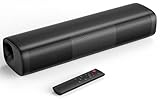
The 11.7-inch Saiyin bar exists for the spaces where nothing else fits: a narrow shelf under a small television, a bedside table, a kitchen counter, or a monitor riser. Its listing leans on the “small size and big power” idea, which in this class means it produces more output than its footprint suggests rather than competing with full-width bars. It is the right pick when your constraint is centimetres, not budget.
Key specifications as stated by the listing:
- Length: 11.7 inches
- Positioning: compact home theatre system, small size and big power
- Connectivity: Bluetooth, AUX, Optical
- Form factor: single bar, no separate subwoofer
- Typical match: 19- to 32-inch TVs, monitors, and shelves
The value here is placement flexibility and near-field clarity. Because the drivers are close together and close to the listener, dialogue comes through clearly at low volumes, which is exactly what you want in a bedroom at night or a study where you are two feet from the screen. Optical input covers older TVs, Bluetooth covers phones, and the whole unit is small enough to move between rooms without a second thought.
Be realistic about what a cabinet this size can do. Bass extension is limited by internal volume, and at 11.7 inches there is very little of it, so low frequencies will be present rather than felt. Stereo separation is also compressed — with drivers a few inches apart, the left-right image is narrow, and no amount of processing fixes that physically. For music listening at a desk it is perfectly pleasant; for a film with a big score, it will sound small.
Pros
- 11.7-inch width fits shelves and stands nothing else will
- Clear dialogue at low volume, ideal for bedrooms and studies
- Easy to move between rooms
- Simple optical and Bluetooth connections
Cons
- Very limited bass — no subwoofer and little cabinet volume
- Narrow stereo image because the drivers sit close together
- Not suitable as a main system for a large living room
Next to the RIOWOIS 17-inch bar, this Saiyin is the more compact of the two and the better fit for genuinely tiny spaces, while the RIOWOIS gives you more cabinet volume and a slightly fuller sound. Both sit in the budget single-box class; pick by measuring your shelf before anything else.
8. Saiyin 17-inch 4-Speaker Sound Bar – Best Budget Loudness for Mid-Size TVs

This 17-inch Saiyin bar takes a different approach to the budget problem: instead of adding a subwoofer, it packs four speakers into the cabinet. That gives it more driver surface and more output than a two-driver bar of the same length, which is useful when you want volume for a 40- to 55-inch TV without spending mid-range money. It is a sensible pick for a spare room, a garage, or a rental where you do not want another box on the floor.
Key specifications as stated by the listing:
- Length: 17 inches
- Drivers: four speakers in the bar
- Processing: surround sound system for TV
- Connectivity: Bluetooth, AUX, Optical
- Form factor: single bar, no separate subwoofer
Four drivers in a 17-inch cabinet means each one is small, which is the classic trade in compact audio: more output and a wider apparent stage, at the cost of per-driver bass capability. The practical result is a bar that plays louder and sounds more open than a two-driver design of the same size, which is exactly what you want when the alternative is television speakers firing backwards off a wall. The surround processing widens the image, though it cannot create channels that are not physically there.
The honest limitation is that more drivers do not equal more bass. Cabinet volume is still the binding constraint, and without a separate subwoofer you get punch and presence rather than depth. If your room is larger than roughly 1,500 cubic feet, or if you watch a lot of action films, the Saiyin system with the separate subwoofer at a similar budget tier will serve you better despite having fewer front drivers.
Pros
- Four drivers give more output than typical budget two-driver bars
- 17-inch width suits 40- to 55-inch TVs without overhanging
- No subwoofer means one box, one cable, one outlet
- Surround processing widens the stereo image
Cons
- No dedicated subwoofer, so deep bass is absent
- Small individual drivers limit low-frequency output per channel
- Processing-based width is not the same as real rear channels
Against the Saiyin bar-and-subwoofer system, this model trades bass depth for a tidier footprint and more front-stage drivers. Against the RIOWOIS 17-inch bar, it is the same length with more drivers and therefore more output. If you can accommodate a subwoofer, buy the system with one; if you cannot, this is the better single-box compromise.
9. TCL S45H 2.0 – Best for Atmos Without a Subwoofer

The S45H is the interesting one for people who want modern decoding but cannot or will not add a subwoofer. It is a 2.0-channel bar rated at 100W, with Dolby Atmos and DTS:X support and TCL’s auto room calibration, which measures your room and adjusts the output accordingly. It suits a 43- to 55-inch TV at 6 to 9 feet, and it is a strong choice for apartments where a subwoofer would be antisocial.
Key specifications as stated by the listing:
- Channel configuration: 2.0 channels
- Power rating: 100W
- Immersive audio: Dolby Atmos and DTS:X decoding
- Room correction: auto room calibration
- Connectivity: HDMI, Optical, Bluetooth
Auto room calibration is the standout feature at this tier. It typically works by playing a test signal through the bar, measuring the response, and applying correction so that dialogue and effects are balanced for where you actually sit — not for an idealised room. In practice this mostly tames boominess from being placed near a wall and lifts intelligibility, which is the number one complaint about television audio. The Atmos and DTS:X decoding means the bar will correctly interpret object-based soundtracks rather than downmixing them badly, even though a 2.0 cabinet cannot reproduce height information as discrete overhead channels.
The 100W rating needs context. Power figures on soundbars are usually quoted at a peak or at a specific distortion threshold, and a 100W bar at normal listening levels might draw 15 to 30W from the wall. What the rating tells you is headroom: a 100W bar will play cleaner at high volume than a 40W bar before it distorts. What it does not tell you is bass depth, and with no subwoofer, that remains the S45H’s ceiling.
Pros
- Dolby Atmos and DTS:X decoding at a mid-range tier
- Auto room calibration corrects for wall placement and seating position
- 100W rating gives useful headroom before distortion
- No subwoofer, so it suits apartments and small rooms
Cons
- 2.0 layout means no real bass extension and no rear effects
- Atmos decoding cannot create height channels in a two-driver cabinet
- No path to add a subwoofer within the same product
Compared with the Samsung HW-B400F, the TCL wins on decoding formats and room calibration but gives up the integrated bass driver. Compared with its sibling, the TCL S55H 2.1, it is the same family of processing without the wireless subwoofer. If your room is small and your neighbours are close, the S45H is the more considerate choice; if you have the space, the S55H is the better system.
10. TCL S55H 2.1 – Best Overall for Most Living Rooms

The S55H is the bar to buy if you want one decision and no regrets. It is a 2.1-channel system rated at 220W with a wireless subwoofer, Dolby Atmos and DTS:X decoding, and the same auto room calibration found on the S45H. That combination — more than double the power rating of the 2.0 model, plus a dedicated bass cabinet — is what makes it the best fit for a 50- to 65-inch TV at 7 to 10 feet in an ordinary living room.
Key specifications as stated by the listing:
- Channel configuration: 2.1 channels
- Power rating: 220W
- Bass: wireless subwoofer
- Immersive audio: Dolby Atmos and DTS:X decoding
- Room correction: auto room calibration
- Connectivity: HDMI, Optical, Bluetooth
Why this combination works: the bar handles dialogue and mid-range, the subwoofer handles everything below roughly 100 to 150 Hz, and the crossover between them is set for you. That division of labour is why a 2.1 system sounds dramatically bigger than a 2.0 bar of the same physical width — the main drivers no longer have to try to produce frequencies they cannot, so they play cleaner. The wireless subwoofer can then be placed against a wall or near a corner, which typically adds several decibels of low-frequency output compared with the same subwoofer in open space.
The 220W rating gives generous headroom for a mid-size room. As a rough guide, a bar of this class averaging 25 to 40W at normal listening levels, used four hours a day, consumes on the order of 40 to 60 kWh a year — a few pounds or dollars of electricity, not a meaningful running cost. What you are paying for is the ability to play a film at reference-ish levels without the bar compressing or hardening.
The limitations are the same as any 2.1 system: effects stay in front of you. Atmos decoding gives you a wider, taller-sounding front stage, not speakers behind your head. If you have space behind the sofa and want true surround, the LG S40TR or the ULTIMEA M60 is the step up.
Pros
- 220W rating and wireless subwoofer give real headroom and depth
- Dolby Atmos and DTS:X decoding covers modern streaming and disc soundtracks
- Auto room calibration removes most manual tuning work
- Well matched to the most common TV size and seating distance
Cons
- No rear channels — surround effects remain in front of the listener
- Subwoofer needs a mains outlet even though the signal is wireless
- Premium tier pricing for a 2.1 layout
Against the ULTIMEA bar with wireless subwoofer, the TCL offers a higher power rating, Atmos and DTS:X decoding, and automatic calibration, while the ULTIMEA counters with app-based manual tuning. Against the Maraawa system, the TCL is the more conventional layout and the Maraawa is the more flexible one. For most people, most of the time, the S55H is the balance point of this entire list.
11. Maraawa Sound Bar with Subwoofer – Best for Detachable Layouts

The Maraawa system is the flexible option: a 120W bar with Bluetooth 5.3, a subwoofer, and detachable speakers that can be separated from the main cabinet. That detachability is the whole point — you can run it as a single bar in front of the TV when space is tight, then split the speakers out to the sides or behind the seating position when you want more spread. It suits a 50- to 65-inch TV in a room where the furniture layout changes or where you cannot commit to permanent rear speakers.
Key specifications as stated by the listing:
- Power rating: 120W
- Wireless standard: Bluetooth 5.3
- Components: soundbar with detachable speakers plus subwoofer
- Intended use: surround sound system, home theatre
- Connectivity: Bluetooth 5.3, Optical, AUX, HDMI (per listing)
Bluetooth 5.3 is worth a note because it is genuinely newer than what most budget and mid-range bars use. Compared with older Bluetooth versions it typically means better power efficiency, lower latency, and more robust connection when there are many devices competing for the 2.4 GHz band — the classic cause of audio dropouts when someone in the house starts streaming video over Wi-Fi. For phone and tablet listening, that is a real improvement rather than a spec-sheet footnote.
The detachable design has practical consequences. Detached speakers need power and a signal path, which usually means they are battery-powered or tethered, and either approach has trade-offs: batteries need charging and eventually lose capacity, cables limit placement. Detaching also changes the acoustic crossover, because a driver designed to work in a shared cabinet behaves differently when it is moved a metre away — good implementations adjust for this, but the results are rarely as clean as a purpose-built rear channel. Treat detachability as a flexibility feature, not as a substitute for a proper 5.1 system.
Pros
- Detachable speakers adapt to changing room layouts
- Bluetooth 5.3 for more stable, lower-latency wireless audio
- 120W with a subwoofer covers mid-size rooms
- Broad connectivity including HDMI and optical
Cons
- Detached speakers introduce power or cabling compromises
- Less predictable acoustic tuning than a fixed-cabinet design
- Premium tier pricing for a flexible rather than strictly superior layout
Against the TCL S55H, the Maraawa offers detachability and newer Bluetooth but a lower 120W rating and no stated Atmos or DTS:X decoding or room calibration. If flexibility matters more than maximum output and automatic tuning, the Maraawa is the more adaptable product; if you want the system to configure itself, the TCL is the safer buy.
12. LG S40TR 4.1 – Best for True Rear-Channel Surround
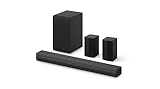
The S40TR is the pick when “surround sound” has to mean something. It is a 4.1-channel system with dedicated wireless rear surround speakers and a wireless subwoofer, plus LG’s Wow Interface for on-screen control from compatible LG televisions. Four channels plus a subwoofer means discrete front left and right, two rear channels, and a bass cabinet — a genuine step beyond any 2.1 bar on this list. It suits a 55-inch-and-up TV at 9 to 12 feet in a room where you can place the rear speakers behind the seating position.
Key specifications as stated by the listing:
- Channel configuration: 4.1 channels
- Rear channels: wireless rear surround speakers included
- Bass: wireless subwoofer
- Control: Wow Interface integration with compatible LG TVs
- Audio processing: Dolby-based processing per the listing
The advantage of real rear speakers is directional accuracy. When a film mix places a helicopter behind the character, a 4.1 system puts that sound behind you, and your brain reads it as spatial rather than merely loud. Rear channels also reduce the work the front bar has to do, because effects no longer have to be squeezed into a stereo pair. If you play games, the benefit is arguably larger than for films: positional audio tells you where an enemy is, and no amount of virtualisation fully replaces a speaker behind your head.
Placement is the deciding factor. Rear speakers work best at or slightly above ear height, positioned just behind and to the sides of the main listening seat, angled inward toward the listener. If your sofa is pushed flat against the back wall, you have no room for that geometry, and the surround effect collapses into a wider front stage. Before buying, measure the gap between the back of your sofa and the wall: you want at least a foot, ideally two, to make the investment pay off.
Pros
- Genuine 4.1 channels with wireless rear speakers for directional effects
- Wireless subwoofer adds proper low-frequency output
- Wow Interface gives on-screen control with compatible LG TVs
- Biggest spatial upgrade over any 2.0 or 2.1 bar here
Cons
- Requires space behind the seating position to work properly
- Two rear speakers plus a subwoofer means three extra power points
- Premium tier pricing, and full value depends on your room geometry
Against the ULTIMEA Poseidon M60, the LG is the simpler system — fewer boxes, 4.1 rather than 5.1 — while the M60 offers an additional channel of front-stage separation and explicit Atmos support. If you want the most channels for the money, the M60 is the more ambitious purchase; if you want rear surround with the least setup fuss and tight integration with an LG television, the S40TR is the cleaner route.
How to Choose
Most soundbar purchases go wrong for one of three reasons: the bar is the wrong physical size for the TV, it lacks the connection your television actually has, or its bass capability is mismatched to the room. Work through the four criteria below in order and the shortlist usually collapses to two or three products.
Start with screen size and seating distance
Physical proportion matters more than most buyers expect. A soundbar should be roughly 60 to 75 percent of the width of the television it sits under — shorter looks undersized, longer can overhang the stand and block the TV’s infrared receiver. Use the table below, which assumes a 16:9 screen and a mixed-use viewing position (roughly a 35- to 40-degree field of view).
| Seat-to-screen distance | Comfortable 4K TV size | TV width (approx.) | Soundbar width that fits | Channel target |
|---|---|---|---|---|
| 6-7 ft | 43-50 in | 37-44 in | 24-30 in | 2.0 or compact 2.1 |
| 7-9 ft | 50-58 in | 44-51 in | 30-36 in | 2.1 with subwoofer |
| 9-11 ft | 58-70 in | 51-61 in | 36-45 in | 2.1 or 4.1 |
| 11-13 ft | 70-85 in | 61-74 in | 45-55 in | 5.1 with rear speakers |
The maths behind the second column is simple: for a 4K screen, a comfortable viewing distance is roughly 1.2 to 1.5 times the diagonal. At 8 feet, that is 96 inches divided by 1.5, which gives a 64-inch screen — so a 55- to 65-inch television is the right range. Television width is then approximately 87 percent of the diagonal for a 16:9 panel, which is where the third column comes from. If your numbers land between two rows, buy the smaller bar if you sit closer to the low end of the distance range and the larger one if you sit further back.
