What's inside
- Quick picks by patio situation
- Foam density matters more than cushion thickness
- Fabric: fade resistance and water behavior are different
- Head-to-head: thin fiber cushions versus thick foam cushions
- Measure the furniture, not the old cushion alone
- Ties, non-slip features, and the wind problem
- Storage is part of the cushion specification
- Cleaning and maintenance that prevent early failure
- What to buy for the best balance
- Quick picks by patio situation
- Foam density matters more than cushion thickness
- Fabric: fade resistance and water behavior are different
- Head-to-head: thin fiber cushions versus thick foam cushions
- Measure the furniture, not the old cushion alone
- Ties, non-slip features, and the wind problem
- Storage is part of the cushion specification
- Cleaning and maintenance that prevent early failure
- What to buy for the best balance
As an Amazon Associate I earn from qualifying purchases. This post may contain affiliate links at no extra cost to you.
The best patio cushions match your frame precisely, use medium- to high-density foam, resist fading with solution-dyed fabric, and have enough water management and storage protection for your local weather—not simply the thickest filling or the lowest price.
As an Amazon Associate we earn from qualifying purchases at no extra cost to you.


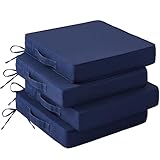

What we cover
- Quick picks by patio situation
- Foam density matters more than cushion thickness
- Fabric: fade resistance and water behavior are different
- Head-to-head: thin fiber cushions versus thick foam cushions
- Measure the furniture, not the old cushion alone
- Ties, non-slip features, and the wind problem
- Storage is part of the cushion specification
- Cleaning and maintenance that prevent early failure
- What to buy for the best balance
Quick picks by patio situation
| Patio situation | Best cushion specification | Why it fits |
|---|---|---|
| Occasional use and a tight budget | 2.5–3 in. polyester fiber or medium-density foam; 180–250 gsm polyester cover | Lower initial cost and adequate comfort when cushions are stored after use |
| Daily dining | 3–4 in. foam; 1.8–2.2 lb/ft³ foam density; solution-dyed acrylic or olefin cover | Supports frequent sitting without becoming flat quickly |
| Long lounging sessions | 4–6 in. foam; layered foam or foam with a fiber wrap; 50–60 kg/m³ density | Provides more pressure distribution and a softer surface without relying on loose filling alone |
| Humid, rainy, or coastal climate | Reticulated quick-dry foam or drain-through construction; breathable, solution-dyed cover | Reduces the time moisture remains inside the cushion |
| Intense sun exposure | Solution-dyed acrylic, typically 200–300 gsm, with a fitted cover | Color is built into the fibers rather than applied only to the surface |
| Small storage space | 2–3 in. cushions with removable covers and compression-friendly fiber fill | Stacks and stores more easily than thick foam cushions |
Foam density matters more than cushion thickness
Thickness affects how much cushioning you feel, but density is a better indicator of how well foam will retain its shape. A 4-inch cushion made with low-density foam can flatten sooner than a 3-inch cushion made with better foam. For patio seating used several times a week, look for foam around 1.8–2.2 lb/ft³, equivalent to approximately 29–35 kg/m³. High-resilience foam can offer a more supportive feel, while a fiber wrap softens the initial contact.
Polyester fiber-filled cushions are usually less expensive and can feel plush when new. Their trade-off is compression: the fill may migrate or form a hollow in the most-used spot. They are a practical choice for occasional seating if you can shake, rotate, and store them regularly.
For wet climates, conventional interior foam is a weak choice because its open cells can retain water. Reticulated foam has a more open structure that lets air and water pass through, but it costs more and still needs a cover that does not trap moisture underneath.
Fabric: fade resistance and water behavior are different
Outdoor fabric can be water-repellent without being waterproof. A water-repellent finish encourages droplets to bead and gives you time to wipe up a spill. It will not prevent rain from reaching seams, zippers, or the foam after prolonged exposure. A cushion with a breathable cover and quick-draining insert is often more reliable than a heavily coated cushion that dries slowly inside.
- Solution-dyed acrylic: A strong choice for full-sun patios. The pigment is added during fiber production, helping the color resist ultraviolet exposure. Sunbrella is a well-established example of this fabric category, although the exact performance depends on the specific fabric and construction.
- Olefin: Often offers good color retention and stain resistance at a lower price than premium acrylic. It is suitable for many covered or partly exposed patios.
- Polyester: Common and affordable, but performance varies widely. A coated outdoor polyester may repel water well initially, while an inexpensive printed fabric may fade sooner in direct sun.
- Cotton and indoor upholstery fabric: Comfortable but generally unsuitable for permanent outdoor exposure unless the manufacturer specifically rates it for outdoor use.
Check whether the cover is removable and machine washable, whether the zipper is corrosion-resistant, and whether the stated fabric weight is for the cover alone. Fabric weight by itself does not guarantee long life; stitching, UV treatment, foam quality, and storage habits also determine durability.
Head-to-head: thin fiber cushions versus thick foam cushions
| Characteristic | Fiber-filled, 2.5–3 in. | Foam, 3–6 in. |
|---|---|---|
| Typical market range | $25–$80 per seat or bench cushion | $60–$220 per seat or bench cushion |
| Initial feel | Soft and compressible | More supportive; firmness depends on density |
| Shape retention | Fair; benefits from fluffing and rotation | Good to very good when density and construction are suitable |
| Drying after rain | Variable; loose fill can hold moisture | Good with drain-through or reticulated foam; poor with sealed, waterlogged foam |
| Storage footprint | Small and easier to compress | Large, especially at 5–6 inches thick |
| Best use | Occasional seating, sheltered balconies, and low-cost replacements | Daily dining, lounge seating, and cushions expected to last through frequent use |
Measure the furniture, not the old cushion alone
Before ordering, measure the inside width and depth of the frame, plus the distance between arms. Measure the back angle and check whether the seat has a raised lip or curved corners. An outdoor cushion that is even 1 inch too wide may buckle at the sides, while one that is too short can slide forward and expose the frame.
For a replacement seat, measure the old cushion only if it has not stretched or collapsed. Compare its dimensions with the frame and allow for the cushion’s compressed thickness. A useful fit target is a finished cushion width about 1/4 inch narrower than the clear opening, with enough depth to reach the back without forcing the front edge upward.
For a bench, calculate the total coverage before choosing separate cushions. For example, a 60-inch bench can use one 59.5-inch cushion for a clean continuous surface, or two 29-inch cushions with a small central gap. Two cushions are easier to carry and replace, but the gap can be noticeable during lounging.
Ties, non-slip features, and the wind problem
Chair cushions with two pairs of fabric ties usually stay in place better than cushions with only one pair, particularly on metal or smooth-painted frames. Look for ties approximately 10–14 inches long, reinforced at the stitching point. Thin ties can tear when someone drags a chair by the cushion.
For benches and deep lounge cushions, ties may be less effective than a non-slip base, hook-and-loop attachment, or a fitted shape. Avoid permanently gluing a cushion to outdoor furniture: trapped moisture and difficult cleaning can shorten the life of both materials. If your patio is windy, a storage routine is more dependable than relying on decorative ties alone.
Storage is part of the cushion specification
Even the best patio cushions last longer when they are protected from overnight moisture, pollen, and ultraviolet light. A breathable cushion box, ventilated deck trunk, or indoor closet is preferable to a sealed plastic bag while the cushion is still damp. If you use a storage bag, dry the cushions completely first and choose a breathable outdoor fabric rather than airtight wrapping.
Estimate storage volume before buying. A 24-by-24-inch seat cushion that is 4 inches thick occupies about 1.33 cubic feet before compression. Four cushions therefore require approximately 5.3 cubic feet, plus clearance for handling. A storage box advertised at 5 cubic feet may be too small once its walls, lid supports, and internal corners are considered.
Cleaning and maintenance that prevent early failure
- Brush off grit weekly during heavy use; abrasive particles wear the fabric at seams and piping.
- Blot spills instead of scrubbing them deep into the foam.
- Wash removable covers according to the care label, and avoid chlorine bleach unless the fabric maker explicitly permits it.
- Stand wet cushions on edge in moving air. Do not return them to a storage box until the seams and underside are dry.
- Rotate reversible cushions every few weeks to distribute compression.
- Inspect ties, zipper sliders, piping, and the underside first. These commonly fail before the main fabric panel.
Do not pressure-wash a cushion at close range. The force can drive dirt and water into the filling, damage coatings, and weaken stitching. Likewise, applying a generic waterproofing spray may alter the fabric’s breathability or void its care recommendations.
What to buy for the best balance
For most uncovered patios, the strongest all-purpose specification is a 3–4-inch seat cushion with approximately 1.8–2.2 lb/ft³ foam, a solution-dyed acrylic or quality olefin cover, reinforced ties, a removable washable cover, and either quick-dry foam or a design with effective drainage. Choose 4–6 inches only when the frame can accommodate the height and you value lounge comfort more than compact storage.
Choose a less expensive fiber-filled cushion when the furniture is used occasionally and can be stored indoors. Spend more on foam density, fabric quality, and drainage when the cushions will remain outside, receive daily use, or face strong sun and frequent rain. The most durable purchase is not necessarily the thickest one; it is the cushion whose fit, materials, drying behavior, and storage plan match the patio where it will live.