What's inside
As an Amazon Associate I earn from qualifying purchases. This post may contain affiliate links at no extra cost to you.
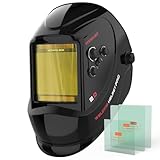
The best large view welding helmet for most fabricators is the Lincoln Electric VIKING 3350, while the Miller Digital Infinity is the stronger choice when maximum rectangular viewing area matters and the 3M Speedglas G5-01VC is better for tight joints where peripheral awareness is valuable.
A wider lens is not automatically a clearer view. The useful comparison is how much of the weld remains visible when your helmet is close to a corner, whether side windows introduce distraction, how quickly the lens reacts, and whether the headgear keeps the viewing window aligned throughout a long session.
As an Amazon Associate we earn from qualifying purchases at no extra cost to you.


What we cover
Large-view welding helmets compared
| Helmet | Viewing area | Reaction time | Side-window design | Best fit |
|---|---|---|---|---|
| Lincoln Electric VIKING 3350 | 3.74 × 1.78 in; about 6.7 sq in | 1/25,000 second | No side windows; broad front lens | Best all-round large-view helmet |
| Miller Digital Infinity | 3.85 × 2.38 in; about 9.2 sq in | 1/20,000 second | No side windows; very tall lens | Maximum front-facing work area |
| ESAB Sentinel A60 | 3.93 × 2.36 in; about 9.3 sq in | 1/25,000 second | No side windows; curved front shell | Large lens with a compact-feeling shell |
| 3M Speedglas G5-01VC | About 3.66 × 1.78 in; configuration-dependent | Up to 1/25,000 second | Optional shade-5 side windows | Tight joints and improved peripheral awareness |
Viewing dimensions and reaction times can vary by lens version, region, and replacement cartridge. Treat the figures above as useful comparison points, then confirm the exact configuration before buying. All of these helmets are passive-darkening auto-darkening designs that should be used with the correct shade for the process and amperage.
Head-to-head: which clear view welding helmet wins?
Lincoln Electric VIKING 3350: the safest general recommendation
The VIKING 3350 has a slightly shorter window than the Miller Digital Infinity or ESAB Sentinel A60, but its 3350 lens technology is known for a bright light state and natural-looking color compared with older green-tinted filters. That matters when locating the joint before striking an arc, checking the end of a bead, or repositioning a torch.
Its four arc sensors, adjustable sensitivity, delay control, and grind mode make it versatile for MIG, TIG, stick, and grinding work. The headgear is also a major part of the value: a large lens is wasted if the shell tilts forward or the ratchet loosens while you work.
Choose it when you want one dependable large view welding helmet for a mixed fabrication routine rather than the absolute largest rectangular opening.
Miller Digital Infinity: best for a tall, unobstructed front view
The Digital Infinity’s approximately 9.2-square-inch viewing area is substantially larger than the VIKING 3350’s. Its extra height is useful when following a vertical joint, inspecting a wide fillet, or working with the helmet positioned close to a fixture. The digital control panel is easy to adjust, and the lens offers welding, cutting, and grinding modes.
The trade-off is physical size. A large front lens can feel more cumbersome in a crowded booth, and the helmet still cannot show what is hidden behind the shell or workpiece. For overhead or awkward-position welding, check that the headgear holds the lens at the angle you naturally use rather than judging the opening only by its advertised dimensions.
ESAB Sentinel A60: broad coverage in a streamlined shell
The Sentinel A60 combines a roughly 3.93-by-2.36-inch viewing area with a low-profile shell. Its curved front and external shade controls are appealing when you frequently switch between welding and grinding or need to adjust settings without removing gloves.
It is a strong choice for fabricators who want a very large front view but dislike the bulk of some traditional wide-lens helmets. Inspect the replacement outer-lens availability and local pricing before purchase; consumable availability is part of the real ownership cost.
3M Speedglas G5-01VC: the specialist choice for tight joints
The G5-01VC uses a front auto-darkening lens with optional shade-5 side windows. Those side windows do not make the main lens larger, but they can reveal the edge of a bracket, pipe, or gusset before you move your head. That is particularly useful when the joint is tucked into a corner and the helmet shell would otherwise block peripheral vision.
Side windows are not universally better. Their darker peripheral image can be distracting for beginners, and they do not replace correct helmet positioning. They are most helpful when the joint geometry—not poor lens quality—is limiting visibility.
Decision matrix by working situation
| Your situation | Recommended direction | Why |
|---|---|---|
| Occasional home or repair work | VIKING 3350 or a reputable mid-range wide-lens helmet | Good light-state visibility without paying for specialized side windows |
| Daily fabrication with long beads | Miller Digital Infinity or ESAB Sentinel A60 | Tall viewing area reduces repeated head movement along the joint |
| Pipe, brackets, and recessed corners | 3M Speedglas G5-01VC with side windows | Peripheral visibility helps identify edges in confined geometry |
| New welder learning torch or gun control | VIKING 3350 or Digital Infinity | Simple front-focused view is easier to interpret than multiple peripheral images |
| Small booth or frequent overhead work | Low-profile Sentinel A60 or a compact wide-lens model | Shell depth and balance may matter more than the last inch of lens area |
How much viewing area do you really gain?
Compare area, not just the longest dimension. Using the published nominal dimensions, the Digital Infinity provides about 9.2 square inches, while the VIKING 3350 provides about 6.7 square inches:
(9.2 − 6.7) ÷ 6.7 × 100 = approximately 37% more nominal front viewing area.
That does not mean you will see 37% more of every joint. A helmet shell, your nose and cheek position, the torch or gun, and the angle of the workpiece all limit usable visibility. In a narrow inside corner, a smaller lens correctly positioned near the joint can outperform a larger lens worn too far away.
Lens reaction time: important, but not the whole decision
Modern helmets commonly quote switching speeds between 1/20,000 and 1/25,000 second. Both are fast enough for normal arc welding when the helmet is functioning correctly and the sensors have a clear view of the arc. Sensitivity adjustment matters more in some situations: low-amperage TIG, heavily shaded workspaces, and welding partly hidden from the sensors can require careful adjustment.
Before welding, check that the arc sensors are not covered by stickers, spatter, grime, or a badly fitted external lens. A fast cartridge cannot react properly if the arc is blocked from its sensors. Replace cracked, deeply scratched, cloudy, or heat-damaged cover lenses; polishing a damaged cover lens is not a safe substitute.
Comfort and maintenance that affect visibility
- Balance: A front-heavy shell encourages neck strain and makes the lens angle change during a bead. Tighten the headgear so the helmet stays put without creating pressure points.
- Lens alignment: Set the vertical position so your eyes naturally meet the center of the viewing area when you are in your normal welding posture.
- Cover lenses: Keep spare inner and outer covers available. Spatter and smoke haze reduce contrast long before the cartridge appears damaged.
- Cleaning: Use a soft, clean cloth and the manufacturer’s recommended method. Abrasive shop towels and solvent overspray can permanently cloud plastic surfaces.
- Headgear wear: Ratchet bands, pivot friction parts, sweatbands, and shell pivots usually wear before the auto-darkening cartridge. Replace those parts rather than tolerating a loose fit.
- Battery storage: Follow the specific helmet’s battery and solar-storage instructions. Remove or replace batteries when the low-battery indicator appears; do not continue welding through unreliable switching.
Bottom line
Buy the Lincoln Electric VIKING 3350 for the best balance of clear light-state vision, reaction speed, comfort, and broad everyday usefulness. Select the Miller Digital Infinity or ESAB Sentinel A60 when the largest front-facing work area is your priority. Choose the 3M Speedglas G5-01VC when side-window visibility can solve a specific problem in recessed or tight joints.
Whichever large view welding mask you choose, prioritize a stable headgear fit, replaceable cover lenses, dependable local parts availability, and a viewing area that matches your joint geometry—not merely the biggest number on the specification sheet.