What's inside
As an Amazon Associate I earn from qualifying purchases. This post may contain affiliate links at no extra cost to you.
What we cover
The Short Answer: Which Miller Welder to Buy in 2026
If you only have a 120V outlet, the Millermatic 142 is the Miller welder to buy; if you have or can add a 240V circuit, the Millermatic 211 is the best value in the line, and if you need to TIG weld aluminum or run multiple processes, the Multimatic 220 AC/DC is worth the extra money. The Syncrowave 210 is a dedicated AC/DC TIG/stick machine and only makes sense if TIG is your primary process. Miller welders sit at the premium end of the market — expect roughly $1,000–$1,600 for the 142, $1,800–$2,600 for a 211, and $3,500–$5,000+ for a Multimatic 220 or Syncrowave 210 with accessories — but the resale value and warranty support partially offset the sticker shock.
Current Lineup Compared: Power, Output and Duty Cycle
The spec that matters most in daily use is duty cycle at the amperage you’ll actually weld at — not the peak number in the headline. Here are the published figures for the current Miller welder lineup:
As an Amazon Associate we earn from qualifying purchases at no extra cost to you.
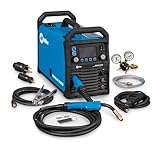

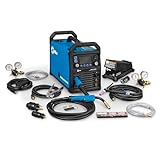

| Machine | Process(es) | Input Power | Max Output | Duty Cycle | Auto-Set |
|---|---|---|---|---|---|
| Millermatic 142 | MIG / flux-core | 120V | 140A | 60% @ 100A | Yes |
| Millermatic 211 | MIG / flux-core | 120V / 240V | 230A | 40% @ 170A (240V); ~20% @ 115A (120V) | Auto-Set + manual |
| Millermatic 252 | MIG / flux-core | 240V (208V compatible) | 300A | 60% @ 250A | Auto-Set + manual |
| Multimatic 215 | MIG, flux-core, DC TIG, stick | 120V / 240V | 230A MIG | ~20% @ 120A (120V); 40% @ 180A (240V) | Auto-Set Elite |
| Multimatic 220 AC/DC | MIG, flux-core, AC/DC TIG, stick | 120V / 240V | 230A MIG / 210A TIG | 20% @ 210A TIG (240V) | Auto-Set Elite |
| Syncrowave 210 | AC/DC TIG, stick | 120V / 240V | 210A TIG | 60% @ 150A; 25% @ 210A (240V) | Auto-Set |
Note the 120V column behaves differently across machines. A dual-voltage Miller welder on a 120V outlet is limited to roughly 140–150A and thin material — the 240V side is where these machines earn their rating. If your garage only has 120V today, the practical move is a dedicated 240V, 30–50A circuit (typically a few hundred dollars from an electrician) rather than a bigger machine you’ll never unlock.
What Duty Cycle Actually Means for Your Work
Duty cycle is measured over a 10-minute window. The Millermatic 142’s 60% at 100A means six minutes of continuous welding at that amperage — more than enough for sheet metal, exhaust and light fab. The 211’s 40% at 170A on 240V covers 1/4-inch structural work in long beads. Where buyers get burned is expecting 120V performance to scale: on household power, the 211 and Multimatic 215 behave like ~140A machines, not the 230A headline figure.
For aluminum MIG work, remember you need a spool gun (Miller’s Spoolmate series) on the Millermatics, and higher duty cycle than steel at the same thickness — aluminum conducts heat into the puddle faster and demands more amperage.
Is Auto-Set Worth the Price Step?
Auto-Set (and Auto-Set Elite on the Multimatics) dials voltage and wire speed from material thickness and wire diameter. Worth it if:
- You’re new — the single biggest beginner failure is wrong voltage/wire-speed pairing, and Auto-Set removes it entirely.
- You switch thicknesses constantly (job-shop or fabrication work).
- Multiple people share the machine.
Skip it if you’re experienced and want manual control — but note Miller doesn’t sell a cheaper “manual” Millermatic in the current line, so the question is really whether Auto-Set justifies Miller over a competitor. Given how consistently the presets land and that you can always override to manual on the 211, 252 and Multimatics, the premium holds up for most buyers.
Decision Matrix: Match Your Situation to a Machine
| Your situation | Best pick | Why |
|---|---|---|
| Garage, 120V only, repairs/auto body/beginner | Millermatic 142 | Full capability on household power; portable (~52 lb) |
| Home shop, 240V available, general fab up to 3/8 in | Millermatic 211 | Best value-to-capability ratio in the line |
| Farm/shop, heavy steel, long weld days | Millermatic 252 | 60% duty @ 250A never forces a cool-down break |
| Want TIG + stick + MIG, no AC TIG needed | Multimatic 215 | Cheapest multiprocess Miller welder; TIG lift-arc is DC only |
| TIG-weld aluminum occasionally, mostly MIG | Multimatic 220 AC/DC | AC TIG for aluminum plus full MIG — one machine does it all |
| Precision TIG is the job (bikes, intake, fabrication) | Syncrowave 210 | Proper AC balance/frequency control, foot pedal, pulse |
Ownership Realities: What a Listing Won’t Tell You
Consumables: Contact tips are the first thing you’ll replace — buy a 25-pack (~$15–25) and expect to swap every few hours of arc time if you run the tip recessed into the nozzle. Nozzles spatter up; a $2 can of anti-spatter dip triples nozzle life.
Gas is a hidden cost: C25 mix for MIG runs roughly $50–$90 to fill an 80 cu ft cylinder plus annual lease or a one-time bottle purchase. Flux-core works gas-free but produces more spatter and slag cleanup — fine outdoors, annoying indoors.
What wears first: Drive rolls and liners, usually from dirty or rusty wire. Keep wire in a sealed bag with desiccant, and blow out the liner with compressed air at every spool change. Drive rolls should be checked — a flattened V-groove from running U-groove aluminum wire causes feed stutters that people wrongly blame on the machine.
Common mistakes: Plugging a dual-voltage machine into a shared 120V circuit (nuisance trips at high output — give it a dedicated 20A); running an undersized extension cord (use 10 AWG minimum for 240V, 8 AWG for a 252); and over-estimating duty cycle — a 142 pushed flat-out on 1/4-inch will thermal-shut down and you’ll wait, not weld.
FAQ
Can a Millermatic 211 really weld 3/8-inch steel? Yes, with 240V input, proper bevel prep and flux-core or multiple passes on solid wire. Single-pass capability tops out around 1/4-inch.
Millermatic vs. Multimatic — is multiprocess worth it? If you’ll realistically TIG or stick weld within a year, the Multimatic saves buying a second machine. If you’re MIG-only, the Millermatic’s money goes further.
Is the Syncrowave 210 still current? Yes — it remains Miller’s entry AC/DC TIG/stick machine, and its 120/240V dual input is unusual at that power level, making it viable in shops without dedicated high-amp circuits.
Are Miller welders worth the premium over budget brands? For resale value, parts availability and the True Blue 3-year warranty, yes — budget machines often lose 40–50% value in two years while used Millers hold close to their used-market floor.