What's inside
- The Short Answer
- Contents
- Types of Welding Carts
- How to Choose a Cart for Your MIG Welder
- Features That Matter
- Gas, Power and Duty Cycle: What a Cart Has to Account For
- Where Each Cart Style Works Best
- Assembly and Loading
- Safety on and Around a Cart
- Maintenance
- Common Mistakes
- Who Should Choose What
- Buyer’s Checklist
- Frequently Asked Questions
- Conclusion
As an Amazon Associate I earn from qualifying purchases. This post may contain affiliate links at no extra cost to you.
What we cover
- The Short Answer
- Contents
- Types of Welding Carts
- How to Choose a Cart for Your MIG Welder
- Features That Matter
- Gas, Power and Duty Cycle: What a Cart Has to Account For
- Where Each Cart Style Works Best
- Assembly and Loading
- Safety on and Around a Cart
- Maintenance
- Common Mistakes
- Who Should Choose What
- Buyer’s Checklist
- Frequently Asked Questions
- Conclusion
Our Top Picks

The Short Answer
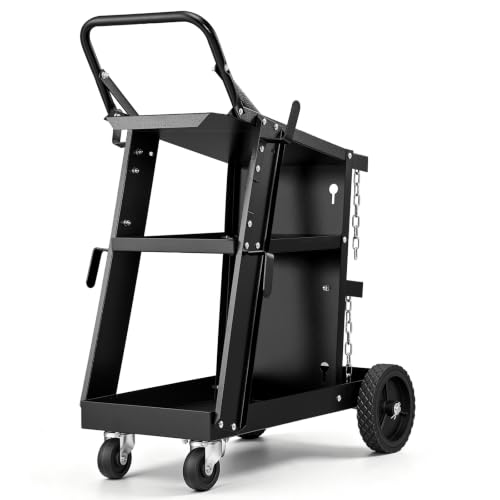
The best welding cart for a MIG welder is one that carries your machine’s weight with margin to spare, holds a shielding gas cylinder upright and restrained, rolls on wheels suited to your floor, and keeps cables, gun and consumables tidy. For most home and small shops, a two-tier cart with a cylinder rack and a chain or strap is the practical choice. Small bench-top machines can live on compact carts, while larger machines and frequent movers benefit from bigger wheels and a sturdier frame. This guide explains cart types, what to measure, how to load a cart safely and which design fits which shop.
Contents
- Types of Welding Carts
- How to Choose a Cart for Your MIG Welder
- Features That Matter
- Gas, Power and Duty Cycle: What a Cart Has to Account For
- Where Each Cart Style Works Best
- Assembly and Loading
- Safety on and Around a Cart
- Maintenance
- Common Mistakes
- Who Should Choose What
- Buyer’s Checklist
- Frequently Asked Questions
- Conclusion
Types of Welding Carts
A MIG welder is a box with a heavy transformer or inverter, a wire feeder, a gun on a long lead, a ground cable and a gas hose. A cart turns that pile into one mobile station. Designs vary widely, so it helps to sort them by layout.
Single-shelf utility carts
The simplest option is a flat platform on four wheels with a handle and sometimes a small cylinder bracket. They are light, inexpensive to buy and easy to store. They suit compact machines and users who need to move the welder from bench to bench. The limits are obvious: little room for accessories and often a cylinder holder that is more of a cradle than a secure restraint.
Two-tier carts with a cylinder rack
The most common design for MIG work has a top shelf for the machine, a lower shelf or tray for gloves, pliers, wire and a spare spool, and a rear rack that holds the gas bottle upright with a chain. The weight of the cylinder sits low, which helps stability. It is a good general-purpose choice for garages and fabrication shops.
Cabinet and drawer carts
These add closed storage or drawers for consumables such as tips, nozzles, liners and brushes. They are heavier and take more floor space, but they keep small parts organized and dust-free. They are popular in teaching shops and tidy home workshops.
Fabrication-table carts
Some carts incorporate a steel top that works as a small welding surface alongside a shelf for the machine. They save space by merging bench and cart, though a mobile table is a lighter surface than a dedicated heavy bench and may shift under hammering.
Folding and knock-down carts
For people short on storage, folding carts collapse flat. They are handy for mobile repair or for a shared space, but joints and hinges are potential weak points, so pay attention to the stated load rating and lock mechanisms.
Comparison of cart types
| Cart type | Strengths | Weaknesses | Best match |
|---|---|---|---|
| Single shelf | Light, cheap, compact | Minimal storage and cylinder support | Small machines, short moves |
| Two-tier with cylinder rack | Balanced, secure bottle, shelf space | Takes more floor area | General garage and shop use |
| Cabinet or drawer | Organized consumables | Heavy and bulkier | Tidy workshops, training areas |
| Fabrication table | Combined work surface and machine stand | Lighter top than a fixed bench | Small spaces, light fabrication |
| Folding | Stores flat, easy to carry | Hinges limit strength | Mobile and shared use |
How to Choose a Cart for Your MIG Welder
Start with the machine in front of you, then work outward to the space and the way you work.
Weigh and measure everything
Find the welder’s weight and footprint in its manual, then add the gas cylinder, which is considerably heavier when full than most people expect, plus a spare wire spool and accessories. The cart’s stated capacity should exceed that total by a comfortable margin. Check that the shelf is deep and wide enough for the machine’s base, with feet or rubber pads not hanging over an edge.
Think about the cylinder
MIG welding needs shielding gas, and the cylinder size you use determines the rack you need. Compact cylinders fit small cradles, while larger ones need a tall frame, a wide base and a proper chain. Make sure the rack is tall enough to restrain the cylinder above its midpoint and that the cylinder can be lifted on and off without strain.
Consider where you will roll it
Smooth concrete is easy on any wheel. Gravel, cracked floors, thresholds and outdoor use call for larger, softer or pneumatic wheels. Casters that swivel make tight maneuvering easy, but at least two should lock so the cart stays put while you weld.
Plan for how you work
If you weld in one corner every day, a heavier cart that rarely moves is fine. If you carry the welder to different jobs, weight and handle design matter more than extra shelves. Think about whether you work right- or left-handed and whether the cart lets you reach the gun and controls without stretching.
Features That Matter
Frame and construction
Steel tube frames with welded joints are typical and are sturdy when the material is thick enough and the welds look clean. Check for bracing between the legs and under shelves so the frame does not flex when loaded. Powder coat or paint should cover the frame evenly, because bare steel rusts and sparks can chip thin finishes.
Shelves and trays
Steel shelves handle spatter and heat better than plastic or wood. A lip or raised edge keeps the machine from sliding when you roll over a bump. Perforated or open shelves let debris fall through, while solid shelves keep small items from dropping.
Wheels and casters
Wheel size controls how well a cart rides over cracks. Small hard wheels are fine on a clean floor but jar a loaded cart on rough ground. Larger rubber or pneumatic wheels roll easier but may add height to the cart. Look at axle mounts and bolts as well, since a wheel that tears off the frame under load is a real hazard.
Cable and hose management
Hooks, wrap-around horns and cable hangers keep the ground lead, gun lead and power cord from tangling and from being run over. Good cable storage also reduces trip hazards, which matters more than most people expect in a small shop.
Gas, Power and Duty Cycle: What a Cart Has to Account For
A cart does not change how a welder performs, but it has to support the demands the process places on your setup. Three ideas are worth understanding before you buy.
Shielding gas
MIG welding with solid wire normally uses a shielding gas, commonly a blend suited to steel, delivered through a regulator and flowmeter to the gun. Flux-cored wire may run without gas, which means the cart needs no cylinder rack at all. If you plan to use gas, the cart must restrain the bottle and keep the regulator accessible and protected. Gas hose should have slack for turning but not hang where wheels can catch it.
Power and cord routing
Most home machines plug into a standard household or dedicated outlet, and larger ones need a higher-capacity circuit. The cord should run to the outlet without being stretched or pinched under a wheel. If you need an extension, it must be rated for the machine’s current draw and kept as short as practical, since an undersized cord overheats. A cart with a cord hook lets you store slack off the floor.
Duty cycle in plain language
Duty cycle describes how much of a ten-minute period a welder can run at a given output before it needs to cool. A machine rated for a moderate percentage at its higher output can weld for that portion and then must rest. For a cart this matters in two ways. Machines need airflow around vents, so do not box one into a cabinet cart that blocks the fan intake. And hot machines cool faster when the shelf is open, which is a reason to prefer a shelf with open sides over a solid enclosure.
Where Each Cart Style Works Best
Match the cart to the way you spend your hours at the welder.
- Home garage repairs: A two-tier cart with a rack is stable and keeps the cylinder from toppling while you reach across the work.
- Hobby fabrication: A cart with a table top or roomy lower shelf keeps clamps, squares and filler handy.
- Training and shared shops: Cabinet carts keep consumables locked and organized, so each user finds the same setup.
- Mobile and on-site work: Folding or lightweight carts with larger wheels are easier to load into a truck.
- Tight spaces: Narrow carts with locking casters tuck behind a door and roll out when needed.
Comparing features by use
| Situation | Wheel style | Cylinder support | Storage priority |
|---|---|---|---|
| Smooth shop floor | Small to medium swivel casters, lockable | Rear rack with chain | Lower tray and cable hooks |
| Rough or outdoor ground | Larger rubber or pneumatic wheels | Wide base rack with strap | Compact, tool-light layout |
| Frequent loading into a vehicle | Medium wheels, foldable frame | Removable cylinder carrier | Minimal accessories |
| Teaching or shared use | Lockable casters | Fixed rack with sturdy restraint | Drawers and labeled bins |
Assembly and Loading
Many carts ship as flat-pack kits, and the way you assemble and load one affects stability for years.
Assembling the cart
Lay out all parts and fasteners and read the instructions before starting. Leave bolts finger-tight until the frame is square, then tighten them fully. Check that shelves sit flat and that wheel mounts are fully seated. Re-tighten fasteners after the first few days of use, since vibration loosens new hardware.
Loading the machine and cylinder
- Place the cart on level ground and lock the casters.
- Lift the welder onto the top shelf, using a second person if it is heavy, and center it over the frame.
- Stand the cylinder on the rack with its valve cap on, then secure it with the chain or strap above its midpoint before removing the cap.
- Fit the regulator and flowmeter, leaving the cylinder valve closed until you are ready to weld.
- Route the power cord, gas hose, ground cable and gun lead so none of them hang below the wheel line.
- Test-roll the cart a short distance to confirm it does not tip or shift.
Safety on and Around a Cart
A cart sits at the heart of a welding station, so its layout affects how safe the work is.
Gas cylinder security
Compressed gas cylinders can be hazardous if they fall and damage the valve. Keep the cap on while moving, restrain the cylinder upright on the cart with a chain or strap, and never rely on a loose cradle alone. Transport the cart with the cylinder valve closed. Keep cylinders away from heat sources and from the path of sparks.
Electrical safety
Inspect the power cord and plug for cuts or damage before each use and do not weld with wet gloves or standing in water. Keep the machine’s cover on, avoid running cords across walkways, and use a properly grounded outlet. If you must use an extension cord or a generator, confirm it is rated for the welder’s draw and follow the machine’s manual. Unplug the welder before opening it or changing internal parts.
Fire and fume precautions
Keep paper, rags, solvents and wood off the cart and out of the spatter zone. Welding spatter can start fires in nearby clutter, so keep an extinguisher accessible and check the area after finishing. Weld with ventilation, and avoid breathing fumes, especially from galvanized or coated metals. Wear a welding helmet with the proper shade, flame-resistant clothing, gloves, closed leather boots and hearing protection when grinding.
Maintenance
A cart needs little attention but does suffer from spatter, dust and hard use. Wipe down shelves and brush out debris so it does not collect beneath the machine’s vents. Check wheels for flat spots or trapped wire and thread, and lubricate swivel bearings and axles as the manufacturer recommends. Inspect fasteners regularly and replace any cracked or bent parts. Replace chains or straps that are frayed or stretched, and touch up chipped paint to slow rust.
Common Mistakes
- Ignoring total weight. Adding the cylinder, spool and tools to the machine often pushes a light cart past its rating.
- Trusting a loose cradle. A cylinder needs a chain or strap, not just a ring that it sits in.
- Blocking the vents. Pushing the welder against a back panel or into a closed cabinet starves it of cooling air.
- Skipping the caster locks. A cart that drifts while you weld pulls the gun and wrecks a bead.
- Choosing tiny wheels for rough floors. They catch on cracks and can tip a tall load.
- Letting cables dangle. Leads under wheels get cut, and cords across walkways cause falls.
Who Should Choose What
Beginners with a compact machine
A simple two-tier cart with a small cylinder rack is enough, and it keeps costs low. Look at a few MIG welding carts with cylinder racks and compare shelf depth against your machine’s footprint.
Hobbyists who fabricate regularly
Pick a cart with extra shelf space or a work surface, plus hooks for cables. A welding cart with a built-in table top can save floor space in a small garage.
Mobile and farm users
Choose larger wheels, a wide base for the cylinder and a design you can lift into a truck. Pair it with secure cylinder restraint chains or straps for the road.
Shared or teaching spaces
Select cabinet-style carts with lockable casters and drawers so consumables stay organized and every station is set up the same way.
Buyer’s Checklist
- Weigh the welder, full cylinder, spool and accessories, then pick a cart rated above the total.
- Confirm the shelf fits the machine’s footprint with room for airflow.
- Verify the rack holds your cylinder size and includes a chain or strap.
- Choose wheel size and material to suit your floor, with at least two locking casters.
- Look for hooks or horns for the power cord, ground lead and gun lead.
- Inspect welds, bracing and finish quality before accepting delivery.
- Plan an outlet location so the cord never stretches or crosses a walkway.
- Keep an extinguisher near the station.
Frequently Asked Questions
Do I need a cart if I have a workbench?
Not strictly, but a cart lets you position the welder near the work and keeps the cylinder restrained, which a bench rarely does.
How do I know if a cart is strong enough?
Compare the stated capacity with the combined weight of your machine, cylinder and accessories, and look for thick tubing and bracing.
Can a flux-cored welder use a cart without a cylinder rack?
Yes. Self-shielded flux-cored wire needs no gas, so a plain two-shelf cart works, though a rack leaves room to add gas later.
Should the welder be bolted to the cart?
Some people strap or bolt it down, which prevents sliding. Use fastening that does not block vents or damage the casing.
Are pneumatic wheels worth it?
They help on gravel and uneven ground but can go flat and raise the cart’s height, so solid rubber suits smooth floors better.
Where should I put the cylinder on the cart?
Low and at the back, restrained upright with the valve accessible, so the weight keeps the cart stable.
Can I weld on the cart’s shelf?
Avoid it. Spatter and electrical return paths can damage the cart and the machine, so use a proper workbench and clamp the ground there.
How often should I check the cart?
Look over wheels, fasteners and restraints before each session and give the frame a fuller inspection every few months.
Conclusion
The best welding cart for a MIG welder is the one that supports your real load, secures the cylinder and rolls well where you work. For most people that means a two-tier cart with a rack, locking casters and cable hooks. Weigh your gear, measure your space and plan your outlet before buying. When you are ready, compare welding carts for MIG welders against the checklist above and choose one with comfortable margin.
Disclosure: As an Amazon Associate, we earn from qualifying purchases. Links marked as sponsored may earn a commission at no extra cost to you.
