What's inside
As an Amazon Associate I earn from qualifying purchases. This post may contain affiliate links at no extra cost to you.
The best dehumidifiers for bathrooms are compact compressor models for heated, regularly used rooms, desiccant models for cold bathrooms, and small thermoelectric units only for cupboards or very light condensation.
As an Amazon Associate we earn from qualifying purchases at no extra cost to you.

What we cover
Quick picks by bathroom size and humidity
| Bathroom situation | Best fit | Useful target | Why |
|---|---|---|---|
| Small cloakroom, occasional condensation | Thermoelectric unit | 0.3–0.8 L/day; 0.5–1.5 L tank | Small footprint and low purchase cost, but slow extraction |
| Typical family bathroom, heated to 18–22°C | Compact compressor model | 8–12 L/day; 1.5–2.5 L tank | Best balance of extraction, running cost and size |
| Cold bathroom, winter condensation, or poor ventilation | Desiccant model | 6–10 L/day; 1.5–3 L tank | Maintains useful performance at lower temperatures |
| Large bathroom, ensuite plus laundry drying | 12–20 L/day compressor | 2–4 L tank or continuous drain | Shortens drying time and avoids frequent emptying |
Manufacturers usually quote extraction at warm, very humid test conditions, often around 30°C and 80% relative humidity. A unit labelled “10 litres per day” will collect substantially less in a normal 18°C bathroom. Treat the rating as a comparison figure, not a guaranteed daily yield.
What to buy for the most common bathrooms
Best all-rounder: an 8–12 L/day compressor dehumidifier
For a heated bathroom of roughly 4–8 square metres, a small compressor unit is normally the sensible choice. It removes moisture efficiently once the room is warm enough, and its power consumption is generally lower than that of a similarly sized desiccant machine.
Look for a humidistat, a laundry or continuous mode, an automatic shut-off when the tank is full, and a drain-hose connection. A claimed operating noise of about 38–45 dB is suitable for use after a shower, although the compressor starting and stopping can be more noticeable than the headline number suggests.
The MeacoDry Arete One 10L is an example of this category, with a compact domestic design, a built-in humidistat and a tank intended for routine household use. The Pro Breeze 12L 5-in-1 dehumidifier is another example of a compact compressor format. Exact dimensions, noise figures and included hose fittings vary by version, so check the particular model rather than relying on the series name.
Best for a cold or intermittently heated bathroom: a desiccant unit
Desiccant dehumidifiers use an absorbent rotor rather than a refrigerated coil. They continue working effectively at temperatures where compressor units become slow, and their warm exhaust can help a chilly bathroom dry faster.
The trade-off is higher electricity use and often more audible fan noise. A desiccant unit may draw roughly 300–700 watts while operating, compared with approximately 150–250 watts for many small compressor models. That does not automatically make it a poor choice: if a compressor struggles in a 10–15°C room, the desiccant unit may finish the job sooner.
EcoAir’s DD1 Simple is a well-known example of the domestic desiccant format. It is better suited to a cold bathroom, garage-adjacent washroom or winter laundry area than to a consistently warm ensuite.
Best for a tiny space: a thermoelectric mini unit
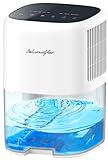
Thermoelectric, or Peltier, dehumidifiers are quiet and easy to store. They can suit a small cloakroom, a bathroom cupboard or a room with only minor moisture. Their extraction is usually measured in hundreds of millilitres per day rather than several litres.
Do not choose one simply because its casing is small. In a steamy family bathroom, a mini unit can run continuously while still leaving mirrors, grout and towels damp. If the room regularly produces visible condensation, step up to a compressor model.
Head-to-head comparison
| Feature | Thermoelectric mini | 8–12 L compressor | Desiccant |
|---|---|---|---|
| Typical extraction rating | 0.3–0.8 L/day | 8–12 L/day | 6–10 L/day |
| Typical power draw | 20–60 W | 150–250 W | 300–700 W |
| Useful room temperature | Above 15°C | Above about 15°C | About 1–30°C |
| Typical noise | 25–40 dB | 38–45 dB | 35–50 dB |
| Common tank size | 0.5–1.5 L | 1.5–2.5 L | 1.5–3 L |
| Typical width | 150–220 mm | 250–320 mm | 250–350 mm |
| Best use | Light, local condensation | Normal heated bathrooms | Cold, damp rooms |
The figures above are representative buying ranges, not specifications for every model. Noise depends on fan speed, floor vibration and distance, while capacity depends heavily on temperature and relative humidity.
Drainage, noise and storage matter more than they appear
A small tank is convenient to lift but inconvenient if it fills after every shower. As a worked example, suppose a compact compressor collects 0.7 litres during a humid evening. With a 2-litre tank, it can run for nearly three such periods before emptying, assuming the tank is not already partly full. A 0.8-litre mini unit might need attention after a similar amount of moisture, despite extracting it much more slowly.
Continuous drainage is useful when a bathroom has a suitable low-level drain. Check that the hose connection is included or compatible, that the hose slopes continuously downward, and that the machine can operate safely in that position. Avoid improvised hose routes across walking areas.
For storage, measure the actual footprint rather than just the width. Allow space around the air intake and exhaust: pushing a dehumidifier tightly against a wall or inside a cupboard can reduce airflow and raise noise. A model around 280 mm wide and 200 mm deep is easier to store on a shelf than a taller unit, but height affects whether it fits beneath a basin or beside a toilet.
How to use one effectively after a shower
- Run the extractor fan during the shower and for around 15–30 minutes afterward. Removing steam at source is usually more efficient than asking the dehumidifier to process all of it.
- Close the bathroom door while the unit operates, but leave enough clearance around the machine for unrestricted airflow.
- Set the humidistat to approximately 50–60% relative humidity. Very low settings can waste energy and dry the room unnecessarily.
- Use a higher fan setting for the first drying period, then switch to automatic humidity control.
- Keep towels spread out rather than bunched together; airflow can then remove moisture from the fabric more quickly.
- Never place the unit where splashing water can reach it, and follow the manufacturer’s bathroom-placement and electrical-zone instructions.
Most portable dehumidifiers are not designed to sit inside a shower room’s wet zone. Place the machine outside the splash area, use a properly protected socket with residual-current protection where required, and follow local electrical regulations. A bathroom extractor fan and adequate ventilation remain important even when a dehumidifier is present.
Ownership costs and maintenance
Filters usually need cleaning every one to four weeks, depending on dust and lint. A blocked filter restricts airflow, makes the fan louder and reduces water collection. Washable filters should be cleaned only as directed and allowed to dry fully before refitting.
The water tank, float and drain outlet are common trouble spots. Empty the tank before storage, wipe away residue, and inspect the float so it can move freely. If the machine smells musty, clean the tank and accessible surfaces according to the manual rather than masking the smell with fragrance.
Compressor models can become less effective if their refrigerant system develops a fault; this is not normally a user-serviceable repair. Desiccant machines have a rotor and heating element, while all types eventually experience fan-bearing or switch wear. A longer warranty, replaceable filter and readily available drain parts can matter more than a slightly higher extraction claim.
Final buying decision
- Choose a thermoelectric mini only for a very small room with mild, occasional condensation.
- Choose an 8–12 L compressor for most heated bathrooms and the best balance of efficiency, noise and footprint.
- Choose a desiccant model when the room stays cold or needs drying through winter.
- Choose a 12–20 L compressor when the bathroom is large, used by several people, or also serves as a laundry-drying space.
Whichever type you choose, prioritise a humidistat, safe placement, a washable filter, a practical tank or drain arrangement, and dimensions that leave room for airflow. Those details usually determine whether the dehumidifier remains useful after the novelty of the first few weeks has passed.