What's inside
As an Amazon Associate I earn from qualifying purchases. This post may contain affiliate links at no extra cost to you.
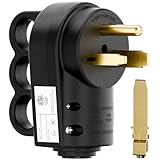
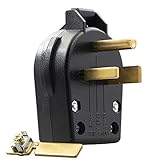
The right 50 amp welder plug for most workshops is a NEMA 6-50P — two hot conductors plus a ground on a 250V circuit, wired with 6 AWG copper on a 50-amp breaker — because nearly every modern single-phase inverter welder (Miller, Lincoln Electric, Hobart, ESAB) ships with or expects that configuration. The decision gets more nuanced if your machine is an older transformer unit, if you want a shared RV-style outlet, or if the receptacle will live outside or in a dusty fab shop. Here’s how to sort it out.
As an Amazon Associate we earn from qualifying purchases at no extra cost to you.


What we cover
Start With the NEMA Configuration
NEMA numbers are not interchangeable, and forcing a mismatched plug into an outlet is the most common — and most dangerous — wiring mistake in small shops. Three configurations cover almost all “50 amp 220v welder plug” situations:
| NEMA type | Blades / conductors | Voltage | Neutral required? | Typical use |
|---|---|---|---|---|
| 6-50P / 6-50R | 2 hot + ground (3-wire) | 250V | No | The standard welder outlet; most 220V welders |
| 14-50P / 14-50R | 2 hot + neutral + ground (4-wire) | 120/250V | Yes | RV hookups, ranges, some multi-voltage welders |
| 10-50P / 10-50R | 2 hot + neutral (3-wire, no ground) | 120/250V | Yes | Legacy outlets only; obsolete, no equipment ground |
Decision rule: match the receptacle to the plug already on your welder, never adapt. If the welder cord ends in a 6-50P, install a 6-50R 50 amp welder receptacle. If you find an old 10-50 in the wall of a garage you just bought, replace it — it has no dedicated ground and fails current code (NEC 250.140 requires an equipment grounding conductor for new 50-amp circuits).
The NEMA 14-50 deserves a note because EV charging made it ubiquitous. Some shop owners deliberately install a 14-50R as their 50 amp welder outlet so the same circuit can serve a welder (via a legitimate 14-50P-to-6-50R pigtail that ignores the neutral) and an RV or EVSE. That’s a defensible choice if you want flexibility; just know your welder will only ever use two legs of it.
What Actually Separates a Good Plug From a Cheap One
Beyond the NEMA stamp, a welder plug 50 amp buyers should compare five things:
- Contact material and blade thickness. Look for solid brass or nickel-plated brass blades. Thin stamped blades heat up under sustained draws near 50A — a hot plug is an early failure warning.
- Body material. Nylon or glass-filled thermoplastic bodies (Leviton’s “rhino” style housings, Hubbell’s HBL series) survive drops onto concrete and welder carts. Plain hard rubber or brittle phenolic bodies crack.
- Strain relief. This is the part most budget plugs skip. A proper cord grip clamps the cable jacket over at least an inch of length. Without it, every tug on a stiff 6/3 cable transfers to the terminal screws, loosens them, and creates the high-resistance joint that melts plugs.
- Wire compatibility. Check the terminal range. You want a plug rated for 6 AWG stranded copper — many cheap 50A plugs only open to 8 AWG, and 8 AWG THHN is borderline for a 50A welder circuit depending on duty cycle and insulation rating.
- Terminal style. Box lugs or screw-clamp terminals that accept stranded wire without tinning are far easier to torque correctly than wrap-around screws.
For the receptacle side, flush-mount industrial-grade devices (Hubbell HBL9450A, Leviton 5206-S10 class) use better contact springs than the thin residential units sold as range outlets. In a workshop, the plug gets cycled hundreds of times — contact tension is what wears out first, and industrial grade holds it roughly twice as long.
Weather Resistance and Where the Outlet Sits
Indoor shop outlets are straightforward. If your 50 amp receptacle for welder use mounts in a garage that gets damp, an unconditioned pole barn, or anywhere outdoors, add two things: an outdoor-rated receptacle in a weatherproof “while-in-use” or NEMA 3R enclosure, and GFCI protection, which the NEC now requires for 50-amp 240V receptacles in garages and outdoors (2023 NEC 210.8 expanded this). Non-GFCI 50A welder circuits are still common in existing installs, but new work should include it — a 2-pole 50A GFCI breaker runs noticeably more than a standard breaker, typically $80–$150 vs. $15–$40.
Indoor dust matters too: welding and grinding dust is often conductive. A receptacle mounted at 18–24 inches off the floor, facing down or in a recessed box, accumulates far less contamination than one at shin height pointing up.
Safe Installation Requirements
A 50 amp welder outlet is a dedicated circuit, and the whole chain has to agree:
- Breaker: 50A double-pole. Note that welders with high duty-cycle ratings can sometimes use a smaller breaker under NEC 630’s welder-specific sizing rules — check your machine’s nameplate input current (e.g., a welder drawing 42A at rated output may legally run on a 40A breaker with 8 AWG wire). The receptacle rating, not the plug, is what locks you to 50A.
- Wire: 6 AWG copper for 6/3 with ground (NM-B or THHN in conduit). Aluminum requires 4 AWG and is rarely worth it at this short-run scale.
- Ground: A real equipment grounding conductor back to the panel — never to a conduit body, water pipe, or the outlet box alone unless the box is bonded through listed conduit.
- Torque: Terminal screws on plugs and receptacles have published torque specs (commonly 20–25 in-lb for 6 AWG lugs). Under-torqued is the failure mode, and it’s invisible until the plug browns.
- Permits: In most US jurisdictions a new 240V circuit is a permitted, inspected job. DIY is often allowed for owner-occupants, but check locally.
Pick by Situation
| Your situation | Best choice | Why |
|---|---|---|
| Standard modern inverter welder, dry indoor shop | NEMA 6-50P plug + industrial-grade 6-50R (Hubbell HBL9450A / Leviton 5206 class), ~$15–$30 plug, $25–$50 receptacle | Native match, durable contacts, no neutral needed |
| Want the circuit shared with RV or EV | NEMA 14-50R with 14-50P→6-50R adapter pigtail | One circuit serves both loads; welder never uses neutral |
| Outdoor or damp barn/garage | 6-50R in NEMA 3R box + 50A GFCI breaker; cord cap with gasketed boot | Code-compliant moisture and shock protection |
| Frequent plugging/unplugging (mobile welder) | Industrial-grade receptacle + plug with heavy cord-grip strain relief | Contact wear and cable flex are the two failure points |
| Found a legacy 10-50 outlet in the wall | Rewire to 6-50R (or 14-50R); don’t buy a 10-50 plug | No equipment ground; unsafe and non-compliant |
Ownership Realities
What wears first on a welder circuit is almost always the receptacle’s contact springs, then the plug’s strain relief, then the terminal joints if they were under-torqued. Inspect yearly: blades should be bright brass, not heat-discolored blue or brown; the plug body shouldn’t be warm after an hour of welding near rated output; and the cable shouldn’t rotate inside the cord grip. A $20 plug replaced on schedule is cheaper than a melted receptacle taking the cord with it. Keep a spare 6-50P on the shelf — a damaged plug mid-project is a common and entirely avoidable shop-stoppage.
FAQ
Can I use a dryer or range outlet for my welder? Only if it’s a NEMA 6-50 or 14-50 and the circuit is otherwise unused. A 30A dryer outlet (10-30/14-30) is under-rated and uses a different blade pattern — don’t adapt it.
Is “50 amp 220v” the same as 240V? Practically, yes — “220” is informal; modern US supply is nominally 240V, and 6-50 and 14-50 devices are rated 250V to cover it.
Do I need a neutral for a welder? Almost never. Welders are pure 240V loads using both hots plus ground — which is why the 3-wire 6-50 exists. The neutral on a 14-50 goes unused.
Can I run a welder on a 50A extension cord? Yes, with 6 AWG cord and properly rated 6-50 connectors, kept as short as practical. Coiled or long undersized cords cause voltage drop the welder reads as poor arc performance.