What's inside
- Best Bathroom Vanity Lights for Clear, Even Lighting
- Choose by bathroom layout
- Specs that matter more than appearance
- Comparison: fixture styles and typical specifications
- Size and mounting: check the fit before buying
- Match the choice to the job
- Ownership details people often overlook
- A quick buying checklist
- Best Bathroom Vanity Lights for Clear, Even Lighting
- Choose by bathroom layout
- Specs that matter more than appearance
- Comparison: fixture styles and typical specifications
- Size and mounting: check the fit before buying
- Match the choice to the job
- Ownership details people often overlook
- A quick buying checklist
As an Amazon Associate I earn from qualifying purchases. This post may contain affiliate links at no extra cost to you.
What we cover
- Best Bathroom Vanity Lights for Clear, Even Lighting
- Choose by bathroom layout
- Specs that matter more than appearance
- Comparison: fixture styles and typical specifications
- Size and mounting: check the fit before buying
- Match the choice to the job
- Ownership details people often overlook
- A quick buying checklist
Best Bathroom Vanity Lights for Clear, Even Lighting
The best bathroom vanity lights for most bathrooms are a dimmable, high-CRI LED fixture sized to roughly half to three-quarters of the mirror’s width, with a damp- or wet-location rating appropriate to its placement. For the most even light on a face, use matching vertical fixtures on both sides of the mirror; when the layout only allows one fixture, choose a wide, diffused bar and position it above the mirror.
Choose by bathroom layout
- Single mirror with room on both sides: Two vertical sconces usually reduce shadows under the eyes and chin better than one light overhead. Aim for fixtures whose centers land around face height, commonly about 60–66 inches above the floor, then adjust for household height and the mirror.
- Wide mirror or double vanity: A long horizontal fixture can cover a broad area, but one centered bar may leave the outer sinks dim. Consider separate lights over each mirror or a pair of side sconces for each station.
- Narrow wall or medicine cabinet: A slim bar above the mirror is often the practical choice. Check that its canopy and mounting hardware fit the available wall space and do not obstruct cabinet doors.
- Low ceiling or tall mirror: A compact, shallow-profile fixture helps preserve clearance. Confirm the fixture does not collide with the ceiling, door swing, or trim.
Specs that matter more than appearance
Brightness: Lumens describe light output; watts mainly describe energy use. As a starting point, a single-sink vanity often works well with about 1,500–2,500 lumens of combined vanity lighting. A double vanity may need roughly 3,000–4,000 lumens, depending on room size, wall color, ambient lighting, and whether the fixture is the only light source. Dimming makes a brighter fixture more flexible.
As an Amazon Associate we earn from qualifying purchases at no extra cost to you.
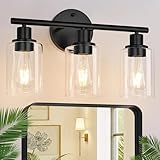


Color rendering: Look for a color rendering index (CRI) of 90 or higher when accurate skin tone, makeup, or shaving detail matters. A lower-CRI lamp can make colors look dull or shifted even if it appears bright.
Color temperature: About 2700–3000K gives a warmer, softer appearance; 3500K is a middle ground; 4000K looks cooler and more task-oriented. If the bathroom has other fixed lighting, matching color temperature helps avoid a patchy mix of warm and cool light.
Moisture rating: Damp-rated fixtures are intended for moisture in the air, not direct water exposure. Wet-rated fixtures are designed for locations where water may reach them. Follow the fixture’s listing and local electrical rules, especially near a shower or tub; do not assume that a vanity light is suitable for a shower zone.
Glare control: Opal glass, diffusers, and shades that hide the LED source soften harsh points of light. Clear glass can look attractive but may expose bright lamps and create glare, particularly when viewed in a mirror. If the bulbs are replaceable, choose compatible frosted lamps.
Comparison: fixture styles and typical specifications
The figures below are practical comparison ranges, not specifications for every product. Always confirm the exact model’s label and installation instructions.
| Fixture type | Typical width | Typical output | Best fit | Main trade-off |
|---|---|---|---|---|
| One-light vertical sconce | 4–8 in. | 400–900 lumens | One side of a single mirror; use a matched pair for balance | Needs wall space and wiring on both sides for the most even result |
| Two- or three-light horizontal bar | 12–24 in. | 800–2,000 lumens | Compact single vanity or narrow mirror | Can leave the face shadowed if the light is too high or too narrow |
| Four-light horizontal bar | 24–36 in. | 1,600–3,200 lumens | Wider mirror or single sink with limited side clearance | May still concentrate light above the head rather than at face level |
| Long integrated LED bar | 24–48 in. | 1,500–4,000 lumens | Broad mirror or double vanity when the output is evenly diffused | Integrated LEDs may require replacing the fixture if the light source fails |
Size and mounting: check the fit before buying
Measure the mirror, the wall area above it, and the distance to nearby cabinets or ceiling. A useful starting point for a single horizontal fixture is a width around 50–75% of the mirror width. For example, a 36-inch mirror suggests a bar around 18–27 inches wide. This is a proportion, not a rule: a narrow bar can look undersized, while an overly wide fixture may extend past the mirror or crowd adjacent walls.
For side sconces, leave enough clearance that the shades do not overlap the mirror edge or obstruct cabinet doors. Mounting height depends on the fixture’s shape and the people using it. Side lights are commonly centered near eye level; an overhead bar is typically mounted above the mirror, with its light directed toward the face rather than into the eyes. Check the manufacturer’s orientation instructions: some fixtures can be installed glass-up or glass-down, while others are designed for only one position.
Match the choice to the job
| Situation | Good starting choice | Why |
|---|---|---|
| Small budget, existing wiring above the mirror | Replace the bar with a diffused, dimmable model sized to the mirror | Uses the existing electrical location and can improve glare control without wall work |
| Frequent grooming or makeup use | CRI 90+, around 3000–4000K, with side lighting where possible | Better color distinction and fewer facial shadows |
| Double sink, one broad mirror | Two lighting zones or a long, evenly illuminated fixture | Helps avoid dark ends and gives each station usable light |
| Fixture close to a shower or tub | A model with the rating required for that exact location | Moisture exposure varies by placement; verify the listing and local code |
| Glare-sensitive users or polished surfaces | Opal diffuser, shielded LEDs, and dimming | Softens bright points reflected in the mirror and tile |
Ownership details people often overlook
Integrated LED fixtures have no ordinary bulbs to replace, but the driver or LED assembly can be difficult to service; check the warranty and whether replacement parts are available. With replaceable bulbs, confirm the base type, maximum wattage, dimmer compatibility, and whether the shade traps heat. A dimmer and LED lamp must be compatible to avoid flicker, buzzing, or a limited dimming range.
Bathroom residue can cloud glass and diffusers over time. Turn off power before cleaning, follow the maker’s care instructions, and use a soft cloth rather than an abrasive pad that can scratch a finish. Avoid spraying cleaner directly into sockets, seams, or the LED housing. Common fit mistakes include choosing by appearance alone, overlooking the junction-box location, and buying a fixture too wide for cabinet doors or mirror trim.
A quick buying checklist
- Measure the mirror, available wall width, and ceiling clearance.
- Choose a layout that distributes light across the face, not just above the head.
- Compare lumens and CRI, then select a color temperature that suits the room.
- Confirm the damp- or wet-location rating for the actual installation position.
- Check orientation, dimmer compatibility, bulb replaceability, and maintenance access.
For most single vanities, prioritize high-CRI, diffused light and fit before decorative details. If the wiring and wall space allow it, a matched pair of side sconces usually gives more even facial illumination; otherwise, a properly sized dimmable bar above the mirror is a practical alternative.