What's inside
- Arc welder vs MIG: the practical difference
- Which process is easier to start with?
- Power requirements: check the circuit before buying
- Outdoor work changes the MIG or arc welder decision
- Consumable cost and cleanup
- Steel thickness: where each process makes sense
- Decision matrix: choose by your actual situation
- When a MIG arc welder combo is worth it
- Ownership details that affect results
- Related Guides
- Arc welder vs MIG: the practical difference
- Which process is easier to start with?
- Power requirements: check the circuit before buying
- Outdoor work changes the MIG or arc welder decision
- Consumable cost and cleanup
- Steel thickness: where each process makes sense
- Decision matrix: choose by your actual situation
- When a MIG arc welder combo is worth it
- Ownership details that affect results
- Related Guides
As an Amazon Associate I earn from qualifying purchases. This post may contain affiliate links at no extra cost to you.
For most home fabricators, a MIG welder is the better first purchase; choose an arc (stick) welder instead when outdoor work, rusty steel, low purchase cost, or thick material matters more than speed and finish.
As an Amazon Associate we earn from qualifying purchases at no extra cost to you.


What we cover
- Arc welder vs MIG: the practical difference
- Which process is easier to start with?
- Power requirements: check the circuit before buying
- Outdoor work changes the MIG or arc welder decision
- Consumable cost and cleanup
- Steel thickness: where each process makes sense
- Decision matrix: choose by your actual situation
- When a MIG arc welder combo is worth it
- Ownership details that affect results
- Related Guides
Arc welder vs MIG: the practical difference
Both processes can make strong welds, but they solve different problems. A MIG welder feeds a continuous solid wire through a gun and normally uses shielding gas. An arc welder, usually called a stick welder, melts a flux-coated electrode held in a stinger; the flux creates its own shielding.
That difference affects nearly every ownership decision. MIG is faster to learn, cleaner, and easier to use on thin mild steel. Stick welding has fewer parts, handles wind and less-than-perfect steel better, and is usually the more economical route into high-current welding.
| Factor | MIG welder | Arc (stick) welder |
|---|---|---|
| Typical input power | 120 V for light work; 240 V for roughly 180–250 A machines | 120 V units commonly reach about 90–140 A; 240 V units commonly reach 160–250 A |
| Useful mild-steel range | About 0.8–10 mm, depending on amperage and joint preparation | About 2–25 mm, with multiple passes for thicker sections |
| Typical light-duty output | 90–140 A at 120 V | 90–140 A at 120 V |
| Consumables | 0.6–0.9 mm solid wire, shielding gas, contact tips, nozzles | 2.5–3.2 mm electrodes for general work; 4.0 mm for heavier work |
| Outdoor performance | Gas can blow away in wind; needs shelter or flux-cored wire | Usually better because the electrode supplies its own shielding |
| Cleanup | Little slag with solid wire, but spatter and nozzle buildup remain | Slag must be chipped and brushed after every pass |
| Learning curve | Generally easier to produce a usable bead quickly | Harder arc starting, rod angle, and rod-to-work distance |
Which process is easier to start with?
MIG usually wins for a beginner. The machine controls wire speed and voltage, and the operator mainly controls travel speed, gun angle, and distance. A properly adjusted setup produces a continuous bead without repeatedly stopping to replace an electrode.
Stick welding demands more coordination. You must strike or tap the electrode to start the arc, maintain a short arc as the rod gets shorter, and stop before the holder touches the molten pool. Beginners often stick the rod to the work, make a tall irregular bead, or trap slag between passes.
That does not make stick welding inferior. It rewards practice and can be very reliable once the operator learns arc length and rod manipulation. A basic practice routine is to run straight beads on clean scrap, chip and brush each bead, then inspect for consistent width, fusion at both edges, and excessive porosity.
Power requirements: check the circuit before buying
A small MIG machine may plug into an ordinary 120 V, 15- or 20-amp circuit, but its output and duty cycle will be limited. It is suitable for sheet metal, brackets, light repair, and many projects using material up to about 6 mm. A 240 V machine gives more reserve for long welds and thicker sections, but may require a dedicated circuit and suitable plug.
Small inverter stick welders are often attractive where electrical capacity is limited. A 120 V stick machine can run 2.5 mm electrodes effectively for light and medium repairs, while 3.2 mm electrodes may push the circuit, extension cord, or duty cycle too far. Use the manufacturer’s input-current requirements rather than assuming that a machine labeled “200 A” can deliver that output continuously from a household outlet.
Extension cords are another common mistake. Long, undersized cords cause voltage drop and poor arc performance. For welding equipment, use a short, heavy-gauge cord rated for the machine’s input current, or have a qualified electrician install the correct outlet.
Outdoor work changes the MIG or arc welder decision
Stick is normally the better choice for gates, trailers, farm equipment, structural repairs, and other work performed outside. Its flux coating creates shielding directly at the arc, so moderate airflow is less disruptive than it is with MIG gas.
Outdoor MIG is still possible, but a breeze can disperse shielding gas and create porous, weak welds that may look acceptable on the surface. Wind screens help, but they add setup time. Self-shielded flux-cored wire can make a MIG arc welder more practical outside, although it produces more smoke, spatter, and slag than solid-wire MIG.
Neither process should be used on wet metal or in rain. Moisture increases shock risk, and wet or contaminated steel can contribute to hydrogen-related cracking in some applications.
Consumable cost and cleanup
Stick has a simple consumables list: electrodes. A general-purpose 3.2 mm mild-steel electrode commonly deposits around 1.5–2.0 kg of weld metal per 5 kg box, depending on electrode efficiency and discarded stubs. The rest is not all waste: some becomes slag, and some is lost in the unused end of each rod.
MIG wire is used more efficiently, but its apparent low cost can be offset by shielding gas. You may need a cylinder rental or deposit, refills, a regulator, contact tips, liners, and nozzles. Solid wire also requires clean, dry steel and a reasonably protected work area.
Here is a simple ownership estimate for a 1 kg weldment:
- Stick: if a 5 kg box costs roughly $25–$45 and deposits about 1.6 kg of weld metal, consumable cost is approximately $16–$28 per deposited kilogram.
- MIG: if wire costs roughly $20–$35 per 5 kg spool and gas costs about $8–$18 per hour of actual arc time, a short job may cost approximately $8–$20 per deposited kilogram before tip and nozzle wear.
These are market ranges, not fixed prices. MIG often becomes cheaper per finished joint when it saves substantial cleanup and rework. Stick can be cheaper when jobs are intermittent and you do not want to maintain a gas cylinder.
Steel thickness: where each process makes sense
Thin sheet, roughly 0.8–2 mm
MIG is the clear choice. Use small solid wire, low voltage, and short stitch welds to control heat. Stick electrodes are difficult to use without burn-through on this thickness, even with a low-amperage inverter.
General fabrication, roughly 3–6 mm
Either process works well. MIG is quicker for repeated brackets, frames, and tack-heavy assemblies. Stick is practical for occasional repairs, particularly when the steel is outdoors or cannot be cleaned perfectly.
Heavy plate, roughly 8–25 mm
Stick becomes increasingly attractive because 3.2 or 4.0 mm electrodes can provide useful penetration and tolerate field conditions. MIG can weld this material, but a 240 V machine, suitable wire, gas flow, joint preparation, and multiple passes are usually needed. On heavy plate, beveling the joint and planning preheat and interpass temperature can matter more than choosing MIG versus stick.
Decision matrix: choose by your actual situation
| Your situation | Best starting choice | Reason |
|---|---|---|
| First welder, indoor projects, thin steel | MIG | Shorter learning curve and better control against burn-through |
| Lowest equipment and setup cost | Stick | No gas cylinder, regulator, wire-feed system, or liner |
| Frequent production of clean frames or sheet-metal parts | MIG | Continuous wire and fast travel reduce interruptions |
| Outdoor repair, farm work, or windy conditions | Stick | Flux shielding is less vulnerable to moving air |
| Rusty, painted, or difficult-to-clean steel | Stick | Some flux electrodes tolerate surface contamination better, though cleaning is still necessary |
| One machine for indoor and outdoor work | MIG arc welder combo | Use solid-wire MIG indoors and stick or self-shielded flux core outside |
When a MIG arc welder combo is worth it
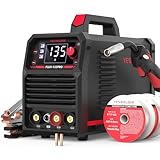
A MIG arc welder combo is useful if your projects vary from thin sheet to outdoor repairs. Look for a machine with clearly stated output ranges for MIG and stick, a genuine 240 V input option if you need thicker steel, polarity selection, and a duty-cycle rating at a specified amperage.
Do not choose a combo machine merely because its maximum amperage is high. Check whether it includes a proper stick electrode holder, work clamp, gas regulator, and MIG gun, and whether the wire-feed system accepts the wire diameter you plan to use. A machine that supports self-shielded flux-cored wire is especially versatile, but it will not produce the same clean finish as gas-shielded solid-wire MIG.
Ownership details that affect results
- Clean mill scale, oil, paint, and heavy rust near the joint. Flux helps, but it cannot replace sound preparation.
- Keep MIG wire dry and protect the gas cylinder from heat and impact. Moisture in wire or shielding gas can increase porosity.
- Replace MIG contact tips when the wire drags, burns back, or feeds inconsistently. Keep the nozzle free of spatter.
- Store stick electrodes according to their packaging instructions. Moisture-sensitive low-hydrogen rods require more careful storage than ordinary general-purpose rods.
- After stick welding, remove all slag before inspecting or adding another pass. Trapped slag is a common cause of inclusions.
- Respect duty cycle. A machine rated at 20% duty cycle at 200 A may need about eight minutes of cooling after two minutes of welding at that output.
So, should you buy an arc or MIG welder? Buy MIG for indoor versatility, thin-to-medium steel, speed, and the gentlest learning curve. Buy stick for outdoor durability, thick steel, minimal setup, and the lowest barrier to occasional repair work. If your projects genuinely span both categories, a properly specified MIG arc welder combo is usually the most capable single-machine solution.