What's inside
As an Amazon Associate I earn from qualifying purchases. This post may contain affiliate links at no extra cost to you.
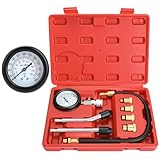
The best compression testers for most home mechanics are kits with a 0-300 PSI gauge accurate to within 2-3%, a 10 to 26-inch hose with a Schrader valve at the tip, and both M14 and M18 spark plug adapters, with the OTC 5605 Deluxe and Innova 3612 covering the widest range of gasoline engines while the Lang Tools TU-15 and Mityvac MV5530 offer better durability for frequent use.
As an Amazon Associate we earn from qualifying purchases at no extra cost to you.


What we cover
What Makes a Compression Tester Accurate and Reliable
Compression testers look simple, but cheap gauges and poorly placed valves can give you readings 15-20 PSI low, which is enough to misdiagnose a healthy engine as worn out. For a buying decision, focus on these criteria in order of importance:
- Gauge accuracy and readability: Look for a 2.5-inch or larger dial with dual reading (PSI and kPa) and stated accuracy of +/- 2% to 3% of full scale. A 0-300 PSI range is ideal for gasoline engines. Gauges that go to 1000 PSI are for diesel and will be hard to read accurately on a 150 PSI small engine. A gauge with a pressure relief/bleed valve on the side lets you reset without disconnecting the hose.
- Valve design and placement: The check valve (Schrader valve) must be at the tip of the adapter or hose end that threads into the spark plug hole, not just at the gauge. If the valve is only at the gauge, the entire hose volume is added to the combustion chamber, which artificially lowers the reading, especially on small single-cylinder engines found in woodworking shop equipment like dust collectors, compressors, and generators.
- Hose length and flexibility: A 10 to 15-inch hose is easier to handle on open engines, but a 25-inch flexible hose is needed for recessed spark plug tubes on DOHC automotive engines and snowblower/generators. Braided rubber with a 1/4-inch NPT fitting is more durable than plain plastic hose.
- Adapter coverage: Most gasoline engines use M14 x 1.25 (most common), M18 x 1.5 (older large engines), M12 x 1.25 (many motorcycles, small powersports, and newer compact cars), and M10 x 1.0 (very small engines). Kits that include a tapered rubber cone adapter are useful for quick checks but not for accurate numbers.
- Durability: Brass adapters with o-rings, a steel gauge case with rubber boot, and replaceable Schrader valve cores will last years. The weak points are usually the o-rings, valve cores, and the hose crimp at the gauge.
Best Compression Testers Compared: Specs and Features
This comparison focuses on widely available gasoline compression tester kits that are still in production in 2026 and suitable for automotive, small engine, and powersports use.
| Kit / Type | Pressure Range | Gauge Size & Accuracy | Hose Length | Adapters Included | Valve Location | Weight (Kit) |
|---|---|---|---|---|---|---|
| OTC 5605 Deluxe | 0-300 PSI / 0-2100 kPa | 2.5″ dial, +/- 2% full scale | 26″ flexible hose + 6″ rigid extension | M10, M12, M14, M18 + rubber cone | Schrader at adapter tip + check valve at gauge | 1.8 lbs |
| Innova 3612 | 0-300 PSI / 0-2000 kPa | 2.5″ dial, +/- 3% full scale | 15″ rubber hose | M14, M18 (M12/M10 with 3612-A adapter set) | Schrader at adapter tip | 1.3 lbs |
| Lang Tools TU-15 Quick-Connect | 0-300 PSI / 0-2100 kPa | 3.5″ dial, +/- 2% full scale | 12″ hose with quick-connect | M14, M18 (M10, M12 sold separately) | Schrader at adapter tip | 2.1 lbs |
| Mityvac MV5530 | 0-300 PSI / 0-2100 kPa | 2.75″ dial, +/- 2.5% full scale | 25″ braided hose | M10, M12, M14, M18 | Schrader at adapter tip | 1.9 lbs |
| Actron CP7828 | 0-300 PSI / 0-2100 kPa | 2.5″ dial, +/- 3% full scale | 10″ hose + push-on cone | M14, M18 + cone only | Schrader at gauge only (cone has no valve) | 1.1 lbs |
| Pittsburgh (Harbor Freight) Basic | 0-300 PSI / 0-2100 kPa | 2.5″ dial, +/- 4% full scale | 14″ hose | M14, M18 + cone | Schrader at gauge | 1.2 lbs |
The table shows a critical difference: kits with the Schrader valve at the adapter tip (OTC, Innova, Lang, Mityvac) will read 5-15 PSI higher and more consistently than kits with the valve only at the gauge, particularly on engines under 400cc. For small shop engines, that difference matters.
What The Numbers Mean For Accuracy
A gauge listed as +/- 2% of a 300 PSI full scale can be off by up to 6 PSI at any point. A +/- 4% gauge can be off by 12 PSI. On a 150 PSI cylinder, that is the difference between reporting 138 PSI and 162 PSI. That is why a larger dial with finer markings (2 PSI increments instead of 5 PSI) helps you spot a 10-15% cylinder-to-cylinder variation, which is the real diagnostic threshold. Avariation greater than 15% between highest and lowest cylinder usually indicates a problem, even if all cylinders are within the factory spec range.
Decision Matrix: Which Tester Fits Your Situation
Choose based on what you work on most often, not just price.
| Your Situation | Priority | Recommended Type | Why |
|---|---|---|---|
| Homeowner testing lawnmowers, generators, and shop compressors occasionally (2-4 times per year) | Low cost, easy storage | Innova 3612 or Actron CP7828 style kit | Lightweight, covers M14/M18 which fits 90% of small engines. Cone adapter is fine for quick go/no-go checks. |
| DIY auto maintenance on modern cars and trucks (gasoline) | Reach and adapter coverage | OTC 5605 or Mityvac MV5530 | 26″ hose reaches recessed plugs on DOHC heads; M10/M12 adapters needed for many newer 4-cylinder engines and prevent buying adapters later. |
| Motorcycles, ATVs, powersports, and woodworking shop equipment with small overhead-valve engines | Valve-at-tip accuracy | OTC 5605, Mityvac MV5530 | Small combustion chamber volume requires tip valve to avoid falsely low readings; M10/M12 essential. |
| Frequent use in a small shop or farm (weekly use, multiple engines) | Durability and serviceability | Lang Tools TU-15 | Large 3.5″ gauge is easier to read, steel case with rubber boot, and quick-connect fittings plus replaceable valve cores reduce downtime. |
| On a tight budget and need a basic check only | Lowest price | Pittsburgh/Basic M14/M18 kit | Acceptable for large automotive cylinders where hose volume error is smaller, but expect +/- 10-12 PSI uncertainty and replace o-rings sooner. |
Compatibility: Will It Fit Your Engine?
Check your engine’s spark plug thread before buying. Most automotive gasoline engines from the 1980s to today use M14 x 1.25, with thread reach of 12.7mm (1/2″) or 19mm (3/4″). Older V8s and some industrial engines use M18 x 1.5. Many Honda, Toyota, and Ford 4-cylinders from 2010 onward use M12 x 1.25. Small Honda GX, Briggs & Stratton Intek, and Kohler Courage engines commonly use M14, while 50cc-150cc powersports engines often use M10.
A kit that only includes M14 and M18 will require a separate M10/M12 adapter set, which typically costs about one-third to one-half of the base kit price. Buying a kit that already includes all four thread sizes is usually cheaper than adding adapters later, even if the upfront price is in the general mid-range of $45-$90 versus $25-$45 for a basic two-adapter kit. Professional-grade kits with large gauges and quick-connects generally fall in the $85-$150 range.
Worked Example: Cost Per Use
If you maintain three pieces of equipment (truck, generator, and shop air compressor) and test compression once a year as preventive maintenance, over five years you will perform 15 tests. A $75 kit that covers all adapters costs about $5 per test over that period. A $30 basic kit that needs a $25 adapter set for your generator actually costs $55 total, or $3.66 per test, but with lower accuracy and more frequent o-ring replacement. For a shop testing monthly (60 tests in five years), a $140 durable kit costs about $2.33 per test and is less likely to need replacement, while a budget kit may need hose or gauge replacement after 30-40 uses.
Step-by-Step: How to Get an Accurate Reading
Correct procedure matters more than the brand of tester. Follow these steps to avoid false low readings:
- Warm the engine, then disable ignition and fuel. Warm oil seals rings better and gives a true operating reading. Pull the fuel pump fuse or relay and disconnect the ignition coil to prevent firing and fuel wash.
- Remove all spark plugs. This lets the engine spin at full cranking speed. On multi-cylinder engines, leaving other plugs in slows cranking and lowers readings by 10-20 PSI.
- Thread the correct adapter by hand, then snug with a hose. Do not overtighten. A damaged o-ring will leak and give a low reading that climbs slowly instead of holding.
- Hold throttle wide open and crank 5-7 compression strokes. Wide-open throttle lets air in. Count the pulses on the gauge; the needle should climb and stabilize by the 5th pulse. Record the highest reading that holds.
- Repeat for each cylinder and use the release valve. Press the side bleed valve to reset the gauge to zero between cylinders. Compare all cylinders, not just to the factory spec.
If one cylinder is low, add a teaspoon of engine oil through the plug hole and retest (wet test). If pressure rises significantly, rings/cylinder wear is likely. If it stays low, suspect valves or head gasket. This test works for gasoline engines only; diesel engines require a dedicated diesel compression tester with much higher range (0-1000 PSI) and different adapters.
Durability and Ownership Realities
Compression testers are not wear-free tools. What fails first is predictable:
- O-rings and adapter seals: Heat and fuel exposure harden them within 2-3 years. Keep adapters clean, lightly oil o-rings before storage, and keep spare o-rings and valve cores. A leaking o-ring shows as a needle that won’t hold steady.
- Schrader valve cores: Carbon and moisture corrode the core. If the gauge is slow to return to zero or reads low after previously reading correctly, replace the core in the adapter tip. Use a standard tire valve core tool.
- Hose crimps and gauge boot: Avoid kinking the hose near the gauge fitting. Store the hose loosely coiled, not tightly wrapped around the gauge. Rubber boots protect the gauge but trap moisture; wipe and dry after use.
- Common mistakes to avoid: Cross-threading adapters (always start by hand), testing a cold engine and comparing to warm specs, using the rubber cone on a high-compression engine where it can blow out and give a false low, and not charging the battery fully before testing. A weak battery can lower all readings by 10-15 PSI.
- Cleaning: No solvents on the gauge. Wipe adapters with a dry rag, clear debris from spark plug wells with compressed air before removing plugs to prevent debris from damaging the valve.
For woodworking shops where the tester sits unused for months, store it in its case away from sawdust and humidity, and check the gauge needle rests at zero before each use. If it rests above or below zero, the gauge has drifted and should be replaced.
Final Picks by Use Case
For the best all-around accuracy and coverage for both automotive and small shop engines, the OTC 5605 Deluxe type kit is the most complete choice due to its four adapter sizes, long hose, and valve-at-tip design. For light automotive-only use where storage space matters, the Innova 3612 style kit is compact and accurate enough. For frequent shop use where readability and parts replacement matter, the Lang Tools TU-15 or Mityvac MV5530 style kits justify their higher general market price through durability and serviceability.
FAQ
Can I use a gasoline compression tester on a diesel engine?
No. Gasoline testers only read to 300 PSI; diesel compression is typically 275-400 PSI for small diesels and up to 600 PSI for automotive diesels, and requires a diesel-specific tester with a higher range gauge and injector/glow plug adapters.
What is a good compression reading?
Most healthy gasoline automotive engines read 125-180 PSI per cylinder, with small engines often 90-150 PSI. More important than the absolute number is uniformity: all cylinders should be within 15% of each other and within the range listed in your engine’s service manual.
Why does my tester read low on my generator but normal on my truck?
If your tester has the check valve only at the gauge, the hose volume lowers the reading more on small-displacement engines. Switch to a kit with the valve at the adapter tip for small engines to get a true reading.