What's inside
- Quick picks by welding situation
- Can you weld aluminium with a MIG welder?
- Spool gun versus push-pull gun
- AC input: what your workshop must provide
- How much aluminium can a MIG welder really weld?
- Machines and configurations worth considering
- Setup details that determine the result
- Can you weld aluminium with a stick welder?
- Final buying decision
- Quick picks by welding situation
- Can you weld aluminium with a MIG welder?
- Spool gun versus push-pull gun
- AC input: what your workshop must provide
- How much aluminium can a MIG welder really weld?
- Machines and configurations worth considering
- Setup details that determine the result
- Can you weld aluminium with a stick welder?
- Final buying decision
As an Amazon Associate I earn from qualifying purchases. This post may contain affiliate links at no extra cost to you.
The best MIG welder for aluminium is a 200–250 amp machine with a spool gun, 230-volt capability, and a manufacturer-approved 0.035-inch (0.9 mm) aluminium wire setup; for occasional repairs, a 140–180 amp 120-volt unit can work, but its realistic aluminium limit is usually about 1/8 inch (3 mm) in a single pass.
As an Amazon Associate we earn from qualifying purchases at no extra cost to you.


What we cover
- Quick picks by welding situation
- Can you weld aluminium with a MIG welder?
- Spool gun versus push-pull gun
- AC input: what your workshop must provide
- How much aluminium can a MIG welder really weld?
- Machines and configurations worth considering
- Setup details that determine the result
- Can you weld aluminium with a stick welder?
- Final buying decision
Quick picks by welding situation
| Situation | Best setup | Useful output | Realistic aluminium capability |
|---|---|---|---|
| Occasional brackets, enclosures and small repairs | 120-volt MIG with spool-gun compatibility | 140–180 A | 1/16–1/8 in (1.6–3 mm), mostly single-pass |
| Regular fabrication and trailer or boat repairs | Dual-voltage MIG with a spool gun | 200–250 A | 3/16 in (4.8 mm) with preparation and multiple passes |
| Long aluminium welds and production work | Push-pull gun and 230-volt power | 250–350 A | 1/4 in (6 mm) and beyond, depending on joint design |
| Thin sheet and appearance-critical work | AC TIG rather than MIG | 180–250 A AC | Better control below 1/8 in (3 mm) |
Can you weld aluminium with a MIG welder?
Yes. An aluminium MIG welder uses direct-current electrode-positive output, 100% argon shielding gas, and soft aluminium wire. The difficulty is feeding the wire: aluminium is much softer than steel, so a conventional 10 or 12-foot steel-wire liner can cause bird-nesting, erratic feeding and blocked contact tips.
The practical solution is either a spool gun, which keeps a small wire spool close to the torch, or a push-pull gun, which uses a motor at the gun to assist the main feeder. MIG aluminium welding is fast and productive, but it is less forgiving than steel MIG. Cleanliness, torch angle, wire-feed adjustment and heat control matter more than the machine’s headline amperage.
Spool gun versus push-pull gun
Spool gun: the sensible choice for most owners
A spool gun carries a 4-inch or 8-inch spool—typically 1 or 2 lb—at the handle. Because the wire travels only a short distance, feeding remains reliable with soft 4043 or 5356 aluminium wire. A spool gun is usually less expensive than a push-pull system and is adequate for intermittent repair work.
- Advantages: simple wire path, lower purchase cost, easy changeover from steel, and good reliability for short welds.
- Limitations: the gun is heavier, the small spool runs out quickly, and the cable is less comfortable on large frames or long seams.
- Best for: homeowners, repair shops and fabricators making occasional aluminium parts.
Push-pull gun: better for distance and frequency
A push-pull system combines the welder’s feeder with a powered motor in the gun. The main feeder pushes wire while the gun pulls it, allowing a longer cable and larger spool. This is preferable for repeated production, long welds and work where stopping to replace a small spool wastes time.
- Advantages: smoother feeding over longer distances, less gun-mounted weight, and better productivity.
- Limitations: higher cost, more controls and cables, and compatibility that must be checked carefully before purchase.
- Best for: frequent fabrication, boat work, vehicle panels and shops that use aluminium every week.
A spool gun is not automatically inferior. For a 4-inch fillet weld followed by a long pause, it can produce the same sound joint as a push-pull setup. The difference is mainly feeding comfort, spool capacity and duty cycle.
AC input: what your workshop must provide
Aluminium MIG does not require AC welding output; it uses DC. The AC question concerns the welder’s incoming electrical supply. A 120-volt machine can run from a standard household circuit, but its maximum output and duty cycle are limited. A 230-volt circuit lets the machine deliver higher current without pushing the input circuit as hard.
| Input supply | Typical MIG output range | Practical aluminium use | Common limitation |
|---|---|---|---|
| 120 V, 15–20 A | 90–180 A | Thin sheet, small repairs and short beads | Low duty cycle and limited penetration |
| 120/230 V dual voltage | 140–250 A | General repair and light fabrication | 230 V is normally needed near maximum output |
| 230 V, 30–50 A | 200–350 A | Longer welds and thicker sections | Requires suitable fixed wiring and breaker capacity |
Check the machine’s manual for input amperage rather than choosing a breaker from the output rating. Extension cords also matter: an undersized or very long cord can cause voltage drop, unstable arc performance and nuisance breaker trips.
How much aluminium can a MIG welder really weld?
Amperage charts are starting points, not promises. Aluminium conducts heat rapidly, so a machine may fuse a 1/4-inch joint in theory but struggle if the joint is wide, dirty, poorly fitted or attached to a large heat sink. A useful buying rule is to choose a machine whose rated aluminium application is at least one step thicker than your target.
- 0.030-inch wire: useful for thin aluminium, approximately 1/16–1/8 inch (1.6–3 mm), where the feeder and spool-gun manufacturer permit it.
- 0.035-inch wire: the versatile choice for general work, commonly used from about 1/8 to 1/4 inch (3–6 mm) with suitable amperage.
- 0.047-inch wire: suited to high-output equipment and thicker fabrication; it needs greater feed capacity and is less suitable for thin sheet.
For a butt joint in 1/8-inch aluminium, a 180–200 amp machine may be sufficient with a tight fit-up and controlled travel. For a 1/4-inch fillet or butt joint, plan on roughly 250 amps, beveling where appropriate and using multiple passes. Do not confuse “can melt the edges” with “can make a structurally sound full-penetration weld.”
Machines and configurations worth considering
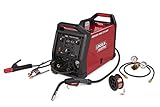
The Lincoln Electric Power MIG 210 MP is a practical dual-voltage category choice when portability and mixed-material work matter. Confirm the exact package and spool-gun compatibility, since accessories and regional bundles vary.
The Hobart Handler 210 MVP is a useful example of a 210-amp-class machine for workshop repair and light fabrication. It is most attractive when paired with the compatible spool-gun arrangement and a 230-volt supply for heavier aluminium work.
The Miller Multimatic 220 AC/DC is a broader process machine. Its AC TIG capability makes it more suitable for owners who need controlled work on thin aluminium as well as MIG productivity. It costs more than a basic MIG-only machine, but the extra process flexibility can be more valuable than buying a second welder later.
For frequent aluminium production, look beyond these portable categories toward a 250–350 amp MIG power source with a purpose-built push-pull gun. The added cost is justified by longer duty cycles, larger spools and fewer wire-feeding interruptions—not simply by a larger number on the front panel.
Setup details that determine the result
- Use 100% argon. Do not use the argon-CO2 mix commonly used for steel. Start around 20–30 cubic feet per hour and adjust for drafts and nozzle size.
- Install the correct liner and contact tip. Use parts intended for aluminium wire. A worn or oversized tip promotes burnback and inconsistent feeding.
- Keep the wire path gentle. Avoid tight bends in the gun cable. With a spool gun, keep the spool dry and protected from dirt.
- Clean the joint mechanically. Remove oil first, then use a dedicated stainless-steel brush to break up the oxide layer. Brush only aluminium with that brush.
- Use a push angle. A travel angle of roughly 10–15 degrees and a short stickout usually gives better shielding and puddle control than dragging the gun.
- Control heat between passes. Aluminium stays hot after the arc stops. Allow cooling when the joint begins to sag or the edges start disappearing.
Aluminium wire and contact tips are consumables. The first items commonly worn are the tip, liner, drive-roll groove and spool-gun torch-neck parts. Clean spatter from the nozzle, inspect the drive rolls for shavings and replace a liner when feeding remains erratic after tension and tip checks.
Can you weld aluminium with a stick welder?
In theory, aluminium stick electrodes exist, so the answer is technically yes. In practical terms, aluminium stick welding is difficult, slow and rarely the best repair method. Electrodes are moisture-sensitive, the arc is hard to control, slag removal is troublesome, and thin aluminium burns through readily. For most owners asking “can I weld aluminium with a stick welder?”, the useful answer is no: choose MIG with a spool gun or AC TIG instead.
Final buying decision
Choose a spool-gun MIG welder if aluminium is occasional work and your joints are short. Choose a dual-voltage 200–250 amp machine if you want a capable all-round aluminium MIG welder for a home workshop. Choose a push-pull system when aluminium is frequent, the welds are long or the machine will be used continuously. If your priority is thin material, low distortion and a neat visible bead, spend the budget on AC TIG capability rather than chasing the highest MIG amperage.