What's inside
- Best MIG Welders Under $500: Quick Picks
- Head-to-Head Comparison
- 1. Hobart Handler 140: Best for Straightforward Steel Work
- 2. Lincoln Electric Easy-MIG 180: More Headroom on 120 Volts
- 3. YESWELDER MIG-250 PRO: Best Feature Set per Dollar
- Choose by Your Situation
- What Materials Can You Actually Weld?
- Setup and Ownership Costs
- Maintenance Mistakes That Shorten Welder Life
- Final Recommendation
- Related Guides
- Best MIG Welders Under $500: Quick Picks
- Head-to-Head Comparison
- 1. Hobart Handler 140: Best for Straightforward Steel Work
- 2. Lincoln Electric Easy-MIG 180: More Headroom on 120 Volts
- 3. YESWELDER MIG-250 PRO: Best Feature Set per Dollar
- Choose by Your Situation
- What Materials Can You Actually Weld?
- Setup and Ownership Costs
- Maintenance Mistakes That Shorten Welder Life
- Final Recommendation
- Related Guides
As an Amazon Associate I earn from qualifying purchases. This post may contain affiliate links at no extra cost to you.
The best MIG welder under 500 dollars for most home and garage projects is the Hobart Handler 140 for dependable 120-volt steel work; choose a dual-voltage inverter instead if you need more output, longer duty cycles, or a realistic path to aluminum welding.
As an Amazon Associate we earn from qualifying purchases at no extra cost to you.


What we cover
- Best MIG Welders Under $500: Quick Picks
- Head-to-Head Comparison
- 1. Hobart Handler 140: Best for Straightforward Steel Work
- 2. Lincoln Electric Easy-MIG 180: More Headroom on 120 Volts
- 3. YESWELDER MIG-250 PRO: Best Feature Set per Dollar
- Choose by Your Situation
- What Materials Can You Actually Weld?
- Setup and Ownership Costs
- Maintenance Mistakes That Shorten Welder Life
- Final Recommendation
- Related Guides
Best MIG Welders Under $500: Quick Picks
- Best for dependable home repairs: Hobart Handler 140 — simple 120V operation, strong support network, and excellent results on mild steel up to roughly 1/4 inch with proper preparation and multiple passes.
- Best for maximum versatility: YESWELDER MIG-250 PRO — high advertised output, 110/220V input, flux-core and MIG modes, and spool-gun compatibility on applicable packages.
- Best compact option: Lincoln Electric Easy-MIG 180 — a portable 120V machine with more headroom than a 140-amp welder and useful wire-size flexibility.
- Best low-cost occasional-use option: a 140-amp inverter MIG/flux-core welder — suitable for brackets, carts, gates, and light automotive work, but inspect the included torch, ground lead, and replacement-parts availability before buying.
Head-to-Head Comparison
| Welder or class | Input and output | Wire compatibility | Duty cycle | Spool-gun support | Best material and use |
|---|---|---|---|---|---|
| Hobart Handler 140 | 120V; 25–140A | .023–.030 in solid; .030–.035 in flux-core | 20% at 90A | No practical factory spool-gun route | Mild steel, home repair, light fabrication |
| Lincoln Electric Easy-MIG 180 | 120V; approximately 30–180A, package-dependent | Commonly .025–.035 in solid and flux-core | Check the exact revision; commonly around 20% at lower 120V output | Some Lincoln packages support a spool gun; verify the model number | Steel and occasional heavier fabrication |
| YESWELDER MIG-250 PRO | 110/220V; up to approximately 250A advertised | Typically .023–.035 in solid and .030–.045 in flux-core | Often advertised around 60% at rated conditions | Supported on compatible versions; gun may be extra | Steel, stainless, and occasional aluminum |
| Generic 140A inverter MIG | 120V; approximately 20–140A | Usually .030–.035 in solid or flux-core | Usually 20% at 90–100A | Rarely supported | Light steel work where low price matters most |
Specifications can change between revisions and bundles, especially for imported inverter welders. Treat the table as a shopping guide, then confirm the manual for the exact model before ordering a spool gun or a specific wire diameter.
1. Hobart Handler 140: Best for Straightforward Steel Work
The Handler 140 is the safest pick when your projects will stay on a normal household outlet and involve mild steel. Its 25–140 amp range covers sheet metal, tubing, lawn-equipment repairs, small trailers, workbenches, and brackets. It uses a tapped-voltage design rather than infinitely adjustable voltage, which is less refined than an inverter but easy for a beginner to understand.
Its 20% duty cycle at 90 amps means you can weld for about two minutes in a ten-minute period at that output before allowing the machine to cool. At lower settings, the usable work period is generally longer. The included torch and ground lead are useful advantages over bargain machines that provide short or lightweight cables.
Use .023-inch solid wire for thinner sheet steel, .030-inch solid wire for general fabrication, and .030- or .035-inch flux-core wire outdoors. The limitation is aluminum: this machine is not a sensible aluminum setup because it lacks a practical spool-gun solution and a standard push-feed torch is prone to bird-nesting soft aluminum wire.
2. Lincoln Electric Easy-MIG 180: More Headroom on 120 Volts
A 180-amp-class 120V welder is a better choice than a 140-amp machine if you regularly weld 3/16-inch plate, heavier square tubing, or joints that need several passes. The Easy-MIG 180 is still garage-friendly, but its actual output and duty-cycle figures depend on the particular Lincoln package and revision.
It is well suited to .025-inch wire for thinner steel and .030- or .035-inch wire for structural-looking home projects. Flux-core operation adds useful outdoor capability because wind can disturb shielding gas. For stainless steel, use compatible stainless MIG wire and the gas specified by the wire manufacturer; do not assume ordinary 75/25 steel gas is ideal for every stainless alloy.
Check the spool-gun connection before purchasing. Some Lincoln 180-class packages are designed for that upgrade, while similarly named versions may not include the required controls or connection. If aluminum is a serious part of your plan, a confirmed spool-gun-ready package is worth more than a higher advertised amp number.
3. YESWELDER MIG-250 PRO: Best Feature Set per Dollar
The MIG-250 PRO is attractive when your garage has both 120V and 240V power available. Dual-voltage input lets you practice on a standard outlet and move to 240V for higher output and better arc stability. The machine is commonly marketed with MIG, flux-core, and stick functions, although included accessories differ by bundle.
Its main advantage is flexibility: a .023-inch wire can handle thinner steel, while .030- or .035-inch wire is more productive on tubing and plate. With a compatible spool gun, aluminum becomes practical for short welds on clean material. Keep expectations realistic: a small spool gun and a modest duty cycle are not equivalent to an industrial aluminum MIG system.
Before buying, verify four details: whether the spool gun is included, whether the machine changes polarity for gas-shielded MIG, the length of the supplied work lead, and the availability of replacement contact tips and liners. A machine advertised at 250 amps is only useful at that level if the input circuit, wire feed, thermal protection, and duty-cycle rating support it.
Choose by Your Situation
| Your situation | Best choice | Why |
|---|---|---|
| Beginner, 120V outlet, occasional steel repairs | Hobart Handler 140 | Simple controls, reliable consumable ecosystem, and enough output for common household fabrication |
| Frequent 3/16-inch steel work | Lincoln Easy-MIG 180 or another 180A-class unit | More reserve for larger wire and multi-pass joints |
| Need steel, stainless, aluminum, and stick capability | Dual-voltage inverter with confirmed spool-gun support | Broader process range and better use of a 240V circuit |
| Very limited budget and only a few projects per year | 140A inverter MIG/flux-core machine | Low entry cost, provided replacement parts and warranty support are acceptable |
| Small garage with frequent moves | Compact inverter, approximately 15–25 lb | Much easier to store and carry than a 50–60 lb transformer machine |
What Materials Can You Actually Weld?
Mild steel
All four categories can weld mild steel. Use shielding gas indoors for cleaner solid-wire welds, or flux-core wire when portability and wind resistance matter more than appearance. Clean mill scale, paint, rust, and oil away from the joint; a welder cannot compensate for contaminated steel.
Stainless steel
Stainless is possible with a machine that has stable wire-feed control and suitable gas. Use stainless wire matched to the base alloy, a clean liner, and dedicated stainless brushes. Avoid dragging carbon-steel contamination across the joint. Thin stainless also benefits from short welds and cooling pauses because it distorts quickly.
Aluminum
Aluminum is the dividing line between a basic home MIG welder and a genuinely versatile setup. You generally need a spool gun, aluminum wire, a suitable shielding gas such as pure argon, and very clean material. A standard torch with a long steel liner is a poor choice for soft aluminum wire. For occasional aluminum repairs, a compatible spool gun can be economical; for frequent or cosmetic aluminum fabrication, TIG may be the better process.
Setup and Ownership Costs
Budget at least 60–150 dollars beyond the welder for a regulator and hose, gas-cylinder rental or purchase, spare contact tips, nozzles, a liner, welding wire, gloves, and cleaning tools. If adding aluminum capability, a spool gun and argon setup can consume much of the remaining budget.
For example, assume a 10-pound spool costs 25 dollars and produces roughly 8 pounds of deposited weld metal after normal wire waste. At 0.25 pounds of deposited weld per project, the wire cost is about 78 cents per project. Add gas, electricity, and consumables and a realistic consumable allowance may approach 2–4 dollars per light project. The larger ownership expense is often not wire; it is replacing neglected liners, tips, drive rolls, and damaged leads.
Maintenance Mistakes That Shorten Welder Life
- Keep the wire dry, particularly flux-core wire, which absorbs moisture and produces unstable arcs.
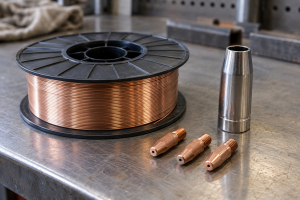
- Replace a worn contact tip when the wire fits loosely or starts arcing inside the tip.
- Clean dust from the machine’s ventilation openings with dry, low-pressure air; blocked airflow causes thermal shutdowns.
- Use the correct drive-roll groove and tension. Excessive tension deforms wire and accelerates liner wear.
- Do not kink the gun cable. A restricted liner creates feeding problems that can look like a bad motor.
- Allow the fan to complete its cooling cycle after high-output work, even if the weld is finished.
Final Recommendation
For mostly mild-steel projects on household power, buy the Hobart Handler 140 and spend the remaining budget on gas, quality wire, and safety equipment. Choose the Lincoln Easy-MIG 180 when thicker steel and extra output matter more than compactness. Choose the YESWELDER MIG-250 PRO or a similar dual-voltage inverter only after confirming its exact duty cycle, leads, polarity controls, and spool-gun compatibility. The best MIG welder under 500 is not the one with the largest number on the front panel; it is the one whose input power, wire system, accessories, and duty cycle match the work you will actually do.