What's inside
- Best MIG 100 Welders for Light-Duty Home Projects
- Quick comparison of 100-amp-class MIG welders
- Best choice by project and experience
- Flux-core-only versus gas-capable MIG
- Wire size determines how friendly the machine feels
- What the duty cycle really means
- Setup that prevents most beginner problems
- Ownership costs and parts that wear first
- Final recommendation
- Best MIG 100 Welders for Light-Duty Home Projects
- Quick comparison of 100-amp-class MIG welders
- Best choice by project and experience
- Flux-core-only versus gas-capable MIG
- Wire size determines how friendly the machine feels
- What the duty cycle really means
- Setup that prevents most beginner problems
- Ownership costs and parts that wear first
- Final recommendation
As an Amazon Associate I earn from qualifying purchases. This post may contain affiliate links at no extra cost to you.
What we cover
- Best MIG 100 Welders for Light-Duty Home Projects
- Quick comparison of 100-amp-class MIG welders
- Best choice by project and experience
- Flux-core-only versus gas-capable MIG
- Wire size determines how friendly the machine feels
- What the duty cycle really means
- Setup that prevents most beginner problems
- Ownership costs and parts that wear first
- Final recommendation
Best MIG 100 Welders for Light-Duty Home Projects
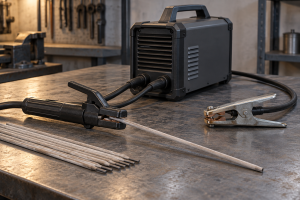
The best mig 100 welder for most home projects is a compact 100-amp-class flux-core/MIG machine with adjustable voltage, wire-speed control, a short 20% duty cycle, and support for both 0.030-inch flux-core wire and 0.023-inch solid wire with shielding gas.
These welders are designed for small repairs, garden equipment, brackets, sheet-metal patches, hobby frames, and mild-steel projects rather than structural fabrication. Their main advantage is simplicity: they run from a normal 120-volt household outlet and are lighter and less expensive than 180- to 200-amp machines.
As an Amazon Associate we earn from qualifying purchases at no extra cost to you.

Quick comparison of 100-amp-class MIG welders
| Welder type | Output range | Recommended wire | Practical mild-steel thickness | Shielding gas | Typical duty cycle | Approximate weight |
|---|---|---|---|---|---|---|
| Flux-core-only 100-amp unit | 40–100 A | 0.030–0.035 in self-shielded flux-core | 1/16–3/16 in with preparation | None | 20% at rated output | 12–18 lb |
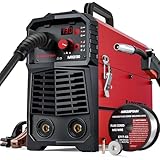
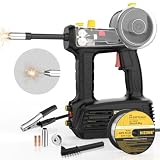
| Dual-process 100-amp MIG/flux-core unit | 40–100 A | 0.023, 0.030, or 0.035 in | Thin sheet to about 3/16 in | Usually CO2 or 75/25 argon-CO2 | 20% at 100 A; often 35–60% at lower output | 15–25 lb |
| Compact inverter MIG 120-class unit | 30–120 A | 0.023–0.035 in | 1/8–1/4 in in multiple passes | CO2 or 75/25 argon-CO2 | 20–30% at maximum output | 10–20 lb |
| Entry-level transformer MIG unit | 35–100 A | 0.030–0.035 in | 1/16–1/8 in comfortably | Often gas-compatible, sometimes flux-core-only | 10–20% at maximum output | 20–35 lb |
Thickness figures are practical ranges, not guarantees. Joint design, clean metal, fit-up, operator technique, and the machine’s actual output all matter. A 100-amp welder may fuse 1/4-inch steel in a carefully prepared joint, but it is not the right tool for repeatedly welding material that thick.
Best choice by project and experience
| Your situation | Best choice | Why |
|---|---|---|
| Lowest cost and outdoor repairs | Flux-core-only 100-amp welder | No regulator, cylinder, or gas hose; flux-core tolerates light wind better. |
| First welder for brackets and repairs | Dual-process 100-amp MIG/flux-core unit | Gas mode produces cleaner welds while flux-core provides a simple backup. |
| Mostly thin sheet metal | Gas-capable inverter with 0.023-inch wire | Small wire and lower settings reduce burn-through and excessive bead size. |
| Occasional use in a small workshop | Lightweight inverter model | Easy to store and usually more efficient than an older transformer design. |
| Frequent work on 1/4-inch steel or long seams | Skip the 100-amp class and buy a 160- to 200-amp machine | More output and a longer duty cycle will save time and reduce frustration. |
Flux-core-only versus gas-capable MIG
A flux-core-only welder is the least complicated option. Self-shielded wire contains flux that creates a protective gas and slag during welding. It works well for outdoor gates, mower repairs, utility carts, and dirty mild steel. The trade-offs are more smoke, more spatter, visible slag to chip, and a rougher finish.
A gas-capable welder mig 100 setup uses solid wire and an external shielding gas. A 75% argon/25% carbon-dioxide mixture is the most useful general-purpose choice for clean mild steel. It produces a smoother arc and less spatter than self-shielded flux-core wire. Pure carbon dioxide is usually less expensive and provides deeper penetration, but it creates a harsher arc and more spatter.
Gas is a poor choice in a strong draft because the shielding cloud can blow away. Flux-core is more forgiving outdoors, although welding in a sheltered area still produces better results. A machine advertised as “MIG” may not include a regulator, gas hose, cylinder, or solid-wire drive roller, so check those items before comparing prices.
Wire size determines how friendly the machine feels
For thin sheet metal, choose 0.023-inch solid wire if the machine supports it. It requires less current and makes it easier to control short tack welds without blowing holes. Use 0.030-inch solid wire for general repairs and 0.030- or 0.035-inch flux-core wire when more penetration is useful.
- 0.023-inch solid wire: best for approximately 20- to 18-gauge steel and other thin material.
- 0.030-inch solid wire: a versatile choice for brackets, tubing, and sheet metal around 1/8 inch thick.
- 0.030-inch flux-core: useful for outdoor repairs and light fabrication.
- 0.035-inch flux-core: better suited to heavier material, but often too aggressive for thin panels on a small machine.
Check whether the included drive roller has separate grooves for the wire sizes you intend to use. A roller set for 0.035-inch wire can crush 0.023-inch wire or cause inconsistent feeding.
What the duty cycle really means
A “100 duty cycle MIG welder” is often misunderstood. Duty cycle is the percentage of a 10-minute period that a machine can weld at a specified output before it needs to cool. A welder rated at 20% duty cycle at 100 amps can weld for two minutes, then requires eight minutes of cooling at that output.
At lower settings, the same machine may have a longer duty cycle. For example, if a manufacturer lists 20% at 100 amps and 60% at 70 amps, thin-sheet work can continue for six minutes of every ten. Never compare duty-cycle percentages without noting the amperage and test standard.
For home projects, a short maximum-output duty cycle is acceptable when welding brackets or making intermittent tacks. It becomes inconvenient when running long continuous beads, building a trailer, or welding several feet of 1/4-inch steel.
Setup that prevents most beginner problems
- Prepare the metal. Remove paint, rust, oil, and mill scale from both sides of the joint. A small welder loses effective penetration quickly when the arc must burn through contamination.
- Choose polarity correctly. Solid MIG wire normally uses electrode-positive polarity. Many self-shielded flux-core wires require electrode-negative polarity. Follow the wire manufacturer’s diagram rather than guessing.
- Install the correct roller and tip. Match the drive roller groove, contact tip, and liner to the wire diameter.
- Set gas flow if using solid wire. A starting range of 20–25 cubic feet per hour is suitable for many indoor mild-steel jobs. Excessive flow can create turbulence and pull air into the weld.
- Set wire speed and voltage from the chart. Make a test bead on scrap of the same thickness. Increase voltage or wire speed gradually rather than adjusting both dramatically at once.
- Use short welds on thin material. Stitching 1/2-inch sections and allowing brief cooling periods reduces warping and burn-through.
As a sizing example, a 100-amp unit rated at 20% duty cycle gives two minutes of welding in a 10-minute interval at maximum output. If a small repair needs twelve 5-second tacks, the actual arc time is only one minute, so the machine has substantial cooling time between welds. A continuous 6-foot seam is a completely different workload and may trigger thermal shutdown before the seam is finished.
Ownership costs and parts that wear first
The purchase price is only part of the cost. A flux-core setup typically needs wire, contact tips, nozzles, and an occasional liner. A gas-capable setup also needs a regulator, hose, cylinder rental or purchase, shielding gas, and solid wire. General market pricing for a basic 100-amp-class machine is roughly $120–$300, while a complete gas-capable setup can reach $250–$500 after accessories.
Contact tips usually wear first, especially when spatter sticks to the nozzle or the tip is dragged against the work. Replace a tip when the wire fits loosely, feeding becomes erratic, or the arc starts inconsistently. Keep the nozzle clear, brush debris from the drive rolls, and blow dust from the machine’s ventilation openings only as directed by the manufacturer.
Common mistakes include using the wrong polarity for flux-core wire, welding over paint, holding too long an arc, installing the wrong roller, and setting wire speed by sound without checking penetration. Keep the work clamp on clean bare metal and avoid coiling excess welding cable tightly, which can increase resistance and make the arc less stable.
Final recommendation
For the broadest home-use range, select a dual-process inverter in the 100- to 120-amp class with 0.023-, 0.030-, and 0.035-inch wire compatibility, adjustable voltage and wire speed, gas connections, and a published duty cycle at both maximum and reduced output. Choose flux-core-only if low cost and outdoor convenience matter more than appearance. If your projects regularly involve thick steel, long welds, or structural joints, a larger 160- to 200-amp machine is the better investment than pushing a small MIG 100 welder beyond its limits.