What's inside
As an Amazon Associate I earn from qualifying purchases. This post may contain affiliate links at no extra cost to you.
The best plasma cutter under $600 for most occasional shop work is a 40-amp, 120/240-volt machine with pilot-arc start and a clean, dry compressed-air supply; for thicker plate or regular production, prioritize a 240-volt unit with a stronger duty cycle instead of trusting its advertised maximum cut.
As an Amazon Associate we earn from qualifying purchases at no extra cost to you.


What we cover
Best picks by job
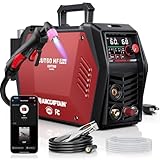
- Best all-around: PrimeWeld CUT60. A dual-voltage, 60-amp-class cutter with pilot arc is a flexible choice for a home shop that has 240-volt power and may tackle thicker steel. Its advertised capacity is not a guarantee of a clean edge at that thickness, so check the manual for cut ratings at each voltage and current.
- Best for lighter work and simpler setup: YESWELDER CUT-40DS. A compact 40-amp-class option suited to sheet, brackets, and general repair. Dual-voltage operation is useful where a 240-volt outlet is not always available, though 120-volt operation reduces available cutting power.
- Best low-cost entry: LOTOS LTP5000D. A 50-amp-class, dual-voltage cutter with pilot arc that can make sense for occasional fabrication when its current price falls below $600. Verify the exact model revision and manual: specifications, included torch, and air requirements can vary by listing or version.
These models are candidates, not promises that every configuration remains under the price ceiling in every market. Prices move; treat roughly $300–$600 as the shopping range, confirm the exact model’s current manual, and budget for air preparation and consumables. If a model’s verified price exceeds $600, choose a comparable machine within budget rather than stretching on the basis of a headline rating.
Compare the specs that matter at the cut
Manufacturers do not always publish comparable clean-cut, severance, and duty-cycle figures under identical conditions. The table separates common published class specifications from practical buying checks. Confirm the numbers for the exact revision before purchasing; do not interpret an advertised maximum thickness as a production rating.
| Machine | Output class | Power | Published capacity context | Air and duty-cycle check | Approx. weight class |
|---|---|---|---|---|---|
| PrimeWeld CUT60 | Up to 60 A | 120/240 V, depending on model and input | Advertised maximum commonly around 7/8 in.; clean-cut capacity is lower | Confirm required pressure and flow in the manual; verify duty cycle at the current and voltage you will use | About 20–25 lb |
| YESWELDER CUT-40DS | Up to 40 A | 120/240 V | Advertised maximum commonly around 1/2 in.; expect a thinner clean-cut range | Check air flow as well as pressure; 120 V limits sustained output | About 15–20 lb |
| LOTOS LTP5000D | Up to 50 A | 120/240 V | Advertised maximum commonly around 3/4 in.; severance is not a clean edge | Confirm the exact version’s air demand and duty-cycle chart | About 20–25 lb |
Weight figures are approximate and can exclude torch leads and accessories. “Clean cut” means a usable edge with limited dross at a controlled speed; “severance” means the machine can separate material, often slowly and with a rougher edge. A seller’s maximum-thickness number may describe severance, not a cut ready for assembly.
Choose by material, power, and work pattern
| Your situation | What to prioritize | Best fit |
|---|---|---|
| Mostly sheet metal and occasional repair; 120 V only | Low-current stability, short lead setup, and realistic thin-material performance | 40-amp dual-voltage class, used at 120 V within its reduced output |
| Mixed brackets and plate; reliable 240 V available | Pilot arc, adequate clean-cut capacity, and a useful duty cycle at working amperage | PrimeWeld CUT60 or a verified comparable 50–60 A unit |
| Dirty, painted, or expanded metal | Pilot arc and torch consumables that are easy to source | Any compatible pilot-arc model, with surface preparation where practical |
| Frequent long cuts or repeated thick plate | Higher duty cycle, dependable air system, and serviceable torch parts | Consider a larger budget or a used industrial machine; a sub-$600 unit may be a bottleneck |
| Portable work at multiple sites | Machine weight, input-voltage flexibility, lead length, and access to clean air | A compact dual-voltage unit, provided the jobsite circuit supports the intended output |
For a clean-cut comparison, look for thickness rated at a stated travel speed and input voltage. A 40-amp cutter may handle thin sheet neatly but slow down and leave more dross as material approaches its upper range. A 60-amp label does not solve inadequate input power, a weak compressor, or an undersized extension cord.
Air supply and duty cycle can make or break the value
Plasma cutting consumes compressed air to form and cool the arc. Check the machine’s required pressure and flow rate, usually stated in PSI and SCFM or L/min. A compressor that reaches the right pressure but cannot sustain the required flow will cause inconsistent cuts, excess dross, or interruptions. Tank size alone is not a reliable measure of whether a compressor can keep up.
Use a water separator and, where the shop conditions warrant it, a suitable filter or dryer. Moisture and oil are hard on the torch and can shorten consumable life. Keep the compressor outlet and air line clean, drain the tank regularly, and avoid a long, narrow hose that restricts flow. If the machine’s air specifications are unclear, get the manual before buying rather than guessing from compressor horsepower.
Duty cycle describes how long a cutter can operate within a 10-minute period at a stated output and ambient condition. For example, a 40% duty cycle at a particular amperage means about four minutes of arc-on time followed by six minutes of cooling under the stated conditions. Do not compare duty-cycle percentages without checking the amperage and voltage attached to each one. Thin sheet with short cuts may never challenge the rating; repeated long cuts in thick plate can.
Consumables and ownership costs
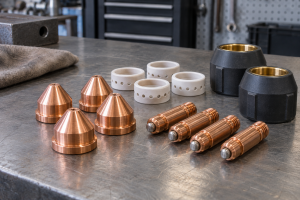
Electrodes and nozzles wear first. Dragging the torch, using wet air, cutting beyond the nozzle’s rating, or holding an inconsistent standoff accelerates wear. A damaged nozzle can widen the arc and produce a less square cut; a worn electrode can make starts unreliable. Inspect parts when cut quality changes, and replace matched consumables rather than continuing with a visibly damaged set.
Before choosing a machine, price a replacement torch or compatible consumable kit and confirm that the torch model is clearly identified. A low purchase price is less attractive if essential parts are difficult to locate. Keep a spare electrode-and-nozzle set on hand, but avoid buying generic parts solely because they look similar: torch compatibility matters.
As a simple ownership calculation, suppose a consumable set costs $20 and lasts through 40 hours of actual arc time in your conditions. That is $0.50 per arc hour, before accounting for electrodes, air-system upkeep, or wasted cuts. If the same set lasts only 10 hours because the air is wet or the torch is dragged, the cost rises to $2 per arc hour. These are illustrative figures, not a lifespan guarantee; material, technique, and air quality change the result.
Setup habits that protect cut quality
- Check the work circuit. Match the input voltage and breaker requirements in the manual. Use a suitable outlet and cable; a long, undersized extension cord can cause voltage drop and poor performance.
- Prepare the material. Remove loose rust, heavy scale, paint, and coatings near the cut when safe and practical. Use appropriate ventilation and protective equipment, especially around coatings that may release hazardous fumes.
- Set the air and amperage. Start with the manufacturer’s settings for material thickness, then make a short test cut on scrap of the same material.
- Maintain a steady torch position and speed. Follow the torch guide’s drag or standoff instructions. Too slow can build dross; too fast can leave an incomplete cut.
- Let the machine cool. Respect its duty-cycle rating, keep vents clear, and avoid blocking airflow with dust or clutter.
Bottom line
For mixed home-shop work with dependable 240-volt power, the PrimeWeld CUT60 is the strongest all-around candidate among these options if the exact model is available under $600 and its manual confirms the capacity and duty cycle you need. Choose the YESWELDER CUT-40DS for lighter work, portability, or greater reliance on 120 V; consider the LOTOS LTP5000D when its price and verified specifications suit occasional cutting. In every case, buy for the thickness you need to cut cleanly and repeatedly—not the maximum thickness the machine can force apart.