What's inside
- Best Angle Grinders Under $150 for Cutting, Grinding, and Finishing
- Quick Picks by Situation
- Best Corded Choice: DEWALT DWE402
- Best Value for General DIY: Makita 9557PBX1
- Best Low-Cost Corded Option: Bosch 1375A
- Best Cordless Route: 18V or 20V Brushless Grinder
- Disc Size, Power, and Speed: What Actually Matters
- Head-to-Head Decision Matrix
- Safety Features Worth Paying For
- Ownership Costs and Maintenance
- Bottom Line
- Related Guides
- Best Angle Grinders Under $150 for Cutting, Grinding, and Finishing
- Quick Picks by Situation
- Best Corded Choice: DEWALT DWE402
- Best Value for General DIY: Makita 9557PBX1
- Best Low-Cost Corded Option: Bosch 1375A
- Best Cordless Route: 18V or 20V Brushless Grinder
- Disc Size, Power, and Speed: What Actually Matters
- Head-to-Head Decision Matrix
- Safety Features Worth Paying For
- Ownership Costs and Maintenance
- Bottom Line
- Related Guides
As an Amazon Associate I earn from qualifying purchases. This post may contain affiliate links at no extra cost to you.
What we cover
- Best Angle Grinders Under $150 for Cutting, Grinding, and Finishing
- Quick Picks by Situation
- Best Corded Choice: DEWALT DWE402
- Best Value for General DIY: Makita 9557PBX1
- Best Low-Cost Corded Option: Bosch 1375A
- Best Cordless Route: 18V or 20V Brushless Grinder
- Disc Size, Power, and Speed: What Actually Matters
- Head-to-Head Decision Matrix
- Safety Features Worth Paying For
- Ownership Costs and Maintenance
- Bottom Line
- Related Guides
Best Angle Grinders Under $150 for Cutting, Grinding, and Finishing
The best angle grinder under 150 for most people is a 4-1/2-inch corded model with a 7- to 11-amp motor, while a cordless 18V or 20V grinder is the better choice when portability and quick setup matter more than continuous runtime.
Quick Picks by Situation
| Best for | Recommended type | Why it fits | Typical market range |
|---|---|---|---|
| Frequent cutting and heavy grinding | 4-1/2-inch, 10- to 11-amp corded grinder | High sustained power without battery changes | $80–$140 |
| General DIY and occasional welding cleanup | 4-1/2-inch, 6- to 8-amp corded grinder | Lower cost, lighter handling, adequate power | $45–$90 |
| Work away from an outlet | 18V or 20V cordless grinder | No extension cord and fast job-site setup | $80–$150 bare tool |
| Detail work and occasional finishing | 4-inch or 4-1/2-inch grinder with variable speed | Better control with flap discs and wire wheels | $70–$150 |
Best Corded Choice: DEWALT DWE402
The DEWALT DWE402 is a strong choice when cutting steel, removing welds, and grinding repeatedly are the main jobs. Its 4-1/2-inch wheel size is the practical standard for home shops, and its 11-amp motor provides more overhead than entry-level grinders when a disc starts to bind in thick material.
As an Amazon Associate we earn from qualifying purchases at no extra cost to you.


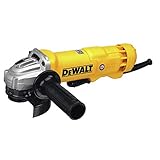

It runs at approximately 11,000 revolutions per minute with no load and weighs roughly 6 pounds, depending on configuration. The grinder has a tool-free guard adjustment, a two-position side handle, and a spindle-lock button for changing accessories. Its dust-ejection features can help reduce abrasive debris entering the motor, although no grinder should be treated as dustproof.
The trade-off is control. This is a high-speed grinder rather than a variable-speed finishing tool. Use light pressure with flap discs and wire wheels, because leaning heavily on a fast grinder creates heat, removes material unevenly, and shortens consumable life. Typical pricing usually places it near the upper end of this budget.
Best Value for General DIY: Makita 9557PBX1
The Makita 9557PBX1 is a useful middle ground for cutting bolts, dressing welds, sharpening lawn-tool edges, and preparing metal for paint. It uses a 4-1/2-inch wheel and a 7.5-amp motor, with a no-load speed around 10,000 RPM. At roughly 4.5 pounds, it is easier to hold for overhead or extended finishing work than many high-output grinders.
This model commonly includes a metal grinding wheel, a cutoff wheel, a wire cup or wire wheel, a flap-style accessory, a side handle, and a case, although package contents can vary. The included accessories add value only if they are appropriate for the material and rated for the grinder’s speed; always verify the maximum RPM printed on each disc.
The 9557PBX1 generally lacks electronic variable-speed control. That makes it less versatile for delicate stainless-steel finishing or polishing, but its simple design keeps operation familiar and maintenance relatively uncomplicated.
Best Low-Cost Corded Option: Bosch 1375A
The Bosch 1375A is aimed at lighter-duty users who need a dependable 4-1/2-inch grinder without spending the entire budget. Its 6-amp motor and approximately 11,000 RPM no-load speed are suitable for cutting thin angle iron, removing surface rust, and cleaning up small welds.
At about 3.75 pounds, it is among the easier grinders to control. That low weight is useful for short jobs, but it also signals the model’s intended workload: it is not the best choice for continuous grinding on thick plate or for production welding. Its compact body, two-position handle, and adjustable guard make it approachable for beginners.
This is the pick when the grinder may be used only a few times each month. Spend part of the savings on quality cutoff wheels, eye protection, and a face shield rather than assuming the included disc is suitable for every task.
Best Cordless Route: 18V or 20V Brushless Grinder
A cordless grinder makes sense in a driveway, on scaffolding, inside a vehicle, or anywhere an extension cord is inconvenient. Models such as the Ryobi PCL445B use an 18V battery platform and accept 4-1/2-inch or 5-inch accessories. Some kits fall below $150, while a bare tool is less expensive but requires a compatible battery and charger.
Brushless cordless grinders usually offer better efficiency and durability than brushed versions, but runtime depends heavily on the battery size and the work. A 4Ah battery contains approximately 72 watt-hours at 18V. If the grinder averages 500 watts while cutting and grinding, the ideal calculation is:
72 Wh ÷ 500 W = 0.144 hours, or about 8.6 minutes of continuous loaded operation.
Real cutting involves pauses, repositioning, and reduced load, so that battery may support roughly 15 to 30 minutes of intermittent work. A 2Ah pack may provide about half that time. A 6Ah pack improves runtime but adds noticeable weight, making the tool more tiring during overhead finishing.
Do not compare cordless runtime with a corded grinder by looking only at no-load RPM. Cordless models can match or exceed 10,000 RPM unloaded, but the useful comparison is how well they maintain speed under load and how many charged batteries are available.
Disc Size, Power, and Speed: What Actually Matters
- 4-1/2-inch discs: The best all-purpose size. They are widely available, relatively inexpensive, and easy to control. Cutting depth is usually around 1 inch, depending on the guard and disc.
- 5-inch discs: Provide slightly more cutting capacity and surface coverage, but compatibility must be checked carefully. A grinder intended only for 4-1/2-inch accessories should not be modified casually.
- 6-amp motors: Adequate for thin stock, rust removal, and occasional work.
- 7.5- to 8-amp motors: A useful balance for household fabrication and moderate welding cleanup.
- 10- to 11-amp motors: Better for frequent heavy grinding, but typically heavier and more tiring.
- Variable speed: Valuable for flap discs, wire brushes, sanding attachments, and stainless steel. It is less important for ordinary steel cutting, where the disc must remain within its rated speed.
Head-to-Head Decision Matrix
| Your situation | Choose | Avoid or accept |
|---|---|---|
| Under $75 and occasional use | 6-amp corded grinder | Expect slower progress in thick steel |
| Weekly welding or fabrication | 7.5- to 11-amp corded grinder | Accept cord management for unlimited runtime |
| Already own compatible batteries | Brushless cordless grinder, preferably with a 4Ah or larger pack | Do not buy a bare tool if you also need batteries and a charger |
| Mostly flap-disc finishing | Variable-speed 4-1/2-inch grinder | Fixed-speed models can overheat work and consumables |
| Long cutting sessions | High-output corded model | Small cordless batteries and compact low-power grinders |
Safety Features Worth Paying For
Every serious choice should include an adjustable wheel guard, a side handle, and a spindle lock or equivalent accessory-changing system. Tool-free guard adjustment is especially useful when changing from cutting to grinding because the guard can be repositioned without hunting for a wrench.
Electronic features are useful but should not replace technique. Soft start reduces the initial twist when the motor starts. Electronic overload protection can help prevent damage during a stall. Brake systems on cordless grinders may stop the wheel faster after releasing the switch. These features improve control, but a cutoff wheel can still shatter if it is twisted, side-loaded, or used without the correct guard.
Wear safety glasses under a face shield, hearing protection, appropriate gloves, and nonflammable clothing. Keep sparks away from fuel, dust, solvents, and compressed-gas cylinders. Use only wheels marked for the grinder’s diameter and maximum RPM, and never use a cutting wheel for side grinding.
Ownership Costs and Maintenance
The grinder itself is only part of the cost. A reasonable first-year setup might include $60 for the tool, $20 for cutoff wheels, $15 for grinding wheels, and $15 for a flap disc and wire wheel: approximately $110 before protective equipment. If the tool is used 20 times, that equals about $5.50 per use. A cordless purchase can cost less initially when batteries are already owned, but a new battery and charger can push the total beyond the apparent tool price.
Cutoff discs usually wear first, followed by flap discs and carbon brushes on brushed corded models. Clean ventilation openings with dry, low-pressure air after dusty work. Do not force debris deeper into the motor, and inspect the cord, guard, handle, spindle, and disc before every use. Replace a wheel that is cracked, warped, water-damaged, or missing its label.
Bottom Line
Choose the DEWALT DWE402 if maximum corded power is the priority, the Makita 9557PBX1 for balanced everyday metalwork, or the Bosch 1375A for inexpensive occasional use. Choose a brushless cordless grinder only when portability has real value or you already own the battery platform. For most buyers, a 4-1/2-inch grinder, a properly adjustable guard, a comfortable side handle, and the right consumables matter more than the highest advertised RPM.