What's inside
As an Amazon Associate I earn from qualifying purchases. This post may contain affiliate links at no extra cost to you.
What we cover
Best Self-Shielding Flux-Cored Welding Wire
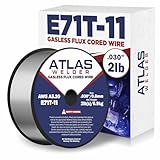
For most general-purpose mild-steel work outdoors, choose 0.030-inch E71T-11 self-shielding flux-cored wire; step up to 0.035 inch for thicker material and a machine that can feed it reliably, and choose E71T-8 when low-temperature toughness and structural-code requirements matter more than easy setup. No self-shielded wire is immune to wind, but it avoids the shielding-gas cylinder and is usually more practical outside than gas-shielded flux core.
Quick comparison: wire size and type
The figures below are typical product and application ranges, not guaranteed limits. Check the wire maker’s data sheet and your welder’s chart: usable thickness depends on joint design, machine output, fit-up, position, and technique. Wire diameter alone does not determine penetration.
As an Amazon Associate we earn from qualifying purchases at no extra cost to you.


| Wire choice | Typical diameter | Common spool size | Practical starting range for mild steel | Best fit |
|---|---|---|---|---|
| E71T-11 | 0.030 in (0.8 mm) | 2 lb (0.9 kg) | About 18 ga to 1/8 in (1.2–3.2 mm); thicker joints may need multiple passes | Small 120 V machines, repairs, general outdoor work |
| E71T-11 | 0.035 in (0.9 mm) | 2 lb (0.9 kg) or 10 lb (4.5 kg) | About 16 ga to 3/16 in (1.5–4.8 mm), depending on machine and joint | More deposition for a suitable 120 V or 240 V welder |
| E71T-11 | 0.045 in (1.2 mm) | 10 lb (4.5 kg) or larger | Typically heavier work with a machine rated for the wire | Higher-output machines and longer runs |
| E71T-8 | Often 0.045 in (1.2 mm), with other sizes available | Varies by product | Structural applications per the product’s qualified procedure | Low-temperature toughness or specified structural welding |
Spool availability varies by brand and wire diameter. Confirm the spool fits your feeder and that the machine supports the wire’s diameter, polarity, and recommended settings before buying.
Choose by job, not by spool size
- Thin sheet, occasional repairs, or a basic 120 V welder: Start with 0.030-inch E71T-11. It is generally easier to control at lower output than larger wire, but thin steel can still burn through. Use short stitches, keep the joint tight, and practice on scrap of the same thickness.
- Fences, brackets, and plate around 1/8 inch (3.2 mm): Either 0.030- or 0.035-inch E71T-11 can work. Favor 0.035 inch if your machine feeds it well and has adequate output; favor 0.030 inch for lighter machines or smaller work.
- Thicker plate or larger fabrication: A compatible 0.035- or 0.045-inch wire can deposit metal faster, but it cannot compensate for insufficient power or poor joint preparation. Bevel thick joints when appropriate and make multiple passes if the procedure calls for them.
- Structural work or specified low-temperature performance: Look for a wire classification and procedure that meet the applicable project requirements. E71T-8 is not a casual substitute for E71T-11: its handling, equipment needs, and qualification requirements can differ.
- Frequent outdoor welding in exposed wind: Self-shielded wire is more convenient than gas-shielded wire, but wind can still disturb the arc and reduce weld quality. Put up a windbreak where possible and inspect the bead; do not assume “self-shielding” means windproof.
What changes between wire types
Outdoor wind tolerance
Self-shielded flux-cored wire generates shielding from the flux in the wire, so you do not need an external shielding-gas cylinder. That makes it a practical choice for mobile work and breezy sites. Strong or gusting wind can still disrupt the protective atmosphere, especially around an exposed joint. A screen helps; welding in a sheltered area is better. If conditions are too windy to maintain a stable arc and sound bead, postpone the weld or use a properly sheltered setup.
Penetration and steel thickness
E71T-11 is commonly used for general-purpose work and can produce useful penetration, but actual fusion depends on amperage, wire feed speed, travel speed, torch angle, and joint preparation. Too little heat or moving too quickly can leave a cold lap; too much heat on thin sheet can cause burn-through. For thick material, prepare the joint and use a qualified multi-pass approach rather than trying to force a single oversized bead.
Slag and cleanup
Flux-cored wire leaves slag that must be chipped or brushed away, including between passes. Some wires produce slag that lifts readily; others can cling at toes or in tight corners. Clean the joint before adding another pass, and check for trapped slag. E71T-11 commonly uses a drag technique—keep the wire pointed in the direction of travel and follow the wire maker’s instructions. Using the wrong angle or pushing when the wire calls for dragging can make the bead harder to control and cleanup less predictable.
Smoke and spatter
Expect more visible fumes and spatter than with many gas-shielded solid-wire setups. Fumes vary with the wire, base-metal coating, contaminants, and welding conditions. Remove paint, oil, rust, and plating from the weld area when safe and appropriate; use effective ventilation and suitable respiratory protection based on a workplace hazard assessment. Keep your head out of the plume. Self-shielded wire is not a low-smoke process simply because it needs no gas cylinder.
Setup details that prevent wasted wire
- Verify wire compatibility. Check the classification, diameter, polarity, and recommended operating range against the machine manual. Many common self-shielded wires use DC electrode negative, but never assume—follow the specific wire and welder instructions.
- Fit the feeder correctly. Use the matching drive-roll groove and contact tip. Set enough tension to feed smoothly without crushing the wire; excessive tension can deform it and cause feeding problems.
- Set the machine, then test on scrap. Start with the manufacturer’s voltage and wire-feed guidance for the material thickness. Listen for a steady arc and inspect the bead for fusion, profile, and porosity before welding the actual part.
- Store the spool dry. Moisture and contamination can impair wire performance. Keep the spool covered when not in use, and follow the manufacturer’s storage guidance rather than leaving it exposed in a damp shop or vehicle.
Consumables and upkeep matter: contact tips wear, liners collect debris, and drive rolls can slip or chew wire. If feeding becomes erratic, inspect the spool, tip, liner, and roll tension before compensating with more machine settings. Keeping the gun cable reasonably straight also helps avoid feed resistance.
Bottom line
For a first spool and varied light-to-medium outdoor repairs, 0.030-inch E71T-11 is a sensible starting point when the welder supports it. Choose 0.035 inch for a compatible machine and more frequent work on thicker steel, and reserve larger diameters or E71T-8 for equipment and procedures suited to those applications. Compare the wire’s data sheet—not just the label—against your material, machine, polarity, and project requirements.