What's inside
As an Amazon Associate I earn from qualifying purchases. This post may contain affiliate links at no extra cost to you.
What we cover
The Short Answer
The best welder plug adapter is one that matches your welder’s plug NEMA pattern to your outlet’s receptacle pattern, is rated for the welder’s full amperage draw, and includes a proper grounding conductor — for most home shops, that’s a NEMA 14-50P to 6-50R adapter rated 50A/250V built from 8 AWG or heavier cable. Anything that tricks a smaller outlet into feeding a bigger welder, or that drops the ground pin, is not an adapter — it’s a fire hazard with a plug on it.
Why NEMA Patterns Matter More Than Brand
Every welder adapter plug is really just a translation between two NEMA configurations. The pattern code tells you the voltage, amperage, and pin layout at a glance: the first number is the wiring configuration, the second is the amperage, and P/R denotes plug or receptacle. A “220v welder plug adapter” (more accurately 240V in modern North American service) almost always involves one of these:
As an Amazon Associate we earn from qualifying purchases at no extra cost to you.
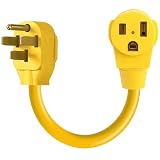

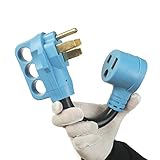

| NEMA Pattern | Voltage | Amps | Pins | Grounded? | Common Use |
|---|---|---|---|---|---|
| 6-50 | 250V | 50A | 3 (2 hot + ground) | Yes | Classic welder receptacle, most MIG/stick machines |
| 14-50 | 125/250V | 50A | 4 (2 hot + neutral + ground) | Yes | EV chargers, RV parks, ranges — the most common donor outlet |
| 14-30 | 125/250V | 30A | 4 | Yes | Electric dryers — common adapter source for smaller welders |
| 10-30 | 125/250V | 30A | 3 (no ground) | No | Pre-1996 dryers — adapters exist but grounding is a real concern |
| 6-20 | 250V | 20A | 3 | Yes | Small inverter welders and plasma cutters |
| 5-15 | 125V | 15A | 3 | Yes | Standard household outlet — only for 120V-capable dual-voltage welders |
The critical insight most listings skip: a 14-50 receptacle can safely feed a 6-50 welder because the welder only uses the two hots and ground — the neutral simply goes unused in the adapter. Going the other direction (6-50 outlet to a device needing 14-50) is a different problem entirely, since no neutral exists.
The Amperage Math That Decides If an Adapter Is Safe
An adapter never increases what the circuit can deliver. If your welder draws 42A at full output and you adapt it to a 30A dryer outlet, the breaker becomes your only protection — and breakers have tolerances. The practical rule:
- Size the circuit breaker at 125% of the welder’s rated input current for continuous use.
- The adapter, cable, and receptacle must all meet or exceed the breaker rating.
- Check your welder’s input spec, not its output. A “200A welder” might only draw 30–35A of input on 240V thanks to inverter efficiency.
Worked example: an inverter MIG rated at 32A input on a 40A circuit through a 14-30 to 6-50 adapter. The adapter is 30A-rated, the outlet is 30A, the breaker is 30A — this setup will nuisance-trip at high output. You either derate the welder’s settings or run a proper 50A circuit. No adapter fixes that.
What a Good Welder Plug Adapter Looks Like Physically
Quality adapters are short (6–18 inches) molded or cable assemblies. Key specs to compare:
| Spec | Budget Adapter (~$20–35) | Quality Adapter (~$40–80) |
|---|---|---|
| Cable gauge | 10 AWG (often borderline for 50A) | 8 or 6 AWG STW/SJTW |
| Construction | Two molded ends, thin jacket | Service-grade cable, strain relief both ends |
| Length | 6–12 in | 12–18 in |
| Certification | Often none listed | UL or ETL listed |
| Rated duty | Intermittent, derate at heat | Full rated amperage continuous |
Well-known makers in this space include Parkworld and Conntek, both of which publish NEMA-pattern-specific listings with stated wire gauge — the gauge disclosure alone is a good signal. A 220 volt welder plug adapter that doesn’t tell you its wire gauge is telling you something.
Decision Matrix: Which Adapter for Your Situation
| Your Situation | Right Choice | Avoid |
|---|---|---|
| Welder has 6-50 plug, garage has 14-50 EV/range outlet | 14-50P to 6-50R adapter, 8 AWG | Cheap 10 AWG versions for continuous 50A use |
| Small inverter welder (~20–25A input), only dryer outlet available | 14-30P to 6-50R, keep welder below ~80% output | Running max output on long beads |
| Old house with 3-prong 10-30 dryer outlet | Have an electrician install a grounded 6-50 circuit | 10-30 adapters with the ground wire “bonded to neutral” |
| Dual-voltage welder, occasional light work | Manufacturer’s 120V pigtail (Miller and Lincoln ship these) | Third-party 5-15 adapters claiming 30A capability |
| Multiple shops/job sites, mixed outlets | Two or three dedicated adapters rather than one universal one | “Universal” twist adapters with exposed contacts |
Ownership Realities Nobody Mentions
- Heat is the failure mode. After a long welding session, feel the adapter. Warm is normal; too hot to hold means undersized wire or a loose receptacle contact — both get worse over time.
- Worn receptacles cause adapter failures, not vice versa. A decades-old dryer outlet with weak spring tension creates resistance heating at the blades. If the adapter plug slides out easily, replace the receptacle.
- Adapters plus extension cords compound voltage drop. Keep total run under ~50 feet on 8 AWG for 50A loads; longer runs need 6 AWG.
- The ground is not optional. Welders put high-frequency and fault current into the chassis. Any 220 welder plug adapter that lacks a continuous ground path, or that adapts a 3-wire ungrounded outlet, should be rejected outright.
FAQ
Can I use a dryer outlet for my welder?
Yes, with a 14-30 to 6-50 adapter, if your welder’s input draw stays under about 24A continuous. That covers many 140–180A-class inverter MIGs at moderate settings, but not transformer machines or high-output work.
Is a 220V welder plug adapter the same as a 240V one?
Functionally yes — “220” is legacy terminology; North American service delivers roughly 240V, and all modern welders and NEMA 250V-rated adapters handle either.
Can I make my own adapter from a cord and two ends?
Electrically competent builders do it, but a listed molded adapter is cheap insurance: strain relief and sealed connections are exactly where DIY builds fail first.