What's inside
As an Amazon Associate I earn from qualifying purchases. This post may contain affiliate links at no extra cost to you.
The essential arc welding accessories are a correctly rated helmet, welding gloves, flame-resistant clothing, a reliable work clamp, suitable electrodes, chipping and cleaning tools, and dry storage; upgrades such as an auto-darkening lens, magnetic holders, a foot-controlled positioner, or a powered respirator improve comfort and productivity but are not required for every welder.
As an Amazon Associate we earn from qualifying purchases at no extra cost to you.
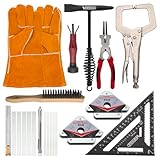


What we cover
What belongs in a complete arc-welding setup?
“Arc welding” can mean several processes, so buy accessories around the process you actually use. Shielded metal arc welding (SMAW, or stick welding) needs electrodes, a holder, a work clamp, and tools for removing slag. Gas metal arc welding (GMAW/MIG) adds shielding-gas equipment, contact tips, nozzles, and wire. Gas tungsten arc welding (GTAW/TIG) adds a tungsten electrode, collet system, ceramic cup, and often a foot pedal.
The safety equipment is broadly shared. The fit and heat rating are more important than brand name: a loose glove can catch on a workpiece, while clothing made from synthetic fabric can melt when exposed to sparks.
Must-have arc welding accessories
1. Welding helmet with the correct shade
A helmet must be marked to the relevant ANSI Z87.1 or equivalent safety standard and provide a shade appropriate to the welding current and process. A fixed-shade lens is inexpensive and dependable, but an auto-darkening helmet is easier for beginners because it lets you position the electrode before striking the arc.
For many common stick-welding jobs, a shade range around 9–13 is practical. The correct setting depends on amperage and process, so follow the helmet and welding-machine guidance rather than choosing by comfort alone. A useful helmet should also have a clear outer cover lens, replaceable inside protection, a secure headgear adjustment, and a viewing area large enough to follow the joint.
2. Heat-rated gloves and clothing
Use leather stick-welding gloves with long cuffs for SMAW. Thick cowhide or split leather offers useful abrasion and heat resistance, although no glove makes it safe to hold hot metal indefinitely. MIG gloves are often thinner for better trigger control; TIG gloves are thinner still and are not a substitute for heavy stick-welding gloves.
Wear a flame-resistant cotton, leather, or purpose-made welding jacket, trousers without cuffs, and leather boots that cover the ankle. Do not wear polyester, nylon, fleece, or other meltable synthetics near the arc. A leather apron is useful for overhead or high-spatter work, but it does not replace a jacket or suitable trousers.
3. Electrode holder, work clamp, and leads
For stick welding, the electrode holder should match the machine’s connector and be rated above the maximum output you intend to use. A holder rated around 200–300 amps covers many home and light-fabrication machines. The work clamp should grip clean metal firmly; a weak clamp creates unstable arcs, heat at the connection, and misleading troubleshooting symptoms.
Check lead length and cable gauge together. Longer leads increase voltage drop, especially with small conductors. As a general starting point, a 25-foot welding lead made with roughly 1/0 cable is more tolerant of higher-current work than a lightweight 25-foot lead using much smaller cable. Follow the welder manufacturer’s cable recommendations, and never use damaged insulation, loose lugs, or improvised connectors.
4. Electrodes and a dry storage solution
Electrode choice affects both weld quality and storage requirements. E6011 is useful for rusty or less-than-perfect steel and can run on many AC or DC machines. E6013 is beginner-friendly for clean, thin-to-medium mild steel. E7018 produces strong, low-hydrogen welds but is more sensitive to moisture and storage conditions.
A sealed container with a gasket is the minimum sensible storage for unopened electrodes. Once opened, low-hydrogen electrodes should be kept in a purpose-made holding oven or according to the electrode manufacturer’s reconditioning and holding instructions. Do not put damp rods in a household oven or guess at a drying temperature: excessive heat can damage the coating, and food-use appliances are not an appropriate substitute.
5. Chipping hammer, wire brush, and grinder
A chipping hammer removes slag from stick welds, while a stiff steel wire brush cleans remaining residue. A grinder with a properly rated grinding wheel or flap disc helps remove sharp edges, mill scale, and defective weld metal. Use the guard, side handle, eye protection, and hearing protection supplied or specified for the grinder.
Keep separate brushes and abrasive discs for carbon steel, stainless steel, and aluminum. Cross-contamination can introduce unwanted particles into a weld or cause surface corrosion. A flap disc is generally better for controlled surface preparation; a hard grinding wheel removes material faster but is easier to misuse.
6. Ventilation and eye protection
Local exhaust ventilation is preferable to simply placing a fan behind the welder. The aim is to capture fumes without blowing shielding gas away from the weld. Use safety glasses under the helmet, preferably with side protection, because sparks and chipped slag can travel outside the helmet’s viewing area.
A respirator is not a universal solution. If coatings, galvanized steel, stainless steel, or unknown materials are involved, identify and control the hazard first. Remove paint and coatings where appropriate, consult the relevant safety data, and use professionally selected respiratory protection when ventilation alone is insufficient.
Useful upgrades rather than universal requirements
- Auto-darkening helmet: worthwhile for frequent work, awkward joints, and beginners who struggle to start the arc without moving the electrode.
- Magnetic welding squares and holders: speed up tack-up and hold parts at common angles, but remove them if they interfere with fit-up or arc access.
- Electrode holding oven: valuable for regular E7018 work; unnecessary if you only use small amounts of non-low-hydrogen electrodes and follow their storage instructions.
- Welding table and fixturing clamps: improve repeatability and grounding. A heavy steel table is more stable than a thin portable sheet, but it requires more floor space.
- Arc-welding pliers: convenient for MIG nozzle cleaning and wire trimming, but ordinary cutters and a suitable brush can cover occasional work.
- Powered air-purifying respirator: a specialist upgrade for controlled environments, not a replacement for ventilation, material assessment, or proper training.
Accessory specifications that matter
| Accessory | Practical specification | Replace or inspect when | Best suited to |
|---|---|---|---|
| Auto-darkening helmet | Shade range about 9–13; reaction time around 1/25,000 second; two or more sensors | Lens has pits, cracks, unreliable darkening, or damaged seals | Frequent stick, MIG, or TIG work |
| Stick electrode holder | 200–300 A rating; insulated handle; machine-compatible connector | Jaw spring weakens, insulation cracks, or cable lug heats | Home and light fabrication |
| Welding gloves | Long-cuff split or grain leather; lined palm for stick work | Seams open, fingertips thin, or heat reaches the hand | SMAW and high-spatter work |
| Electrode container | Gasketed, moisture-resistant box; enough capacity for 5–10 lb of rods | Seal no longer closes or rods show coating damage | Occasional stick welding |
| Welding cable | Common working lengths: 10–25 ft; size selected for amperage and distance | Exposed copper, crushed insulation, hot connectors | All cable-connected arc processes |
| Angle grinder | 4-1/2-inch or 5-inch model; guard and side handle; discs rated above tool speed | Damaged disc, excessive vibration, worn cord, or failing switch | Preparation and slag-edge cleanup |
Choose by situation
| Your situation | Buy first | Delay or skip initially |
|---|---|---|
| Low budget, occasional repairs | Fixed-shade helmet, leather gloves, jacket, E6011 or E6013 electrodes, clamp, hammer, brush, and safety glasses | Electrode oven, premium powered respirator, large welding table |
| Beginner learning stick welding | Auto-darkening helmet, clear cover lenses, E6013 electrodes, comfortable gloves, and a grinder | Specialty electrodes and complex magnetic fixtures |
| Weekly fabrication | Auto-darkening helmet, quality leads, solid clamps, welding table, multiple abrasives, and sealed rod storage | Extra specialty tools that duplicate existing hand tools |
| Limited workshop space | Compact helmet, 10–15-foot leads, folding table, small angle grinder, and a gasketed storage box | Permanent oven and oversized fixture table |
| Regular E7018 work | Moisture-controlled storage or suitable holding oven, fresh electrodes, and a temperature log if required by the job | Leaving opened rods in the original paper box |
Fit, heat rating, and consumable-life checks
Size gloves while holding the position you commonly weld in, not with the hand hanging open. Fingers should reach near the ends without being compressed, and the cuff should overlap the jacket sleeve. For a helmet, adjust the headgear so the shell stays stable when you look down; a helmet that shifts can expose your face or force poor posture.
Consumable life depends on contamination and storage as much as on usage. A 10-pound box of 1/8-inch E6013 electrodes may contain roughly 70–90 rods, depending on the manufacturer and rod length. If a beginner uses two rods per short practice session, that box can last several dozen sessions. By contrast, repeatedly striking arcs with damp or damaged electrodes wastes rods and can produce a weld that must be ground out.
A simple ownership calculation illustrates why storage matters. If a $15 box loses 20% of its rods to moisture or damage, the effective cost of usable electrodes is $15 divided by 80%, or $18.75. A $10 sealed container can pay for itself after preventing one partially ruined box, especially with moisture-sensitive low-hydrogen electrodes.
A practical setup and maintenance routine
- Inspect before connecting: check the helmet lens, glove seams, jacket, leads, holder, clamp, and grinder guard.
- Prepare clean metal: remove paint, oil, rust, and mill scale from the joint and the clamp location.
- Confirm polarity and amperage: match the machine setting to the electrode package and weld position.
- Secure the work: clamp parts firmly and place the work clamp on bright, clean metal as close to the joint as practical.
- Weld and clean in stages: allow hot slag to cool enough to remove safely, then chip and brush between passes.
- Store consumables: return unused rods to dry storage and keep different electrode types identified.
- Clean and record wear: replace cover lenses before visibility becomes poor, discard cracked abrasives, and investigate hot connectors rather than continuing to weld.
The best arc welding accessories are the ones that control the main risks and prevent rework: correct eye protection, heat-resistant clothing, sound electrical connections, dry consumables, and clean joint preparation. Add productivity upgrades only after those basics fit your process, available space, and frequency of use.