What's inside
As an Amazon Associate I earn from qualifying purchases. This post may contain affiliate links at no extra cost to you.
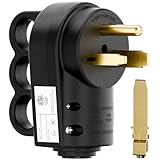
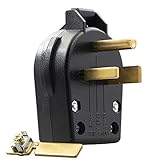
The best 240V welder plug for most single-phase hobby welders is a NEMA 6-50P connected to a matching 6-50R, but the plug, breaker, receptacle, and cable must be sized from the welder’s nameplate input requirements and local electrical code—not from the welder’s advertised output amperage.
As an Amazon Associate we earn from qualifying purchases at no extra cost to you.


What we cover
Common 240V welder plug configurations
A “welder 240V plug” is not one universal connector. Welders commonly use a two-hot-wire-and-ground arrangement, while the receptacle style determines how the cord connects to the wall. Most shop welders do not need a neutral conductor.
| Plug and receptacle | Typical rating | Best use | Important limitation |
|---|---|---|---|
| NEMA 6-30 | 30A, 250V | Smaller 240V welders and light shop equipment | Not suitable when the welder’s required circuit exceeds 30A |
| NEMA 6-50 | 50A, 250V | Common MIG, TIG, and stick welders | Needs a matching 6-50R; it has no neutral |
| NEMA 14-50 | 50A, 125/250V | Equipment requiring two hots, neutral, and ground; some welders and workshop circuits | Do not install a 14-50 merely because it looks more versatile |
| NEMA 10-30 | 30A, 125/250V | Older three-wire dryer installations | It lacks a separate equipment grounding conductor and is generally a poor choice for new welder wiring |
The NEMA designation matters more than the plug’s physical appearance. A 6-50 plug and a 14-50 plug are both commonly associated with 50A equipment, but they are wired differently. Never force, adapt, or replace a plug to fit an existing receptacle without confirming the welder’s voltage, current, grounding, and manufacturer instructions.
How to match welder input current to the circuit
Read the welder nameplate or manual for “rated input current,” “maximum input,” “I1max,” and recommended overcurrent protection. Output amperage is not the number used to choose the branch circuit. A 200A welding machine may draw far less than 200A from a 240V supply because the inverter or transformer changes the voltage and current internally.
Duty cycle also matters. A machine rated at 40A input may not draw 40A continuously, because its duty cycle limits how long it can weld before cooling. Welding equipment has special rules in electrical codes that can permit different conductor and overcurrent-protection calculations from ordinary continuous loads. The manufacturer’s stated breaker size is therefore valuable, but it does not override local code or an electrician’s calculation.
| Welder nameplate situation | Common circuit direction | Typical receptacle choice | What to verify |
|---|---|---|---|
| Input requirement up to about 24A | Dedicated 30A, 240V circuit | NEMA 6-30R if specified by the manufacturer | Breaker recommendation and conductor ampacity |
| Input requirement around 30–40A | Dedicated 40A or 50A circuit, depending on instructions and code | 6-50R is common when the cord has a 6-50P | Whether the supplied cord and receptacle are rated for the selected circuit |
| Input requirement near 40–50A | Dedicated 50A circuit when permitted | NEMA 6-50R or 14-50R only if the welder is designed for it | Conductor size, termination temperature rating, voltage drop, and breaker type |
| Input requirement above 50A | Specialized circuit often requiring hardwiring or a larger connector | Manufacturer-specified industrial receptacle | Service capacity and an electrician’s design |
These ranges are orientation points, not a wiring prescription. A 240V welder plug rated at 50A does not automatically mean the machine should have a 50A breaker, and a 50A breaker does not make undersized cable safe.
Cable gauge, breaker, and receptacle: how the parts fit together
For a typical copper branch circuit, a 30A circuit often uses 10 AWG copper conductors, while a 50A circuit commonly uses 6 AWG copper under applicable ampacity rules. However, conductor size can change with insulation temperature rating, terminal limitations, cable length, ambient temperature, conduit fill, installation method, and local amendments. Some installations may use 8 AWG copper for particular welder applications under the welding-equipment rules, but that decision belongs to the code calculation—not guesswork.
For a 6-50R, the circuit normally has two insulated hot conductors and a separate equipment grounding conductor. A 14-50R adds a neutral, which is unnecessary for a welder that uses only 240V, but may be required by equipment designed for both 120V and 240V operation. The neutral must never be substituted for the grounding conductor.
Use a two-pole breaker that disconnects both ungrounded conductors. The receptacle rating should be at least the rating required by the equipment and installation design. The circuit should generally be dedicated, especially where the welder’s startup demand could trip a shared breaker or cause lights and sensitive electronics to flicker.
A practical selection matrix
| Your situation | Most sensible direction | Why |
|---|---|---|
| Small home shop, occasional welding, machine under 30A input | Dedicated 6-30 circuit if the cord specifies 6-30 | Lower installation cost and a smaller receptacle are adequate without oversizing |
| Frequent use with a conventional 50A-class welder | Dedicated 6-50 circuit when supplied with a 6-50P | It is a common, simple two-pole welding connection with no unused neutral |
| Existing garage has a correctly wired 14-50 circuit | Use it only for a welder supplied or approved with a 14-50P | The connector and conductor arrangement must match the machine |
| Long cable run from a distant panel | Have voltage drop calculated; consider larger conductors | Low voltage can reduce performance and increase heating at high load |
| Rented space, uncertain panel capacity, or no 240V service | Ask an electrician before buying the welder | The service, panel, grounding, and landlord restrictions may control the choice |
Safe installation sequence
- Record the machine requirements. Write down input voltage, maximum and rated input current, recommended breaker, plug type, and whether a neutral is specified.
- Inspect the electrical service. Confirm that the panel has capacity for a two-pole 240V circuit and that the grounding system is suitable. A free breaker position alone does not prove adequate service capacity.
- Plan the route. Protect cable from sharp edges, welding heat, abrasion, vehicles, and standing water. Keep the receptacle accessible but away from sparks and grinding dust.
- Install matching equipment. Use the correct two-pole breaker, listed cable or individual conductors, box, strain relief, and receptacle. Tighten terminals to the manufacturer’s torque specification.
- Verify before energizing. An electrician should check conductor identification, grounding continuity, polarity, voltage between the hot legs, and voltage from each hot leg to ground.
- Perform a controlled first run. Plug in with the machine switched off, check for heat or looseness after a short welding session, and stop immediately if the receptacle, plug, or cable becomes unusually hot.
Do not work inside an energized panel. Turning off a branch breaker does not necessarily make every part of the panel safe. If you are not qualified to install and test a 240V circuit, use a licensed electrician and obtain any required permit or inspection.
Durability and ownership details that are easy to miss
The receptacle’s contacts and the plug’s blades usually wear first, especially when a welder is unplugged under load or when a loose terminal causes heat. Inspect for discoloration, melted plastic, cracked housing, loose fit, or a burning smell. Replace damaged plug-and-receptacle pairs rather than cleaning and reusing visibly overheated parts.
Keep the welder cord off hot metal and prevent it from being sharply bent near the plug. Avoid inexpensive travel adapters and extension cords unless the welder manufacturer permits them and the entire cord assembly is rated for the load. Long, undersized extension cords can create voltage drop and heat even when the breaker does not trip.
A 240V welder plug should be selected as part of a complete circuit: machine nameplate, breaker, conductors, grounding, receptacle, and installation environment. When those details agree, a common NEMA 6-50 setup is convenient; when they do not, changing only the plug creates a dangerous mismatch rather than a solution.
Frequently asked questions
Can I put a 6-50 plug on any 240V welder?
No. The welder must be approved for that connection, and its input current must be compatible with the circuit. The plug is not a current limiter or a substitute for the manufacturer’s wiring instructions.
Is a 50A breaker always required for a 50A receptacle?
No. Receptacle rating, breaker rating, conductor ampacity, and welder load calculations are related but not identical. Follow the equipment instructions and applicable electrical code.
Do I need a neutral for a 240V welder?
Many welders use only two hot conductors and an equipment grounding conductor, so a neutral is not needed. A 14-50 connection should include a neutral only when the equipment or another permitted load requires it.